Mux Mool’s Planet High School gets its point across without speaking
It may not be an easy task for a lyricist to pen a song that accurately depicts what he’s feeling at any given moment, but he has one important tool that an instrumental artist does not: words. Such was the dilemma electronic music auteur Mux Mool (aka Brian Lindgren) faced when he sat down to compose his latest album Planet High School, released Feb. 7, 2012, on Ghostly International.
“When you write songs without words, first of all, it’s hard to name the thing,” Lindgren said in a recent interview with Submerge. “It’s hard for people to tell what it’s about.”
Lindgren’s album, in this case, addressed what he observed as a prolonged adolescence in modern culture–a culture where, amongst other annoyances, over-sharing the minutia of everyday life has become all too prevalent.
“It was just something I was feeling when it came time to write another album,” Lindgren explained. “That’s what I was feeling more than anything over the past year, or year and a half.”
Though he was expressing these feelings through song, he did mention that it didn’t really change the way he worked all that much.
“It influenced how I felt, which may have influenced where I was grabbing things from, but it wasn’t like, “Oh, this is a high school gym class, this is a march song, this is a this,” he said. “It didn’t change it in that way.”
Though he acknowledged the lack of lyrics in his songs may make such concepts difficult for listeners to latch on to right away, their effect can certainly be felt through the album to those who are paying attention. Planet High School sheds the ethereality inherent in a lot of electronic music for something far earthier. The opening track, “Brothers,” seems to have a gin-and-juice-soaked swagger to its electro groove while the album’s first single, “Palace Chalice,” rattles with a sort of island beat. The overall feel of the album is one that is brash, headstrong, and perhaps a bit petulant, but that may not be surprising if you’d ever spoke to Lindgren, who, quite refreshingly, has no problem speaking his mind.
In the following interview, Lindgren, who will make an appearance at this year’s Sacramento Electronic Music Festival, divulged details about his creative process while offering pointed social commentary and voicing his opinions on experiencing electronic music in the live setting.
I was checking out the “Cash for Gold” video, and I thought it was a really neat clip. Did you have a lot to do with the concept of it?
The reason why I think I’ve hesitated on music videos for so long was because I never wanted to do a music video with me looking really cool with really cool things–anything flashy or anything like that. I actually wrote the story to the music video–the screenplay and everything was based on. It was just about being yourself and sticking it to your boss.
Do you think cinematically when you write your music?
I just think I think cinematically story-wise. I think narratively as opposed to a random collection of things.
The album does have a bit of a funk feel to it. Is that indicative of the music you were listening to while you were creating it?
No, it just was funky. I was definitely not listening to any more or less funk than I was in the past year.
So your funk intake has remained consistent throughout your entire music career?
Yes, it’s been almost entirely the same.
The album just came out in February, but are you already looking at what’s next? Are you the kind of artist who’s constantly writing?
Yeah, it’s an ongoing process. It’s not really done in blocks. You just have to work when you feel like working, which is not always. Some people like to post that they work every single day and nonstop and all they do is work between flights and, “Oh my God, I’m on my way to a show and I’m working on a song,” and I don’t buy it for a second. Everybody has a limit where they’re like, “I don’t want to work on music. In fact, I don’t want to listen to music, and I don’t want to talk about music.” Everybody has that. I definitely have that. I definitely work quite a bit, every single day, but with these songs it was all in the moment when I started making them at least.
Is that “in the moment” process something you utilized just for Planet High School, or was that also the case with your previous album?
With the last album, the record label wasn’t sure what I was going to do career-wise, so they wanted as many songs as they could get. At the time, they wanted to grab everything, so Skulltaste had less focus in terms of an album, because I think maybe about 12, 13 of those songs could have been an album and seven of those were songs they just grabbed.
When you commented on people bragging about how they’re constantly working, it occurred to me that that may play into the idea of prolonged adolescence–sort of like the kid who’s too eager to answer questions in class.
There are some high-school-type social elements even among professional musicians… To me, there are these dudes who want to post, “Going into the studio!” every day, and it’s like, “Well, you’re a professional musician. That’s just your job.” It’s not like if you’re a janitor you’d post “Scrubbing toilets!” and everyone’s like, “Oh, dude, that’s dope. You’re scrubbing toilets.” It’s not all brag-able. It really isn’t.
Plus, all they seem to talk about is how much they’re working. To me, it seems like real-life experiences are the things that should inspire you to write songs. If your entire life experience is sitting in the studio behind a computer, it’s like, what is a computer song inspired by other computer songs? There’s just no feeling there.
When you’re out on the road, do those experiences fuel what you’re writing?
Yeah, because you’re seeing stuff, and you’re away from home. I saw this thing on Reddit the other day that I thought was really funny, because it was like, “Bus window is a first year philosophy class,” and it’s kind of true. Because as soon as you sit there and you’re by yourself, and you have nothing to do but look out the window and think about stuff, you start thinking some basic philosophical stuff. But when you do that forever, you do that for three years, and that’s every single day, you’re thinking about a lot of stuff for a lot of time.
Before you mentioned you wrote the story for your video. Do you often write stories and do those inform your songwriting?
I think the reason why I wanted to put the message behind the video, of just being yourself at all costs, it’s just more or less what I’ve had to go through in the past couple years, which is just being able to do music for a living, which is not always easy. It’s not always easy to convince people that it’s a viable career, but being myself has always been worth it, because that’s the message I’ve always agreed with.
Is it weird for you to hear yourself say that you’re a professional musician?
I don’t really tell people that. People I meet, I don’t really say that, because everybody’s a fucking DJ. Everybody is.
I’m the same way about telling people I write. I mean, I do, and I get paid for it, but the reaction is always weird.
Right, because they’re like, “Yeah, of course you are, dude.” And you’re like, “No really. I make money at it. It’s a job.” And they’re like, “Uh huh.”
Either that, or they think it’s more interesting than it actually is.
Oh yeah and that, too. That’s the other side of that. That’s when you play shows and people come up to you like, “Oh my God, that was so incredible,” and you’re like, “Calm down. I didn’t just cure cancer. I didn’t give your mom heart surgery or anything. I played with my computer in front of you. I’m glad you’re impressed, but let’s be realistic.”
You mention playing on your computer in front of people. How is it for you to connect with the audience? Do you sometimes have to be more physical to get people involved?
For me the show isn’t about what I’m doing physically. There are a lot of people who go out there with their sets pre-programmed, they press play, they tweak on filters for the next hour and a half and they dance around and throw their hands up during the exciting part of the song. They get a lot of credit, and they get really far that way, and I think that’s a fucking joke. I’m not a clown. I’m not up there to be a clown and choreograph the songs to whatever shitty dance I’m doing. I’m trying to create the mood, but I think about it in a more European style, which means the mood should be created by the songs I’m playing and the order I’m choosing to play them in and how those things are working. It’s definitely more of a listening experience. I don’t dance. I don’t jump. I don’t even make funny faces. At least, I try not to.

Mux Mool will be featured on day 2 (Friday, May 4) of the Sacramento Electronic Music Festival, which will take place at Harlow’s. The festival runs from May 3—5, 2012. For more information and to get a glimpse of the full lineup, go to http://sacelectronicmusicfest.com/
Death Grips
The Money Store
The capital of California, which few could pick out on a map will be the talk of the industry with the release of experimental hip-hop group Death Grips’ Epic debut, The Money Store. Sacramento will faintly appear in every major online and print music publication. It will travel to Ireland and the United Kingdom and stand out awkwardly amongst write-ups in French and German. The strangest of times lie ahead.
Last year’s Ex-Military mixtape unveiled a top-secret project of a highly classified nature, kept in the confines of Oak Park. Death Grips was not a local favorite that got its big break after years of cold shoulders. It was a phenomenon that rattled our cages and left us scratching our heads as to where the fuck it came from. Every announcement surrounding the band is bigger than the last; Coachella dates, All Tomorrow’s Parties appearance, signing to Epic, two albums in 2012 and a European tour. The warp speed of its success is as terrifying and mind-blowing as the music.
Ratchet man Andy Morin, aka Flatlander, and Zach Hill are the Reanimators of the group, who possibly stumbled upon the breakthroughs that led to Death Grips on Hill’s last solo album, Face Tat. The track “Jackers,” with its stem-warps, revving blips and manic drumming, sounds like the birthplace of Death Grips. The two mad scientists were just missing a vessel, which they discovered in Stefan Burnett, aka MC Ride.
The Death Grips sound is a break beat science that experiments with hip-hop echoism, EDM machinations and the wonky warble of (groan) dub-step. The double helix is constructed with a precisionist’s care, only to have a deadly virus unleashed as though Hyde sought to sabotage Jekyll’s work.
As much as we want to seek derivatives for Death Grips, none of them will satisfy; because as you listen to the first five tracks on The Money Store, it’s undeniable that they are without contemporaries or purebred lineage. Sample-based music was a stagnant art form until now; evolving into the digital catalog of stems. Death Grips collect, record and warp them like diggers obsess over vinyl. But Death Grips’ source material is infinite since it ranges from borrowed drum breaks sent through heavy filter or a looped guttural roar from Ride. The Black Google zip file, which included every stem, a capella and instrumental from Ex-Military, wasn’t just for us to tinker and remix, but a glimpse into the creative process. The same goes for the 109 GIFs currently obliterating computer speakers on the Third Worlds website. Ride is a threat without the assistance of effects, but Death Grips is all the more menacing when the track screeches and caterwauls much like horror films allow black cats to jump across cameras and serial killers to stand directly behind terrified damsels–the quick shock hits keep us on our toes.
Small traces of influence, or intention, trickle through The Money Store; Salt N’ Pepa’s “Push It” as performed by 2 Live Crew on “I’ve Seen Footage” is the most blatant, while “Hacker” bears striking resemblance to the outside-the-club sounds in the opening minutes of Daft Punk’s “Revolution 909,” except standing on the fringes of the hopeful patron line is Ride, plotting on whose car is getting jacked once they go inside.
The Money Store pushes Death Grips’ unique sound into a darker realm than the explorations found on Ex-Military, despite the mixtape crippling our senses and causing a cesspool of miscalculated pedigree. It’s inspired and moving faster than we can compute, which is frustrating since it’s only starting to sink in without the nuisance of definition beyond simply calling it Death Grips. In a year’s time, zero copycat bands or established groups attempted to mimic Death Grips as recognition of a new wave. Death Grips stand unchallenged. As MC Ride puts it on “Hacker,” “The table’s flipped, now we got all the coconuts, bitch!”
Much of the intoxicating danger and aggro-rap histrionics in Ex-Military have undergone mutation and the progression suggests that by No Love, the band’s second 2012 record, we’ll have little trace of bread crumbs leading back to introductory tracks like “Guillotine” and “Known For It.” In 23 songs between two records, Death Grips’ movement rivals the intensity of a warpath or rampage with no looking back. It has led them to the kung-fu chamber to face their greatest adversary, themselves, in order to become masters. All that’s left in gauging the impact of The Money Store is the passage of time, but that’s for the canonical talkers, which Death Grips have no time for.
See Death Grips live at Harlow’s on May 5, 2012 as part of Sacramento Electronic Music Festival.
Sacramento comedian Johnny Taylor’s recurring gig “Comedy Kill,” which goes down every fourth Friday at Sacramento Comedy Spot, is quickly becoming one of the city’s premiere stand-up nights. Taylor started Comedy Kill to give him and his friends somewhere to highlight the type of stand-up they’ve been doing. “I thought it would be really rad to showcase smart, offbeat comedy on a consistent basis,” Taylor recently told Submerge. “It’s grown to a point that I get to bring some really talented friends up from the bay area as well,” he said. Taylor has been doing stand-up comedy for just over a year, but has already performed a number of times at 142 Throckmorton Theatre in Mill Valley, Calif., a highly sought after venue. “You never know when you’re gonna be sitting in the green room and Robin Williams or Dana Carvey stroll in,” Taylor said. “I always leave that place feeling starstruck at least once.” Taylor also recently had his set from a gig at Pasadena Ice House recorded for Comedytime.tv. Catch him hosting and cracking jokes at the next installment of Comedy Kill on Friday, April 27 at 9 p.m. at Sacramento Comedy Spot (1050 20th Street, Suite 130) alongside headliner John Ross and featured performers Nick Aragon and Kiry Shabazz. “There are so many talented comics in Sacramento,” Taylor said. “People sleep on this city, but I’d put the top guys in our scene against any other city out there in a stand-up comedy battle royale and feel pretty comfortable with our chances.” Get your tickets for Comedy Kill for just $10 at Saccomedyspot.com.
-J.Carabba
Sacramento Restaurant Receives National Recognition
The Kitchen Restaurant – 2225 Hurley Way, Sacramento
Words by Adam Saake – Photos by Nicholas Wray
Twenty-five years ago, the James Beard Foundation began honoring those in the food and beverage world who were working at a level of excellence. Beard was a highly regarded chef, author and personality whose career spanned over five decades. His passion for cuisine of all different cultures and styles is the spirit and backbone of the foundation’s scholarship program and awards process. Called the “Oscars of the food world” by Time Magazine, The James Beard Foundation Awards recognize cookbook writers and food journalists, TV personalities and photographers, chefs and restaurateurs. Some of the awards celebrate the new and most recent; but other more prestigious awards, like the Outstanding Restaurant Award, require years of consistent quality and service before even being considered. The James Beard website describes the Outstanding Restaurant award as, “A restaurant in the United States that serves as a national standard-bearer for consistent quality and excellence in food, atmosphere and service. Candidates must have been in operation for at least 10 or more consecutive years.” So when Sacramento’s own The Kitchen Restaurant was nominated as one of 20 of the nation’s most outstanding restaurants, the news brought surprise and shock to the Selland Family Restaurant Group.
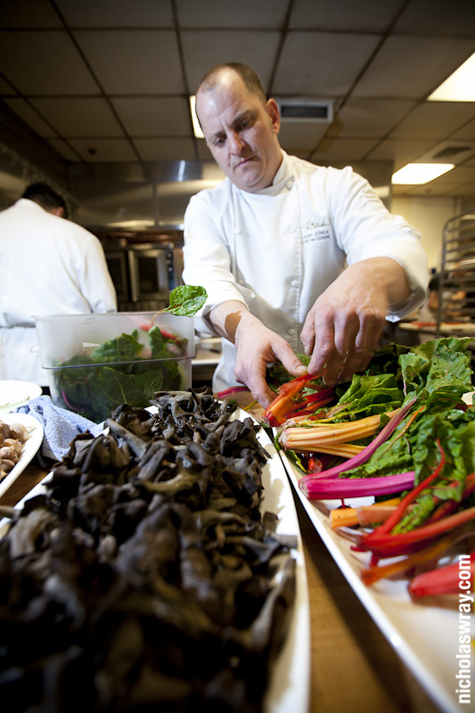
“We were blown away by the whole thing,” says The Kitchen owner and Executive Chef Randall Selland. “If you look at the list of restaurants, it’s just phenomenal.”
The nomination alone is sort of like an award itself, considering the weight that a JBF Award carries. It came unsolicited as well, which means that JBF found them through the hundreds of restaurants all across the nation to be considered.
“We didn’t lobby for it, we didn’t know. It was more of a surprise to us than anything else,” says Selland. “It’s not the award part of it, it’s the recognition. I’m excited to no end that we got this nomination.”

But it really is no surprise that The Kitchen be considered for this prestigious award. The kind of experience offered to guests during the one-seat-per-night dinners is truly of the highest caliber and is sought out and enjoyed by diners searching for the best. It is a spectacle; a show with a cast of characters who throughout the night take the stage to present their course like a ringmaster describing the perils of the lion tamer and trapeze artists. Watch as it all happens right before your eyes! The ringmaster is most certainly Chef de Cuisine, Noah Zonca. Zonca is a showman, a personality and most importantly a talent. When he talks to the crowd, he holds them in his hand, and when he personally addresses you, you feel important in the moment. He prepares visually dazzling courses right before your eyes, often bringing members of the crowd up to hold the pan as it flames up into the hood. He laces the night with humor, making guests feel warm and comfortable at the same time he commands his young staff, ensuring that each course is properly executed.

At the beginning of each dinner, doors open at 6:30 p.m. as a brand new group of elated guests spill into the main dining area. They’re immediately greeted by the impeccable Kitchen manager Eric Philbin, jackets carefully removed, purse hooks pointed out and seats shown. From the second they arrive, they’re pampered in a true professional fashion. The busy dining room fills with chatter, quiet laughter and the encouraged nosiness. One of the chefs stands main stage, preparing a sushi roll filled with yellow tail. “Come on up if you like,” he says to a group of bystanders. They step up into the kitchen and approach as he begins explaining the ingredients, their provenance and flavors. This is a show, but it’s transparent with no curtains. What you see is where it all happens and that is why The Kitchen has become a premier dining experience in not only Sacramento but in the country. It’s all about making the guest feel comfortable, giving them what they’ll enjoy and showing them a good time. And they do it well. Don’t like the first course? They’ll make you something else. Feeling like dessert first? Coming right up.
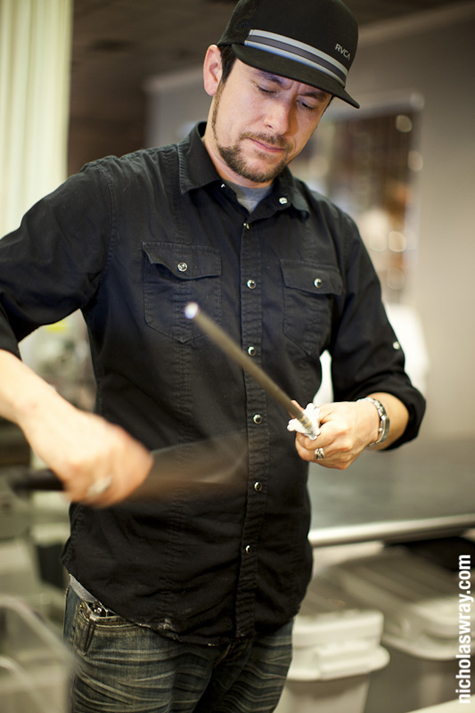
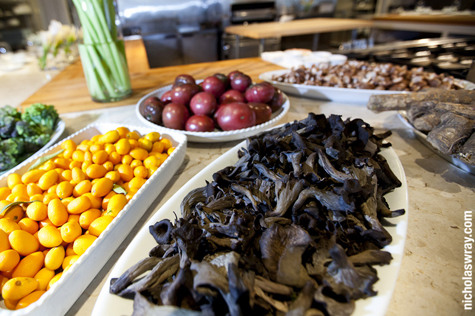
The main attraction is the food, of course, and Selland, Chef Nancy Zimmer and Zonca construct plates and flavors that are inspiring to look at and enjoy. With the colors and combinations of ingredients, conjuring styles of French technique woven with Thai and Japanese influences, their New American cuisine is the finest of dining in the most accessible way. This is how Selland prefers his plates to be.
“I get people to come in, and they feel a bit uncomfortable because they read the menu and they’re more meat and potatoes. Then they find out we’ll give them whatever they want and also, the menu reads a certain way but then when they get the food, the food’s always approachable,” says Selland.
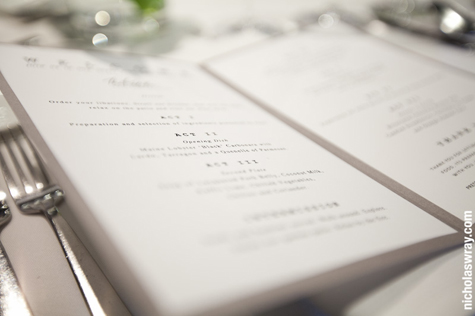
The opening dish for their March menu, called Act II, which followed Zonca’s in-depth description of what guests would be enjoying and how it would be prepared, was a show stopper right from the get-go. A Maine lobster “black” carbonara with crispy lardo, tarragon and a luscious quenelle of Parmesan–a dish whose mere remembrance of makes my mouth salivate. Each course that followed had some peppering of distant cuisines, something that Selland and Zimmer pride themselves on from their past travels to countries like Mexico and Turkey where they found big inspiration in small corners.
“We get more inspiration from the taco cart or the hero sandwich in Turkey, or the little mom and pop place somewhere,” says Selland.

Act III, the second plate, certainly tasted of Thailand with a soup of lacquered pork belly, coconut milk, Kaffir lime, chilled vegetables, chilies and coriander. It reminded me of a light, more citrus-y curry broth with the coconut milk and Kaffir lime really shining through and playing nicely off the fatty pork belly. What followed was Intermission, hardly cookies and coffee, but an elaborate array of sashimi, sushi rolls, freshly ground wasabi root and other light appetizers. Guests meandered around the restaurant, snacking with their wooden chop sticks and poking their heads around the wine cellar and back of the kitchen.
Selland describes the early years of The Kitchen: the restaurant was based off of a concept and it was his and his wife’s side gig. He put every bit of free time into it, cooking at The Kitchen on his only day off during the week.
“When we started The Kitchen, it was a once a month deal, basically trying to drag people off the street, beg friends to go,” says Selland candidly.
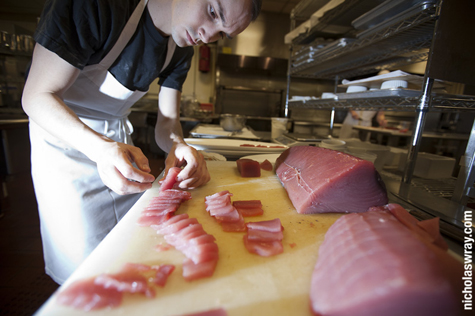
It slowly started to come to fruition and what started out as once month turned into once a week, then three times a week. The beginnings were simple; $35 a head and guests would bring their own wine. The original concept was a lot like how it is today, minus the price tag, which has gone up considerably over the years.
“The same thing we do now; it’s social interaction. You get to interact with the people cooking your food,” says Selland.
What is most endearing about The Kitchen is its uncompromising commitment to excellent service. Selland and Zimmer wanted to service the guests and make food for them that they would enjoy and walk away feeling good about. Not scratching their heads wondering what exactly they just ate or feeling like the reason they didn’t like their meal was because there was something wrong with them.
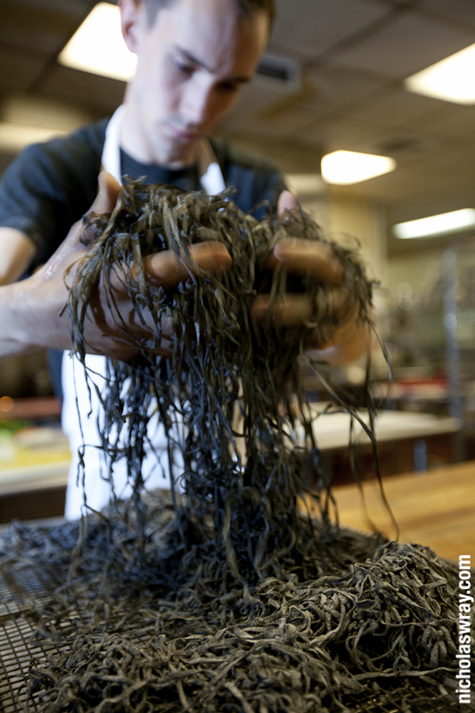
“We don’t care that you didn’t like it. I’ve been to restaurants where I’ve had the waiter say, ‘Well I’m sorry sir, but that’s how the chef cooks it.’ I don’t care about that,” says Selland with passion in his voice. “Here if I cook it perfect for someone and they don’t like it, my question to them is not, it’s supposed to be like this, it’s a matter of what did you not like about it and let me prepare something different for you that hopefully you will like.” As the last course approached–a grilled natural veal, perfectly pink that Zonca sliced himself–two, four, six cooks appeared one by one behind the line, mixing and changing places with plates and duties, Zonca calling out assignments of where to be, what time and dietary restraints. Each cook was listening, interpreting, reacting to each instruction. It’s a rare opportunity to see all the working parts of a kitchen all happening at once to bring you the plate that will sit before you. The drama that unfolds on a nightly basis at The Kitchen, a Sacramento destination restaurant that sits quietly behind an ivy-covered retaining wall, hidden, is what landed them a JBF Awards nomination.
The finalists were narrowed down from 20 to five this past Monday, March 19, 2012 and The Kitchen did not make the cut. But there should be little disappointment, because the JBF nomination has only sparked more excitement for fans of The Kitchen and will certainly generate more excitement for those yet to experience an evening with Zonca and crew.


Record Store Day is Saturday, April 21, and we here at Submerge ask you to not only support local shops like Dimple, The Beat, Phono Select, Records on Broadway, Armadillo Music in Davis and other mom-and-pop/brick-and-mortar stores on this day, but every day. There’s nothing like perusing through records, CDs, video games, posters and all sorts of other cool shit in person and not on the interwebs or at big, soulless corporate stores. On Record Store Day, most shops will have exclusive releases and some will have live bands, so get off your butts and get some new music in your life. You might just find your new favorite band.
For more information visit:
Record Store Day’s website
Dimple’s website
Phono Select’s website
The Beat’s website
Records on Broadway’s website
Armadillo’s website
Planet of the Vampire Women
Not Rated
Anyone who’s stuck around through the credits of your run-of-the-mill Hollywood blockbuster knows that movies require the hard work of a lot of dedicated individuals. From actors to directors, caterers to key grips and so forth, it’s easy to see where a lot of the money from those astronomical budgets is going.
Small or even no-budget films aren’t any easier. They require just about as much work to get the job done. However, instead of relying on a vast team of trained professionals, a dedicated few are required to wear many hats. Such is the case with the Sacramento-based filmmakers behind Trash Film Orgy, headed by director/writer Darin Wood and his wife/producer/director of photography Christy Savage. The credits for TFO’s latest feature, Planet of the Vampire Women, which has just landed a U.S. DVD distribution deal through Seminal Films (international distribution is also being secured through ICAP Media), show a long list of names, but in this case don’t be surprised if you see the same name multiple times.
“I tell the guys this every time. I tell them this every month, and they’re like, ‘I don’t know how to do this, I don’t know how to do that.’ I’m like, we’re going to find out how to do it. I tell them, ‘You don’t understand–95 percent of the whole thing is creative problem solving,’” Wood says. “Just figuring out what the thing is and then options, maybe trial and error. It’s all about that.”
The result may fall short of a James Cameron opus, but what you get is something that feels handmade and personal. Most importantly, though their budgets might be small, TFO certainly does not skimp on the fun. As Savage puts it, “We’re of the mind that at this budget level, you can’t take yourself too seriously, because no one else is going to. At least if you give the people the fun and the silliness, they’re going to have a lot more fun with it than trying to do a $25,000 uber-serious movie. I mean, it worked for The Blair Witch Project, but it doesn’t work for most people.”
This ethos is readily apparent in Planet of the Vampire Women. The film originally premiered at the Crest Theatre in Sacramento on Aug. 31, 2011, but it will return to the venerable movie house on April 13, 2012 to celebrate its distribution deal and official DVD release, which is set for April 24, 2012.
The film opens at a multi-billion dollar space casino that is ransacked by a group of space pirates led by Captain Mickey “Trix” Richards (Paquita Estrada). The heist doesn’t go unnoticed, however, and the group is pursued by the ever-dutiful space marine-turned-cop Sergeant Val Falco (Jawara Duncan). The chase takes its toll as both pursuant and pursuer end up crashed on a deserted rock of a planet on the outskirts of the universe. To make matters worse, Captain Richards has become possessed; she is transformed from foxy inter-galactic plunderer into a vicious undead vixen who must feast on the blood of the living–you know, a vampire–unbeknownst to the unsuspecting crew.
Loyal crewmember Ginger Maldonado (Liesel Hanson) takes the reins, leading what’s left of the ragtag group on what turns out to be a futile expedition to find and rescue the missing Richards. As our heroes plunge forth into this extra-terrestrial heart of darkness, the plot begins to unfold, which involves a doomed race of parasitic beings fighting for survival and an effort to ensure that they don’t spread like a plague across the galaxies. Simple and effective, the story is B-movie gold, giving a wink and a nod to the great films of trash cinema past while casting itself as a new cult classic.
Planet of the Vampire Women’s most striking feature–other than the gratuitous blood and bare breasts–is its setting. Wood, Savage and co-producer Amy Slockbower have crafted an eye-catching world. From the gloriously gaudy interior of the casino to the surreal, cartoonish rock formations of the abandoned planet our protagonists have found themselves stranded upon, sets are cohesive and colorful, and the film’s plentiful CGI follows suit. While it may not look realistic per se, it meshes beautifully with the drugged-out look of the Vampire Women’s more conventional backdrops.
Computer graphics are something of a new feature in TFO’s bag of tricks. In fact, as Savage tells Submerge, Wood, putting his creative problem solving skills to the test, learned 3-D digital modeling on the job with help from students at Art Institute — Sacramento while making Planet of the Vampire Women.
“We knew it was going to be a space movie. There were spaceships and crap like that. We were going to do miniatures in the beginning,” Wood elaborates. “We were just going to buy a bunch of models and mash them all together, and make them look like something random, but I wasn’t going to get them to look the way I wanted them to look.”
Another feature that sets Vampire Women apart from TFO’s previous effort, Monster from Bikini Beach, is more coherent storytelling. Whereas the latter sometimes felt as if it was two movies in one–a story about a down-on-his-luck rogue cop entwined with local crime syndicates colliding with a Creature from the Black Lagoon-type tale–Vampire Women plows headlong into a straightforward story arc. While Bikini Beach wasn’t short on delightfully cheap thrills and snappy dialogue, TFO’s latest film feels more confident and ends up more thoroughly enjoyable. The snappy dialogue hasn’t suffered one bit, though, as evidenced in memorable lines such as “My bullshit meter is picking up huge readings of I don’t give a fuck.” Priceless!
The April 13 event at the Crest has implications beyond just a mere celebration. TFO will also unveil its Planet of the Vampire Women comic book, written by Wood and featuring the artistic talents of Paul Allen.
“[Allen] was at a screening of Planet of the Vampire Women, and he got really excited about it and went home and did some drawings over the next couple of days,” Wood says of the project’s beginnings. “It’s got this Ed Roth kind of style. He’s a really funky kind of artist. He kept saying, ‘We should do a comic book,’ but I was like, ‘We don’t really have any money. We just did the film. We don’t have the resources to do a comic book.’ I would see him at parties, and he would keep bugging me about it, but I never took him seriously.”
Eventually, Wood gave in to Allen’s tenacity to bring Vampire Women to the paneled page. Wood says the story of the book is a mix between a prequel and a sequel, following the exploits of pleasure-clone Astrid Corvain (played by Stephanie Hyden in the film).
“It was a lot of fun,” Wood enthuses. “I’ve never written a comic book before.”
Beyond that, the Vampire Women screening at the Crest will also serve as a fundraiser for TFO’s next movie. The film is untitled as of yet, but the working title is “Badass Monster Killer.”
“I’m hoping not to use that, but some days it grows on me,” Wood says of the name.
He describes the film as “A Blaxploitation take on a Lovecraftian world.” As a result, Wood says he’s also been throwing “Loveshaft” around as a possible title, but jokes that it sounds too much like a porno.
TFO has also set up a campaign on http://www.indiegogo.com/ to raise funds for their forthcoming production. A synopsis posted on the site reads as follows: “On the trashy side of Camaroville, there’s a mob turf war going down, but the new gang in town ain’t content with merely controlling the local dope and sex trade. They are also mixed up with dangerous black magic, intent on resurrecting hideous demon-gods who have waited centuries for the chance to eat all our souls and enslave mankind!”
Exclamation indeed!
See Planet of the Vampire Women in its newly remastered form at the Crest Theatre on Friday, April 13, 2012 at 10 p.m. Tickets are just $10 and can be purchased through http://www.tickets.com/index.html. Some official copies of the DVD will be for sale along with the Vampire Women comic book. If you’d like to donate more to the “Badass Monster Killer” fund, head to http://www.indiegogo.com/badass-monster-killer
Pork Belly Grub Shack
4261 Truxel Road, Sacramento
Words & Photos by Adam Saake
I really miss Red Lotus. Chef Billy Ngo’s dim sum-inspired restaurant featured some of my favorite dishes that I often crave like the kung pao chicken wings, seafood soup and the pork belly buns. Ngo was onto something great that unfortunately ended prematurely, and after the closing of the restaurant in September 2011, I was sure there were still some great ideas up the young chef’s sleeve. Ngo had been scheming with two other local restaurant owners, Aimal Formoli and Suzanne Ricci of the popular East Sacramento spot Formoli’s Bistro, to host monthly Slow Beer Movement Dinners, where the two chefs collaborated on dishes that local beer buff Mark Neuhauser then paired with tasty suds. Some very memorable dishes came from these dinners including a squid ink pasta with baby octopi, hop-smoked chicken and of course, more pork belly dishes that the two chefs seemed to always include in their creations.
It was no surprise that after Formoli’s was finished getting settled in their new location a bit further down J Street and Ngo had his feet back on the ground, comfortable again behind the sushi counter at Kru, that the three would embark on their next food venture: Pork Belly Grub Shack. The Natomas restaurant opened in early November 2011 with an introductory menu, casual seating and décor and the same kind of friendly faces you might find at Kru or Formoli’s. It seems to say, “Welcome, come in and eat something good.”
The menu that consists of salads, burgers, sandwiches and other items like fries, tacos and fish and chips is just a start for Pork Belly. Natomas is still getting acquainted with them and vice versa.

“We’re just trying to feel out what people like and what kind of neighborhood this is so that we can adjust to what their needs are,” says Kim Vu of Pork Belly. “The neighborhood is definitely new to all of us.”
Vu is no stranger to Ngo’s restaurants, having worked at both Kru and Red Lotus, and she knows the importance of first impressions as well as changing to meet the needs of customers. But so far Vu says business has been great. “We definitely have good reviews and good feedback when people come in,” says Vu.
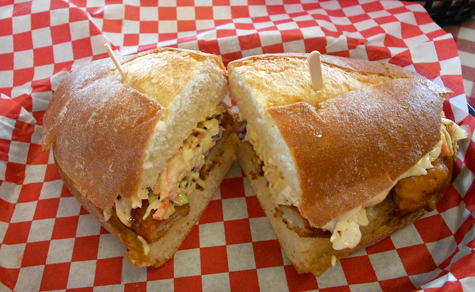
Pork Belly has a great balance of simple and tasty comfort food combined with Asian influences that make for a very approachable menu. Don’t let the name mislead you into thinking that there’s going to be heaps of pork belly on every plate. Many of the dishes like the Catfish Po-Boy ($7.50) on a French baguette with housemade slaw and tartar sauce or the Porkless bella Burger ($7.00), a portabella mushroom burger with jack cheese, tomatoes, greens and truffle oil, don’t have pork belly on them at all. The ones that do however, like the Asian Street Tacos ($1.75 each) with pork belly in corn tortillas with pickled carrots, daikon, cilantro, spicy teriyaki sauce and lemon pepper aioli, are absolute home runs and showcase the fatty cut of pork in all its glory.
Part of Natomas getting to know Pork Belly is, well, getting to know pork belly.
“This area, people don’t know what pork belly is. It’s a little different with the food scene in downtown. Everybody knows what it is, it’s on everybody’s menu,”
Often the best way to describe pork belly to someone is to let them know that bacon comes from this same cut of the pig. But pork belly isn’t bacon in that it’s not seasoned and cured. With pork belly, you see a thicker cut of meat with a delicious portion of fat that can be prepared in many different fashions and incorporated into many different styles of dishes. Chefs tend to really love working with pork belly and, in the past five years or so, there’s been more and more menus with dishes showcasing its range.
Chef Formoli’s touch makes its way into the burger selection, an area he’s proven to be quite proficient in. If you haven’t tried the much-raved about Whiskey Burger at Formoli’s Bistro, then I recommend you run, not walk, to eat one now. Pork Belly throws a little hip-hop homage into the mix with burgers like the Notorious P.I.G. or the Big Piggin’ (Pig Pimpin’? No?). But when I visited, these tempting burgers were trumped by a behemoth of a burger called none other than the Hot Mess. I had to order it. Not because its alluring name conjured memories of my romantic life’s past (I like classy broads), but because the sheer curiosity of what this “mess” might look and taste like was too much to bear. Two patties of beef with melted jack and cheddar, piled with sweet caramelized onions, a heavenly fried egg, barbecue sauce (oh my!) and roasted garlic aioli on sourdough. I had finally met my match. The Hot Mess is delicious in all its heart-stopping glory, but I recommend you might want to split yours with a friend.
Items I must return to try are too many to mention; but the banh mi is amongst the ranks, and certainly the French Pig with melted brie cheese, roasted tomatoes and truffle oil on sourdough is a must try. Specials rotate throughout the week and, knowing the chefs, inventive pork presentations will continue to be offered. And progressive still, there is talk of introducing a dinner menu along with a beer and wine list. As far as I’m concerned, pork belly needs these two components to seal the deal in my mouth.
“It goes hand and hand with this kind of food. The food is good in the winter time because it’s nice and heavy and it warms you up, and in the summertime it’s paired well with beer,” agrees Vu.
Pork Belly is already off to a great start, so whatever additions Ngo, Formoli and Ricci make, they will only be building and working toward a better version of what they have now. I recommend you make the trip to Natomas if you haven’t already; your belly will thank you.

Lagwagon, Cobra Skulls, Nothington
Harlow’s, Sacramento – Wednesday, Feb. 29, 2012
Catering to the working people of the city, Harlow’s hosted an early evening show, promptly starting at 6:30 p.m. with San Francisco’s Nothington. With only a couple dozen early birds in attendance to start, Nothington held little back, providing a solid performance. Bandleader Jay Northington forcefully belted out the mid-tempo “Stop Screaming,” which drew obvious comparison to the gruff vocal styling of Chuck Ragan’s early work in Hot Water Music.
The slightly quicker paced “This Conversation Ends” harked back to familiar pop-punk sounds of the mid-‘90s with straightforward rhythms, but catchy anthemic vocal hooks a la Face to Face or Social Distortion. “A Mistake” was perhaps their best song of the night, which included moments of all three guitarists singing at the same time; a formula that the band thrived on and shined the brightest when doing. At one point in between songs, Northington saluted the crowd with a can of beer, appropriate for the midway point of the third annual Beer Week in Sacramento.
Second on the bill was Cobra Skulls, originally from Reno, Nev., but now calling the Bay Area home. Right out of the gates, Cobra Skulls were ready to roll and brought the rock with them. Drummer Luke Swarm led the way on “The Streets of Cairo” with grooving, danceable beats that grabbed the attention of the ever-increasing crowd. “Cobra Skullifornia” incited several in attendance to dance and mosh in the middle of the room. Adam Beck’s clever single-note guitar leads transitioned well into the chorus of the song, and bassist Devin Peralta legibly shouted disapproving lyrics into the microphone, “You planted seeds in the desert/you stole your water from afar/Southern California stay where you are.”
Other notable songs from the set were the upbeat and driving “Solastalgia” and hip-shaking infectious “Honorary Discharge Under the Influence,” which sparked similarities to AFI and Rancid’s first few albums respectively. Cobra Skulls put forth a ton of energy and charisma with each individual member showcasing their talents as the supporting act.
The legendary Lagwagon graced the stage with much anticipation and adoration from bunches of eager fans in attendance. Though some might argue Lagwagon’s heyday has come and gone, the group still performs with the energy, pizzazz and goofiness of teenagers. Lagwagon quickly riled up diehard fans, old and young, into a moshing frenzy with classics like the stop-and-go “Black Eyes.” Showing their playful side, towering guitarist Chris Flippin took time in the middle of the set to inform the crowd that they were missing American Idol on television. Vocalist Joey Cape also told an entertaining story about a warehouse show the band attended after a Cattle Club performance early in their career, in which Cape recalled seeing an awesome metal band, Crank Lab, whose name he mistook for years as the name of the venue. Prior to playing the catchy “Razorburn,” Cape and Flippin gave praise to an audience member with an impressive mustache. Songs like “Sleep” and “Weak” showed the talent of the band to be simultaneously melodic and aggressive, serving as a reminder as to why Lagwagon reeled us in to begin with and why they remain a relevant punk rock band today.
C!nder’s maniacal machines are creations of pure joy
Not many people can find joy in stepping on a fresh piece of gum. The moment it hits your shoe it suddenly turns into an endless string that seemingly can wrap around your entire body. And no matter how much you wipe the pink bundle of teeth marks on the curb, it lingers on the bottom of your heel. But there might be one person who can find some joy in a gum catastrophe.
“Look at the way that thing pulls apart, it’s awesome. Who would have thought that only one cubic centimeter of chewing gum could stretch about three feet long?” Christian Cinder asked with excitement, while sitting inside Broadacre Coffee.
Finding the simple joys in life has led Cinder to become a professional cartoon surrealist but with a fun twist. He makes you question the stereotypical sci-fi robots that are out to destroy human life and replaces them with fun-loving robots that seem huggable.
“The work is happy because there is happiness,” Cinder said. “Maybe like a Men in Black kind of scenario; the world might be collapsing all around them, but they are going to have the best time they can.”
His current exhibit at the MAIYA gallery in downtown Sacramento, March of the Robots, displays some of Cinder’s (who signs his name C!nder) most recent collections of art pieces that are ready to be admired. He credits his creative inspiration to growing up in the ‘70s, watching Star Trek, reading Mad Magazine and comic books, and the popular ‘60s artist Ed Roth (known for creating the Rat Fink icon).
Whether you are a science fiction nerd, art fanatic or love cartoons, Cinder creates pieces that everyone can enjoy. His art work is bright, imaginative and fun. Cinder likes to portray robots having fun in their environments, smiling and exploring their world with curiosity. One of his pieces shows a red robot sitting and looking very content in a flowery meadow. But not all of this work is happy and easygoing. One piece called Night of the Tinkerbot shows a scared robot running away from other rusty robots who are trying to take his parts.

“The robots can be destructive but so can 5-year-olds,” he admitted.
From destructive robots to robots picking flowers, Cinder uses an art technique called color theory to make the picture on the canvas look dimensional through 3-D glasses.
“When I pick the colors for my subjects, I tint and tone everything according to where they are on the background and the foreground,” he said. “So that’s just the basic concept of color theory. That cool colors will recede and warmer colors will come forward.”
While visiting the MAIYA Gallery, Cinder would walk around with 3-D glasses trying to see if the other artwork on display had the same effect, which made onlookers take a second glance, said Kelly Truscott, owner of MAIYA Gallery. Truscott said that everyone has taken an interest in Cinder’s art, from 10-year-olds to serious art collectors. But Cinder likes to call his fan base the “12-year-old adult.”
“The person who has the energy and interest of a pre-teen and can enjoy life that way but at the same time has the education and experience to appreciate the nuances,” he said. “So anybody who likes a Disney film or Don Bluth animation, I would hope would like my work as well.”
The ideas behind the animation all start with pencil sketches in his worn-out sketchbook. The sticker collage on the front cover of this sketchbook, which includes, In-N-Out Burger, San Diego Comic-Con, Santa Cruz Beach Boardwalk and Space Invaders, can easily give away what he loves most. But once the sketchbook is opened, a new world comes to life with Intergalactic Police, Alien Internet and frolicking robots. Cinder can find robots everywhere. One of his drawings is based on a man who was picking up cans on the Santa Cruz Beach and wearing a medical mask with thick gloves. After Cinder saw him, he drew him as a robot on the beach.
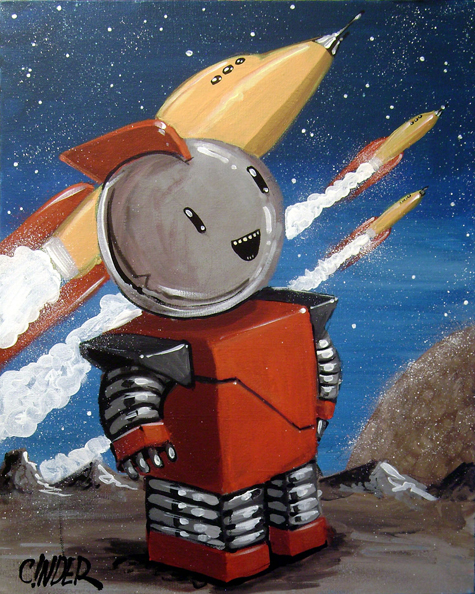
His sketch work shows all the technicalities of creating a robot and he does not allow himself to make any edits in his sketchbook. The process of developing a new robot style, which he calls Cinderbots, is a serious task. He takes multiple styles of robots and gives them a name and purpose in each painting, including the Alpha (single box or geometric shape), the Cinderbots (a more formed robot) and the Hakos (cardboard structure characters).
“I think I get the most fun out of the Alphas, he’s been my longest standing character, he gets into the most mischief,” Cinder said. “In the paintings he discovers the most about his world and the Cinderbots act like a supporting crew. I think the Alphabot is pretty cool, Alpha 1 is his name. He just goes by Al.”
And Al can come at an affordable price. Cinder likes to keep this work within reach for everyone. In the past he was known for making “insane cinder prices” where he would only charge $40 to $60 for a large painting. A former art buyer once asked him if they could pay half in cash and the other half would be a trade in CDs, and of course Cinder agreed. Those days it was easy to mark a big painting for cheap because he earned other income but now he has to be more careful with pricing.
“Affordable pricing is important, but at the same time you’ve got to be able to survive. So, I’m trying to find that middle ground. I’m trying to find that point of compromise,” he explained.
Cinder has been making his art accessible for everyone for the past seven years and has created more than 500 paintings. He learned art education through community college courses, spending many hours in a library and through other artists that he knew in the community. Cinder started to take art more seriously when he would sketch portraits of his co-workers’ pets and babies. Now he somehow finds the time to balance multiple art projects at once and spend time with his wife and three children, who often take part in titling his art.
“The paintings on the wall complement my family life,” he said. “I am a father, a husband and a best friend to all of them.”
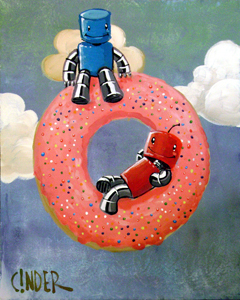
One of his biggest inspirations came from his daughter, and while they were eating donuts she said, “Mini donut, mini donut, for a mini robot!” This idea sparked Cinder to paint doughnut-hole squids, robots chasing doughnuts and create tiny sculptures perfectly matched for Doughbot, the delicious doughnut café. Cinder’s art can be seen at Doughbot, MAIYA Gallery, and on “anything else that can hold paint,” including custom end tables, bicycle helmets, ukuleles, bongo drums, guitar cases, skateboards, cars (interiors and exteriors), pinstriping, leather jackets and denim jeans. He also does modeling for the war miniature gaming community and table top battles. He creates the scenery and terrain for tiny armies to battle on with mountains, forests, valleys and houses.
This artist, sculptor, creator, Sacramento native and all-around happy guy is excited to share his thoughts and stories with everyone in the city. “Being in the physical presence of all the work you’ve already done, you can see what you were thinking. It’s like reading back through your journal but on a visual level, because every piece that I make is in its own moment, its own story,” he said.
See Cinder’s work at Maiya Gallery. His exhibit, March of the Robots, also features the works of Marissa “Nurse Squeeky” Goldberg, Dwight Head, Mark Lifvendahl and Mark Harm Niemeyer. Maiya Gallery is located at 2220 J Street, Suite I, and is open Wednesday through Saturday from 11 a.m. to 7 p.m.
Psychedelic indie rock group Mr. Gnome is returning to Sacramento during their coast-to-coast spring tour. Recently named Rolling Stone’s “Band to Watch” for their third full-length album, Madness in Miniature, Mr. Gnome is ready to release their new 7-inch, Softly Mad. The duo, featuring Nicole Barille and Sam Meister, has been premiered on MTV, for their new track called “The Way.” Cleveland’s Mr. Gnome will be headlining Luigi’s Fungarden on March 28 along with Playboy School and Survival Guide. The show is all-ages and starts at 7:30 p.m. Entrance fee is just $7 at the door.