Sizzling Sirens teach Sacramento how to shake it
Silky bustiers, black feather boas, strings of pearls and a random pair of motorcycle handlebars made of PVC pipe are painted silver and lay on the floor. A gold vintage sofa rests near two racks lined with handmade costumes, including bras stitched with imitation cash and coins. Beneath a clutter of buttons, jewelry and a tower of sewing knick-knacks appears to be a desk–a typical day at the office, if you’re a Siren. This is the headquarters of Sacramento’s only active burlesque troupe, the Sizzling Sirens, a team of 10 women ranging in ages 19 to 43 years old, each radiating with a flare that is uniquely her own.
A little vaudeville filled with theatrical satire and brought to life with provocative striptease and choreographed dance numbers defines burlesque entertainment in the simplest terms. But when Jay Siren founded the company in March 2008, she envisioned this classic genre of performance art with a couple modern alterations. Siren started teaching her first round of classes at The Press Club later that year, eventually gaining more students and at the same time finding some of the first members of Sizzling Sirens.
Since its infancy in 2008, the Sirens have built a reputation within the local music scene and around town by performing alongside bands like Agent Ribbons and Goodness Gracious Me in addition to corporate parties and events. What’s more, the gals now have a regular live show each month at Harlow’s centered around a theme, and if they ever need a live band, they turn to the veteran jazz musicians of the Harley White Jr. Orchestra for support.

“I think the greatest misconception about burlesque that we run into all the time is, ‘Where’s the pole?’” explains Jay, her off-the-shoulder black T-shirt revealing tattooed leaves spreading down her right shoulder. “For us, burlesque is burlesque-fusion. The way that we do it is a little bit different than the way that you see most burlesque presented nowadays. We take elements of everything that we love about the culture, genre and history and make it our own, mixing past and future ideas. A striptease is part of it, but in the sense of using your costume as a tool to engage your audience as though it were a prop.”
Since moving the Sizzling Sirens troupe into a gray, Victorian building on J Street last April, an idea to form a Performance Series of classes, catering to those interested in learning the art of burlesque with the opportunity to perform alongside the Sirens, was created.
Indiana Bones, Georgia Fire and Sass Herass are all present during this afternoon’s Burlesque 101 class, a one-hour introduction course into the Sirens’ world of burlesque-fusion open to the public. Each woman planted on the wooden floor of the small dance studio routinely stretches her legs and arms before claiming her space, waiting to warm up with the day’s basics.
“Alright Sass, teach us some class,” says Jay clapping her hands together like an athlete ready for the next play.
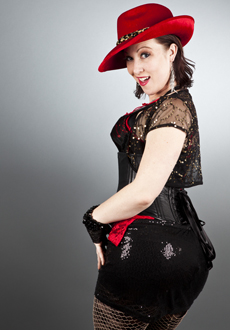
Herass, wearing hot pink spanks that read, “Dance all night,” across her bum, complete with black fishnets, tall black boots and a tilted fedora, is the instructor leading the workshop this week.
Ginuwine’s “Pony” blares from the studio’s sound system and the Sirens begin loosening their hips in a circular motion to the music. Each woman follows Herass’ lead as she keeps time out loud through the steps of the warm up. Now with Etta James’ “W.O.M.A.N” changing the mood of the workshop within the small Midtown space, the four slowly bend forward to stroke the frames of their shapely legs with both hands before gracefully lifting their arms in the air like ballerinas. Using one hand, the Sirens trace the outlines of their faces, then across their chests and eventually following the curves of their bodies. Every move the same, yet differently interpreted through the personality of each Siren.
The newest member to the troupe, Fire, watches her moves in the mirror, her limbs naturally following the flow of the lesson as Bones practices pinup faces while dancing, her short red hair ornamented with a big, white bow. Jay’s once straight black locks begin to curl as the warm-up progresses, sweat glistens down her throat as she attacks each move full out. Herass, who has taught dance over five years, emanates hip-hop in each move she teaches.
“One of our biggest things that we try to reiterate is to honor your spirit and your character,” Herass says. “It’s something that I think is really important, especially with women, we are made to feel like we are supposed to fit one cookie cutter mold and burlesque is about taking what you have and accentuating it. We’re not trying to hide, or diminish anything, just being proud of who you are and what your body is and just adoring yourself. And, that’s something that I’d really like to share with everybody else.”
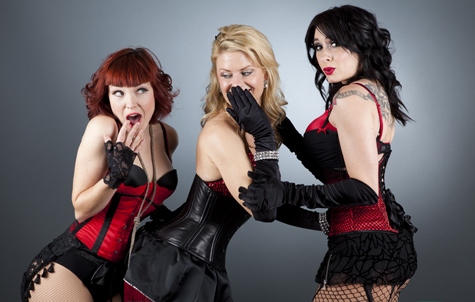
Through the classes Sizzling Sirens hold every week, whether its Burlesque 101, Cardio Burlesque (which is exactly how it sounds), or the Performance Series, the Sirens believe any and everyone, with the right instructor, can learn everything from how to properly shimmy to how to incorporate props into the steps, adding a personal tease to the routine.
“I would like to stress that most people come in with absolutely no theater or dance experience and they have a blast. You seriously do not have to have any dance experience to enjoy the classes. Literally, everything is all-levels. You can walk in, gain an understanding and find a challenge and enjoy it. Truly, you can enjoy this without ever having done it before,” explains Jay, fanning herself at the close of class.
And it’s true according to Fanny Coquette, a 43-year-old Siren joining the cast last August, who took her first class with Sizzling Sirens on a dare from her husband and looks forward to February’s “Good, Clean, Dirty Fun”-themed performance at Harlow’s.
“It’s just fun. It’s fun to step outside of who I am and be 100 percent who I am,” explains Coquette. “When you get older and have a family and have a regular job, there aren’t very many venues to push that line of ‘I don’t care what you think of me.’ So, it’s a great venue to relax and have fun and not worry about what other people think.”
Together Sizzling Sirens witnessed members from the first cast come and go, but have continued to grow in numbers as well as expand their reputation outside of Sacramento, performing at the DNA Lounge in San Francisco during its monthly Hubba Hubba Revue series, named one of the Top 10 Burlesque Shows to see around the world by the Travel Channel.
“I’ve never seen a group of 10 women get along and support each other creatively and emotionally,” says Jay. “Through the process of burlesquing together and learning how to create together, we’ve all become friends.”
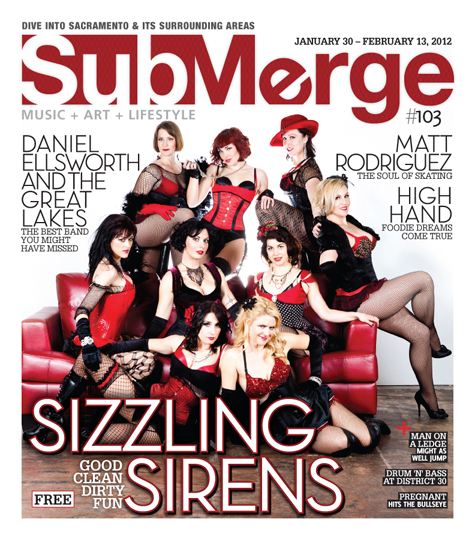
Sizzling Sirens Burlesque is located at 2419 1/ 2 J Street. Hour-long Burlesque 101 and Peel and Reveal classes are taught on Sundays (at 1 and 2:30 p.m. respectively). Cardio Burlesque is taught Tuesdays from 5:45 to 6:45 p.m. For more info on their Performance Series Workshop, go to Sizzlingsirensburlesque.com. If you prefer to watch the girls in action, check them out at Harlow’s for their “Good, Clean, Dirty Fun”-themed performance on Feb. 16 at 9 p.m. Tickets are $12 in advance and $15 at the door. 21-and-over only. You can also catch the Sirens the first Friday of every month for Fishnet Fridays at Dive Bar.
Baroque Bash featuring Doom Bird
Crocker Art Museum, Sacramento – Friday, Jan. 13, 2012
On a normal afternoon the Crocker Art Museum is usually filled with art enthusiasts who quietly soak in the historic and modern art pieces as they roam the halls. But last week on a chilly January night, the art museum was humming. Upon entering the museum lobby, there was a different vibe in the atmosphere. It was filled with excited guests who were patiently waiting for the “Baroque Bash,” a music and art celebration to honor one of the Crockers current exhibitions called Florence and the Baroque: Paintings from the Haukohl Family Collection, to start. People were busy talking in small groups or sipping on glasses of wine and beer. After all, there might not be a better way to properly appreciate 16th century artwork than with a glass of classy wine in hand.
As the room waited patiently for the musical performance by Doom Bird to start, most eyes wandered to the left side of the lobby where museum goers could participate in art demonstrations. A few aspiring artists were caught sketching costume drawings from the Baroque period, along with the help of artist Arturo Balderama. A woman dressed in an elegant dress from the 17th century was modeling for the artists and wandering the lobby so people could appreciate her wardrobe.
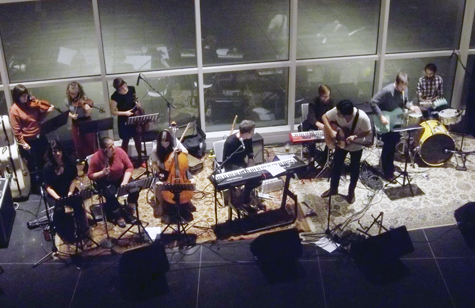
The musical portion of the show began with relaxing melodies from three instrumentalists who gracefully took strums at a cello and two violins. During their performance, the majority of the audience members seemed to appreciate the music, but were also a little distracted by their surroundings.
After the classical performance ended, Doom Bird was ready to take the stage (which consisted of two rugs on the floor). Band members Kris Anaya and Joseph Davancens were accompanied by many local musical guests for the night including Krystyna Taylor (cellist from Exquisite Crops), Arjun Singh (drummer from Wallpaper) and Adam Wade (singer from Golden Cadillacs). Depending on the night, Doom Bird enjoys to be backed up by great musical talent to keep their shows lively and entertaining. “Joe and I usually play with a large group of people for shows,” Anaya described in an e-mail the day after show. “It usually keeps the audience excited about what we are trying to present in our music.” Although the band admitted that they had not performed in nine months, the performance from the musical group was peaceful and flawless. Each song provided the audience with calming but powerful music notes, making the perfect blend of classical and alternative tunes.
For most of the set, frontman Anaya didn’t have much to say to the audience except for the occasional thank you. But during the middle of their set, Anaya noted that the lobby of the museum resembled a mini airport. “Welcome to the International Crocker Airport,” he joked over the microphone. Taking a bird’s eye view of the museum, it did resemble a map from a stereotypical “airport.” Starting at the left of the lobby was a bar serving cocktails to guests, then families enjoying their dinners on square tables; the middle of the room was filled with rows of silver chairs facing the stage (resembling a waiting room). It provided an atmosphere that made the museum appear busy and full of life. Throughout the entire set, audience members could take in the “artistic extravagance” of art and music that the Crocker Art Museum had hoped for.
The Features tap into the sounds they grew up on
Bands that have released albums dating back to 1997 are not expected to catch the eye when scanning The Twilight Saga: Breaking Dawn soundtrack artist listing–you know, because your friend or teenage sister or jejune girlfriend owns it.
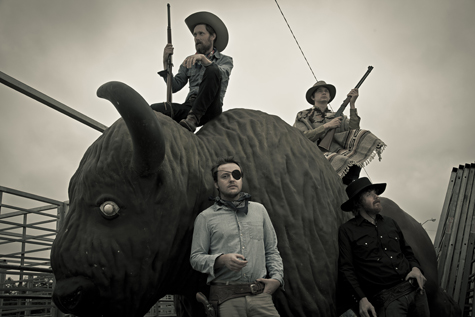
The Features’ timeline is weird in that regard. The band formed in Sparta and Murfreesboro, Tenn.–a couple small/college towns southeast of Nashville–in 1994, which is only a few years before most of the purchasers of The Twilight Saga soundtrack were born. But the compilers of the soundtrack were taking open submissions. Singer/guitarist Matt Pelham described the submission as whimsical and with little expectation. “We had a couple of extra songs from the record and they were taking submissions,” he said. “It’s been pretty crazy. It’s now our most popular song and it’s not a song we wanted to put on a record.”
The Features won’t find out whether “From Now On” will alter the attendance of their shows until the band embarks upon its winter tour through the Southwest and up the coast toward Sacramento. As it stands, the band is pleased with its fan base. Last July, The Features released The Wilderness on the Kings of Leon-run label Serpents and Snakes. Pelham discussed the record’s conceptualization and reception, while driving around Murfreesboro, the band’s current home base.
The Wilderness is described as an amalgamation of genres such as krautrock, indie and classic rock, but I feel as though classic rock and blues are the dominant influences at work. These are also the genres you grew up on. Was there an intention to revisit the music that you first learned to play?
I guess it’s always sort of stuck with us. We all grew up with different influences, which I feel helps us out as a band with everyone writing their own parts. Roger [Dabbs] and I grew up listening to a lot of classic rock, and when I went to college and from that point for another eight to 10 years I got away from it. Only just recently I’ve been going back to it in the past three or four years.
I don’t know if I’m just getting more nostalgic toward it or what it is. It is hard for me to get away from. It’s such a strong influence. On a subconscious level it winds up being what I lean toward when I write.
Were there any records in specific that crept back in to your rotation that played a role in The Wilderness?
No. It’s just one of those things like back in high school I wore out those Led Zeppelin cassettes and then just got so sick of them by college. I started college in 1993, so it was prime time when it came to the music scene changing dramatically. From my junior year of high school to my first year of college it was pretty nuts, the amount of music and variety of music that was out there.
I went from listening to Led Zeppelin, Pink Floyd and Lynyrd Skynyrd all the time, to hearing stuff like Pavement. It was refreshing. I imagine I’ll end up going back to Pavement someday too. But now I’m just revisiting Creedence and stuff I grew up with, which is nice.
Being you grew up in a time of dramatic shift, how do you feel about the current climate of music? You’ve expressed that your band walks the line between mainstream and hipster.
I’ve always had a hard time knowing where we fall in conversation. It’s one of those things I’d love to know. It’s always been this way: you either like punk rock and that’s it. You can’t like punk rock and R&B. But none of us have ever been like that.
It seems like most of the people we end up talking to at our shows, getting to know and who’ve listened to us for a while, seemed to be similar to us in the sense that they just like music. It’s not so much about what kind of music it is or what style. I like that about the people at our shows. They just love music and it’s not so much about a trend.
I really don’t know where we fall in the context or big picture as a band.
You worked with producer Brian Carter and engineer Craig Alvin on The Wilderness. I was curious about their involvement in the recording process. You manage to pack a very big sound into a live tracked record. Where are their fingerprints on this record?
We’ve recorded with Brian in the past. He’s a good friend of ours. We’d always record at his house, which was very comfortable. It was one of the reasons we wanted to work with him again. 1) He’s good. 2) It’s an extremely comfortable environment.
We brought Craig in, who’s originally from Portland [Ore.] and living in Nashville now. We heard he was really good and he really is. He brought a lot to it. We wanted everything to sound big, but almost as if we were playing a house party in a living room. Craig and Brian both, I feel like, they executed it nicely.
Did you record everything live as a full band and jam through or was it tracking and overdubbing the pieces?
It was all done live. There were some overdubs, just added bells and whistles and the vocals were overdubbed, but the basic track is united. It seems to be the only way we can record really. We’ve tried track by track and we sound awful. I like records that are done track by track. They have a nice homemade quality to them. Like [Paul] McCartney’s first record or [David] Bowie records to me sound really neat. They’re stiff, but it just has a… I don’t know… ‘70s sound I like. But we just can’t do that. We sound awful.
With the presence of “Big Mama Gonna Whip Us Good” and “GMF” on the previous record, how important to you is it to slip in a political or environmentally conscious song into your records?
I never intend to put a message out. I’ll start writing a song and nine times out of 10 the lyrics will mumble themselves into place. If I end up getting a line like, “Big mama gonna whip us good,” I’ll think about where I’m going to go with that for months before I actually come up with something. That’s just where that song ended up going. I do feel strongly about it, but the songs write themselves in a sense. I don’t have a lot of control over it and those are my favorite ones because they come out easy.
Maybe it sounds like that? Maybe it kind of sucks because the lyrics are too easy? To me, those are my favorite lyrics, the ones that sort of just happen. I do pay attention to those issues, so it just ends up coming out in a ridiculous way. It’s hard for me to write about stuff like that unless it has a humor to it, otherwise I feel like I’m being someone I’m not.
The Wilderness is about six months old. Will you be working new songs into your set, since you’ve said you’re a band that typically spends its rehearsal time writing new music?
Just before The Wilderness was released we recorded another record. So in the last four or five months of touring we’ve been trying to put some of that into the set to keep ourselves from being bored. We’re trying not to play it too much, since we know eventually we’ll have to play it a lot and we’ll get bored too quickly.
Have you begun talking about the release of that next record?
No. I have no idea what’s going to happen with that. We’re going to continue to tour behind Wilderness and see where we stand in the next three or four months.
I imagine being on a label, they’ve got expectations on releasing singles and stretching out the promotion of a record that’s not reached a year in age.
They’re pretty hands off. There’s not really expectation at all. A lot of it is left up to us, which is really nice. Most of the decisions have been our call as far as how we want to release stuff and when.
The Features timeline has met obstacles like unreleased albums, lineup changes and other setbacks bands experience. Where does your resilience come from to carry on as a band?
I don’t know if any of us would have any good ideas on what we’d want to do or what else we’d be able to do for that matter. We’ve done this for so long it just feels like what we should be doing. It keeps us happy and comfortable. When we’re writing and actually able to practice or be on tour, I feel like it’s when everyone is at their happiest. It keeps us going to have that outlet.
The Features will play Harlow’s on Feb. 3, 2012. The show will get underway at 7 p.m. and tickets are just $10. To purchase them in advance, go to Harlows.com.
Neal Morgan’s Impulsive New Record a Raw Delight
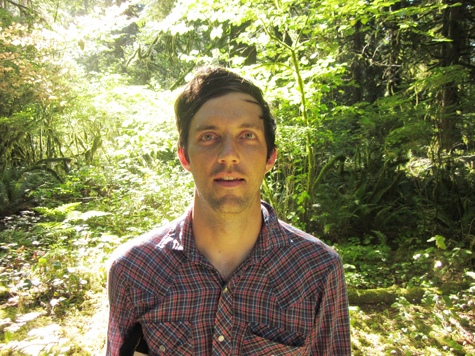
You’re likely at least a little familiar with Neal Morgan, even if the name doesn’t quite ring a bell right away. Fans of Joanna Newsom or Bill Callahan will recognize the name as belonging to the drummer responsible for holding down percussive duties on their respective tours the last few years, as well as on record–notably Newsom’s Have One on Me, and Callahan’s Apocalypse. But Neal Morgan, the solo artist, is something of an anomalous alter-ego to the drummer heard on those recordings. His 2009 debut solo record, To the Breathing World, premiered a symbiosis of voice-and-drums-only compositions, created largely from first impulses to a cassette boom box in his Portland, Ore., garage. The result was a unique, primal offering of polyphonic voice melodies cooing over sometimes-frantic, sometimes-structured drumming. For his newest album, In the Yard, Morgan has also added a spoken word element, a new passion he hopes his work evolves naturally toward.
The self-released In the Yard is out Jan. 24, 2012, with distribution help by Drag City. Morgan is returning to the Sacramento area on the heels of the release, and took some time to speak with Submerge regarding his muses, his music and his hatred of poetry.
Is there anything special about getting into the mindset of making a solo record for you, as opposed to your more regular gig of drumming for other people and being part of a unit?
Well, everything I do is based on first impulses. So even arrangements I’ve made for Bill’s music or Joanna’s music start as first impulses and then it goes from there. But those first impulses when I’m arranging for someone’s record are based on some amount of conversation in advance–what they might be hearing for a particular piece and talking about the piece itself, and then arranging for that. I guess having a blank slate is the major difference.
What draws you to want to create on that impulse, and to have the final product be a really improvisational vibe?
For my own artistic enjoyment, it’s most fun to just be playing and just to do it without thinking too much and editing while I’m working. I tend to like listening to records where it was clearly the first pass that someone made at something. I always love my friends’ demos more than their records, for example. Really early on, I didn’t know how to make music of my own. I thought, “Well you make some demos and then you make a record.” Why make demos? Just make it. Get in the garage and just start and end up in something. Not always, but most of the time I love the thing that happens first, when I wasn’t thinking, the fresh impulse. But after a certain point, I’m a heavy, heavy editor. I spend 20 percent of the time tracking and then 80 percent editing. It definitely flips; it goes from being this impulsive thing into this heavy cerebral experience.
Of the songs that aren’t improvised like “Father’s Day” or “The Evidence,” how do you reconcile getting into the mindset of arranging or composing those songs that are more structured?
Sometimes the first thing you did is just exactly what it needs to be. Sometimes that’s just what happens. There’s a need for further tracking and re-recording of initial impulses. There are a few moments like that on this album, like “Father’s Day” happened fairly quickly. Those initial impulses really just kind of happened. But there are a couple songs on the second side, one in particular–“Thinking Big”–I’d had that drum beat kicking around for a really long time. I decided I wanted to make a highly structured composition. But then the two spoken word pieces [“On Tour,” “I Stand on a Roof”] happened after I thought the record was done. I went away [on the summer 2011 Bill Callahan tour] and came back, and [the record] was very clearly not done with fresh ears. I recorded those in 20 or 30 minutes. It was exactly what the record needed, and I finished it right then.
Sometimes you have to take a step back and give it space…
Yeah. Do you know the painter Philip Guston at all? There’s a response on the record to him, and his painting is on the cover. I think about him a lot and read a lot of his writings and interviews. He talks about being led during the course of painting, and I think that happens. As these things start to show themselves, they kind of tell you which way to go.
What is your recording process like? I read you recorded some of the album on a boom box.
I have a cassette eight-track, and an old boom box that has a microphone. I have a digital program, but I’m not good at any of that stuff. I just wanna hit record and play. Side A [of In the Yard] is really a foreshadowing of what the next record is going to be. Side B is really a wrapping up, I think, of a lot of the ideas that started with the first album. The next one’s gonna be spoken word.
You mentioned you hadn’t really done any spoken word before. How did you get into that?
[I was] in Atlanta [with Bill Callahan], and I was opening the show there. I had just written something that I really liked, but I didn’t really have a melody or anything like that to sing it. I decided just to say it. I just tried it and I loved it.
Was it liberating? It takes a lot of confidence to release music that’s based on first impulses, but also to speak naked words that aren’t under the veil of a melody and just saying it.
Yes, it did feel that way. I think that maybe that’s what continues to draw me to spoken pieces. The next record will be that, because you’re right–it’s the barest of the bare. That show, for me, was an incredible show. My shows are almost always improv. I’ll just decide to play a song at the drum kit one night, or instead I’ll just sing that song. This was a night where I did four or five really new things that I’d never done.
What topics interest you most to write lyrics or spoken word pieces about? Is that also coming from an impulsive source?
I have a notebook, and I’m often writing. You write when an idea comes or something happens that you think is interesting, or you come upon a way to express something that you’ve been curious about. I do a lot of writing and no editing as I’m writing. Zero. I think that’s so important. Then I will look at it some time later, and sometimes nothing resonates for me so I don’t act on any of it. But sometimes pieces of it will resonate and will connect to other ideas I have at the moment. Maybe drum ideas, or they’ll connect to other things I’ve written. Now my process includes speaking those written words in the editing process, because I’m now thinking that way for live and for the next record–hearing how it sounds and seeing how it feels to speak particular lines and then making editing adjustments based on that.
Like working on cadence and intonation?
Yeah, which is all stuff that I’d never really explored before. But it’s all very rewarding for me right now. I also don’t have a lot of frames of reference necessarily, and I want to stay that way.
In terms of spoken word artists?
Yeah, and just for the written word. I don’t have a lot of writers who are heroes of mine in that form. I’m kind of limited in that way.
You haven’t gravitated toward spoken word artists, now that you really enjoy it artistically for yourself?
No, I haven’t done that. I’ve read some more poetry in the past year, but I like so little of it. It’s really wild. But I also don’t devour it. If I read a lot more, I’m sure I would find a lot more I would like. But I really hate a lot of what friends have given me and said, “Oh yeah, this is a great poet, a great book.” I just don’t like it, like 90 percent of it [laughs]. When I’m working on music, I tend to not want to hear much at all. I just want to keep those first impulses what they are without having other ideas flying around.
Neal Morgan performs at the Milk Gallery in Sacramento, Friday, Jan. 27, 2012. The show is all-ages and has a $5 cover. Show starts at 8 p.m. Morgan will also play at the Haven Underground in Nevada City Saturday, Jan. 28, 2012 (also a $5 cover). For more info, go to Havenunderground.org. Both shows feature Aaron Ross opening.
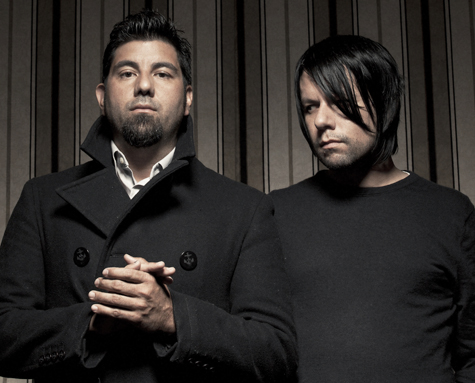
Far’s Shaun Lopez and Deftones’ Chino Moreno let their creativity loose with Crosses
Shaun Lopez (guitarist for Far) and Chino Moreno (vocalist for Deftones) have left an indelible mark on the Sacramento music scene–as well as rock music beyond the River City. Sometime last year, the two (along with bass player and songwriter Chuck Doom) began meeting–more or less in secret–on a new project that would leave a new kind of mark, âœâœâœ, aka Crosses.
Lopez and Moreno worked closely together before, though according to the Deftones vocalist (who also provides vocals for Crosses), it wasn’t the most positive experience. Moreno says that the vocals for Deftones’ Saturday Night Wrist, released in 2006, were recorded at Lopez’s studio.
“We worked pretty close then–a little too close,” Moreno says. “It was a gnarly time. There was probably one point when we were doing that that I said in my mind, ‘I will never work with Shaun again.’”
Lopez adds with a laugh, “I said the same thing.”
One thing positive that did come from the experience was that the two remained friends, despite the difficulty. Moreno recalls that it was a rough time for him personally and that he felt a lot of pressure surrounding Saturday Night Wrist. This time around, however, things were different. Crosses didn’t bear the same level of expectations as did that Deftones album. In fact, for the most part, no one even knew that Moreno was working on new music.
“The music is pretty powerful,” Moreno says. “I hate to sound corny, but when we get together to make some stuff, it straight up sounds good. I think we just enjoy that.”
Crosses got off the ground with just Lopez and Doom at the helm. Lopez says that he’d met Doom two or three years ago through a mutual friend. Doom was looking for a space to lay down tracks for another project he was working on, but as he and Lopez began getting to know each other better, they began writing together.
“He started bringing in some other ideas that were different than what he was doing already,” Lopez says of Doom. “I thought that it was really cool, maybe I can throw some stuff on top of this. Maybe we could do some co-writing. That was sort of the birth of Crosses.”
Beyond that, Moreno calls the enigmatically named Doom a “very interesting guy.” Moreno says that Doom has a penchant for “really old gear” and still employs floppy disks as part of his recording arsenal.
“I think that’s inspiring to me, because it’s not like he’s got an iPad in some room and he’s making shit that sounds like everyone else,” Moreno says. He goes on to praise Doom’s tireless, and perhaps eccentric, work ethic.
“I’ll get an e-mail at 7:30 in the morning sometimes, and it’ll be a 30-second clip of four chords with this weird loop around it… It’s kind of cool to see how [Crosses songs have] evolved from something as little and abstract as that.”
Moreno was the final piece of the Crosses puzzle. Originally, Lopez had planned on having a revolving door of different vocalists to sing over the music he and Doom were creating, but once he heard Moreno sing over a track, it seemed like he needn’t look any further.
“Once we heard what he could do over it, and it just really made sense,” Lopez says. “It all just sounded like something we could hear Chino’s voice on. He basically told us, ‘I don’t want anyone else singing on these songs.’ It was nice that it worked out that way, that it was really natural and really organic, and nobody was forcing anybody to do anything. He was like, ‘I really like this. I want to sing over these songs.’ He heard it, and then we started writing more songs, and he said, ‘I want to sing on all of these.’ So we were like, let’s do it.”
“I’m just that good,” Moreno quips.
It must have been the right formula, because the partnership became pretty prolific. Moreno reports that the trio produced over 20 songs in about six months. The group released its first album, a five-song EP titled EP ✠in August 2011. The album was released for free download through the Internet (it can be downloaded at Crossesmusic.com). Another EP, EP âœâœ, will be released in the same manner on Jan. 24, 2012. The goal is to release a third EP thereafter, and Moreno hopes that they will then compile them all into a full-length album along with five new songs. Both he and Lopez are reveling in the fact that they’re making this music on their own, with little outside pressures or expectations.
“To me, that’s one of the lamest parts of being a part of a big label, at least from my experience,” Moreno says. “Every time you’re making a record, you have someone’s opinion who’s outside of making the record, it’s always a damper.”
“And not so much the label, but anticipation from outside the project…right away there are a million opinions of what it’s going to sound like, what it should sound like. We went into this without any of that. It was cool to do it for fun as it went along. Now that it’s done, I guess people will have their opinion now, but it’s done. It is what it is.”
What it is may not be what Moreno’s fans expect or even want to hear from the lead singer of Deftones. EP ✠is a dark and brooding, ambient yet heavy release, perfect for turning up loud in your headphones and losing yourself in. “This Is a Trick” opens the album with creepy organ sounds washing over a glitchy digital beat that gives way to a chorus in which Moreno’s voice fluctuates between an almost pleading tone to a more metallic yell. From there, the EP traverses down more of a trippy, atmospheric road. Lyrically, the album seems to hold common themes of fantasy versus reality. Moreno says that these are ideas that are actually apparent in his other projects.
“I have a hard time deciding that I’m going to make a song about this topic and just doing it,” he explains. “To me, that takes away all the fun. It puts up walls all around you… I think that’s where the escapism comes through in the lyrics, with all my projects. It’s not like I write differently for this project or that project. When I sit down to write, it comes out however it comes out. A lot of times, it’s a sort of fantasy/escapism, things that are so detached from everyday life or emotions or feelings. I think those things come through anyway.”
Similarly, Lopez and Moreno have a take it as it comes approach toward Crosses. The band will be playing a series of live shows starting Jan. 31, 2012 something they hadn’t really planned to do with the project at its inception. Crosses will play a string of four dates in California, and then two dates in South America (Santiago, Chile for Lollapalooza Chile and Quilmes Rock 2012 in Buenos Aires, Argentina) in late March/early April.
As for the upcoming EP, Moreno gave few details. He says that he doesn’t feel comfortable describing what it will sound like, but mentions that it was recorded at the same time as EP âœ, so it will have a consistent feel, though it will probably be more up-tempo.
“I don’t want to give anyone any pretense of anything,” Moreno cautions.
Those with adventurous ears may find Crosses very rewarding. If nothing else, it’s a shining example of what a group of talented songwriters can do when they’re free to create as they will.
“I think that’s a liberating thing, especially for Chino, that we write, we record, we mix the record, and we basically turn it in and it’s out,” Lopez says. “There still aren’t a lot of people who know about it, which is cool. There are more people learning about it every day, which is kind of what we wanted.”
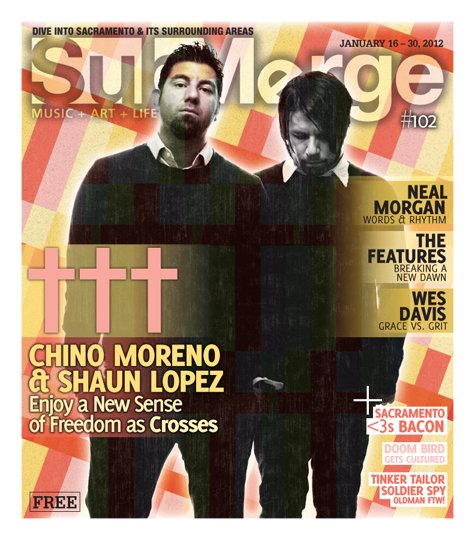
Crosses will play Ace of Spades in Sacramento on Feb. 3, 2012. Also performing will be Secret Empire, Dawn Golden and Rosy Cross. Doors for the all-ages show will open at 7 p.m., and tickets can be purchased through Aceofspadessac.com
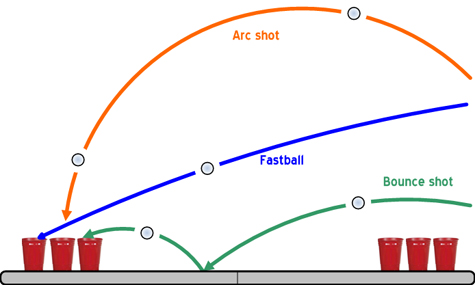
Think you’re hot stuff when it comes to beer pong? If so, get your crew together and head to Stoney Inn (1320 Del Paso Boulevard, Sacramento) on any Wednesday night to put your money where your mouth is. Unless, that is, your crew is comprised of all ladies, because female teams play free! Nor Cal Beer Pong (Norcalbpong.com) puts on this fun and rowdy weekly double elimination tournament, which features official World Series of Beer Pong rules and equipment. There are cheap drink specials all night, line dancing lessons, DJs–all the making for a memorable night, that is, if you don’t black out. For more information, visit Stoneyinn.com.
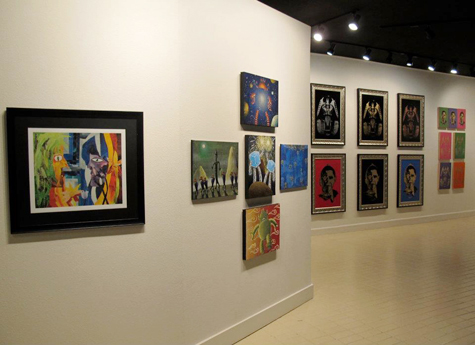
The current exhibit at MAIYA Gallery, located at 2220 J Street, Suite 1 in Sacramento, is definitely one to stop by and take a look at. Duality, which will be up until Jan. 28, is a group show including works by artists C!nder and Mark Harm Niemeyer, illustrated photographs from Brian Collett, small works of art from Bud Gordon and Maureen Hood and Xist’s King Vader series. MAIYA is an acronym for “My Art Is Your Art.” That’s a perfect description of the vibe at MAIYA; owner Kelly Truscott is perhaps one of the nicest, most welcoming individuals Submerge has met in the local arts scene. Stop in Wednesday through Sunday from 11 a.m. to 7 p.m. or by appointment to check out the work and to meet Truscott herself. Visit Maiyagallery.com or call (916) 476-3964 for more information.
Our good friend and occasional Submerge contributor Anthony Giannotti recently celebrated his third anniversary for Anthony’s Barber Shop, located at 2408 21st Street in Sacramento. Full disclosure: Giannotti and I hang out all the time and drink tons of booze and stuff, but nonetheless, congratulations are in order. Anthony’s shop may be my favorite place to hang out besides my own couch in my own home. There are interesting people coming in and out all the time (Broadway is close), and there’s always just a bunch of dudes talking shit about random stuff, but in a clean, you-can-bring-your-kids-in-here sort of way. Here’s to many more years of success! For more information, visit Sacramentobarbershop.com
Zebulon hopes to wipe those mean mugs off your faces
Finding the perfect band name is no easy task. Musicians spend hours arguing over which words best describe them or whether their title should have a “the” in the front of their name. People can even head to Ratemyband.co and have the computer come up with random, witty band names such as “Step-Mother Trip” or “Cheddar Landslide.” But with local electronic hip-hop duo Zebulon, deciding a name came easy. “It’s actually my name. It’s my birth given name. A lot of people don’t believe that at first,” said Zebulon Griffin.
Originally from Atlanta, the hip-hop musician and drumming instructor moved to Sacramento at age 15. Since then he has experienced the differences in the music scenes between the two locations. One of his favorite hip-hop shows was in Atlanta watching Little Brother play a venue that was packed with energy and people. He finds it hard to find local full-energy concerts in California that remind him of his hometown.
“Everybody in California is just sitting there with the mean mug and back against the wall,” he said. “I don’t go to a show to judge everyone else there. I want to go have fun.”
But with his hip-hop duo, Zebulon and Brian Fleshman might be able to transform those “mean mugs” to inspired ones with their new tracks. Formerly from the group SouLifted, the duo is ready to share their new EP, Future Flash. Its six tracks will get your head nodding with their catchy beats and thoughtful lyrics. Although they have been together since 2006, Zebulon has only released music this year.
“That’s a really big step to just being able to get it out there,” Zebulon said. “That’s probably our biggest accomplishment right now.”
Submerge met up with Zebulon outside of Peet’s Coffee to chat about hip-hop, live shows and the upcoming New Year.
Describe the transition from the group SouLifted to Zebulon.
It was pretty seamless. SouLifted has more of a reggae twist to it but the music that Brian and I were writing only had certain hints of that, most of it was more electronic and hip-hop mixed together.
What do you think of the Sacramento hip-hop scene?
I’m digging what I’m hearing so far. There’s a lot of talent here versus if you go to a bigger city, it’s a little more watered down. For being a smaller city there is a lot of condensed talent in one area.
What is your music writing process?
It comes in waves. There are dry spells where I sit down and I try to force it out, I try to abandon that pretty quickly. There are times when it just comes out. Most of our tracks come together in hours and we revisit them later, when we start to find the project coming together. Most of the songs come together really quickly, so it just happens in spurts.
What is the best part about performing a live show?
The energy, even if you have to work for it or it’s just there in the smallest form. That’s truly inspiring to get people amped up into what you are doing… One guy, he was probably in his sixties, he came up to me after the show and was all about it. A lot of older people kind of look over the fact that it’s hip-hop altogether [and say], “I like your singing.”
Has social media helped your music at all?
I’m not as consistent as I could be. I go through waves of being on it, and there are times when I kind of neglect it. I’m not on Twitter yet. I always stay at least two steps behind the curve as far as social media goes. I didn’t get on MySpace until everyone was talking about Facebook.
Describe your new EP, Future Flash.
Lyrically it’s a lot of storytelling and musically we touched a little bit on all of our favorite types of sounds and genres. It has a little bit of old material that we twisted in a new way. There are a few new tracks that we are really stoked on. Back in July or August we started those sessions and then we wrapped it up in October, so pretty swift. We work pretty quick if the inspiration strikes.
What has been your favorite thing about this year?
Putting out [our] record and physically distributing it. I’ve wanted to do that. I’ve released stuff independently. We have gone that route before, so this is the first time we’ve actually printed it up through a company and we have it online now.
Do you have any New Year’s resolutions?
Continue forward with music. Hopefully achieve the goals that we’ve set as far as trying to get the tour going and the new record out. Build momentum.
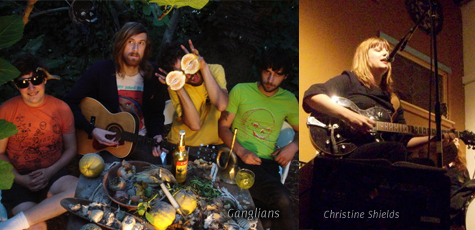
2011 was a very successful year for the fine folks over at Verge Center for the Arts, located at 625 S Street in downtown Sacramento. To celebrate reaching a recent Kickstarter goal of $7,500, which is surely no small feat, especially considering the amount of online fundraising campaigns Submerge has seen go by the wayside, VCA is throwing a “Verge Ahead” success party on Saturday, Jan. 21 at 6 p.m. Catch live tunes from local favorites Ganglians, Fine Steps, MOM, Gentleman Surfer, Christine Shields, DJ Scott Soriano and DJ Hailey. Check out a huge art installation from artist collective Future Art Notables called Assorted Spaces, play around on a mini-golf exhibit created by VCA artists, drink delicious brew from local beer maker Ruhstaller or a fresh cup of joe from Insight Coffee. The event is for all ages and open to the public. A $15 cover charge includes two drink tickets. If you donated $25 or more to Verge’s Kickstarter campaign, you’ll be on the will call list. For more information check out Vergeart.com