Exquisite Corps, Der Spazm
Thursday, June 3, 2010 – Old Ironsides – Sacramento
Words by Joseph Atkins – Photos by Amy Scott
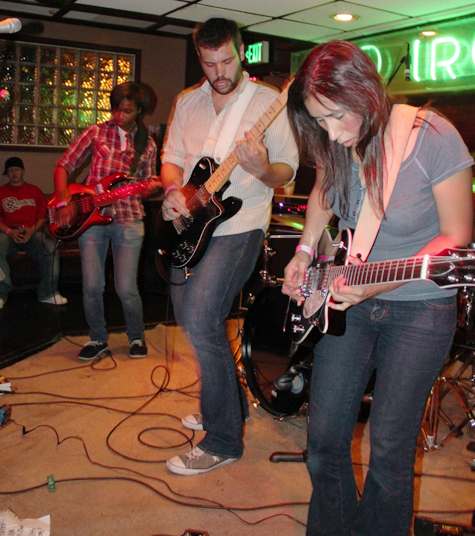
Der Spazm
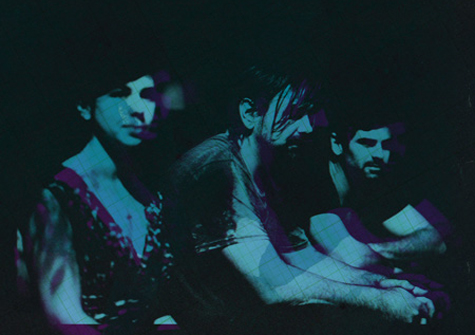
In Der Spazm, Ashley provides bass and vocals, and Leticia provides the majority of the lead fretwork and floating octave accompaniment. Their songs are a patchwork of arpeggiated licks that float across the rhythm guitar and lyric lines of a young and lightly bearded frontman, Dillon. Bouncy and jittery, their tunes enable easy allusion to multiple post-punk groups. But rather than leave Der Spazm floundering at the feet of their mentors, we want to place them in our own time. The lyrics of one chorus in particular say, “Love is born in the heart of a/Revolution,” calling attention to our constant, varied antagonisms. The shout-climax of the word “revolution” is emphasized by both Dillon and Ashley (who wrote the lyrics).
The song was composed in response to the events preceding Prop 8, which officially legalized inequality, and we should note what has occurred since 2008. On a cultural basis we’re witnessing the erosion of personal liberties. A partial list goes something like this: Prop 8, California student protests and arrests, Arizona Immigration Act, BP oil spill censorship, culminating with the Israeli raid of a flotilla protest last week when a teenage U.S. citizen was shot through the head. Individually these events corrupt the universal ideas of say, “Life, liberty, and the pursuit of happiness,” and Der Spazm places love as an opposing force. Love is the thing growing, inside of the heart outwards, into the greater body at large, circulating through the body politic (“man,” that political animal), which realizes itself as revolution. Revolution isn’t necessarily the purpose; it’s a unified response to a militarized state opposition. While we’re not here to put politics into the jittery joyous melodies of Der Spazm, we are here to place Der Spazm’s spastic tensions within the politics of the world at large–the place where we all indefinitely exist. A place and time where Der Spazm is both pleasure and opposition in a direct, interconnected act.
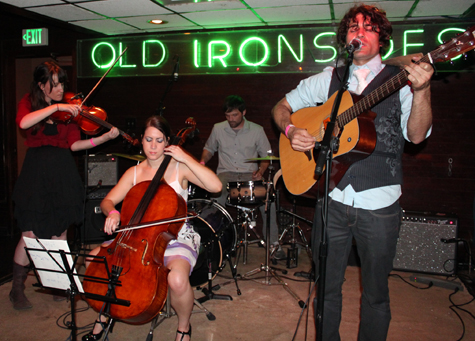
Exquisite Corps
To contrast the sounds of Der Spazm, Exquisite Corps placated the audience with the lulling movement of bows over a violin and cello combination. Krystyna Ogella primarily lays out the bass lines on cello, while Holly Harrison supplements vocal harmonies and provides lead melodies throughout the songs. Patrick Boylan keeps time on drums, rumbling the songs forward with a series of bass drum-floor tom rhythms, while Bryan Valenzuela provides the vocals and acoustic chord structures filling out the canvas of sound. The vocal melodies come out from the deep cavern of Valenzuela’s mouth, an arid timbre ricocheting out of his subtly parted lips, before rising into the higher registers. The songs are dominated by a sort of narrative lyric flow, a series of events set in chronological order accumulating tension until the choral release. Valenzuela’s shaggy curly hair throws shadows over his closed eyes as he grimaces and sneers his soft discomfort into the mic. The group achieves something slightly lighter than Murder By Death, though they share that sort of folk macabre on occasion. As a name for a young band playing its third show and already headlining, they make an interesting statement.
The surrealists developed the exquisite corpse exercise where each member draws something then covers it up so another can add to it without any conscious connection. Musically the group doesn’t recreate that spontaneity, instead the pun on the corpse as body into the sort of militarized corps, or group, as Valenzuela says, “Like the Marine Corps.” Forcing us backward through the garbage pile of history, the inter-war period of Europe, and landing in our time harmoniously disjunctive at that great venue Old Ironsides, established just after the surrealists themselves, 1934.
Lee Bannon and Chuuwee look to make a mark among local hip-hop connoisseurs
With the recent death of legendary MC Guru of Gang Starr, nostalgia is running strong in hip-hop for the golden era sound. Gang Starr’s simplistic formula of Guru lending his commanding voice only to DJ Premier’s gritty boom bap production was a staple of an era that would be followed by meandering albums with a gang of producers tugging the sound in all directions.
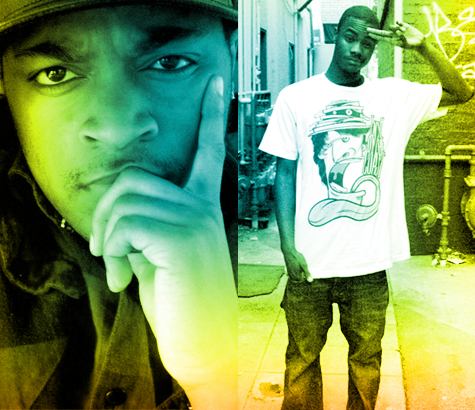
So it goes, with every death there is a birth. Local rapper Chuuwee wasn’t born yesterday, but he was barely an infant when Gang Starr’s Step Into the Arena first hit the streets. Out to get a rep, Chuuwee is only 19, but his mind is old. Case in point: I never expected the first influence he mentioned to be Big L, another late great-just like I never expected Chuuwee to be underage when I inadvertently invited him to meet me at a pub. “Am I allowed in here?” he asked sheepishly, but I shrugged it off and guided the kid to the beer garden-he looks old enough.
On “6 Feet Deep,” a track Chuuwee played for me, he harks back to the Nas lyric, “I keep falling, but never falling 6 feet deep,” like he grew up on Illmatic. With the right influences in place, Chuuwee just needed his Premier, his Large Professor, hell, even his DJ Jazzy Jeff, to provide the proper backdrop to his voice. He found his complement in Lee Bannon, who is three years his elder. “There’s been duos throughout time and usually the producer is older,” Bannon said. “I look at it like we’re part of that tradition-the classic way of doing it.”
Bannon is neither a household name, nor a certified buzz name on the streets or blogs. Such credentials are inconsequential since it’s only a matter of time until the honors are added to his résumé. Bannon has lent his sound to Inspectah Deck of the Wu-Tang Clan, Talib Kweli, the Bay Area’s The Jacka and Los Angeles’ U-N-I. He has also produced numerous solo instrumental records. Like most producers, his sound can carry further than the name. Too often we appreciate the voice, but neglect to look to the maestro assisting the voice. As we continued to listen to music, Bannon would name drop producers like DJ Muggs and Madlib as styles he aimed to mimic.
Typically, when a producer does this, I nod politely, but consider the comparisons a stretch. But, as Bannon played beats to an upcoming project, it actually had DJ Muggs qualities, like an off-kilter bounce and the sharp chop of cacophonic samples.
The two met by chance at a local beat battle. Bannon took the initiative, reaching out to Chuuwee before the battle and giving him a beat to perform over. Initially, Chuuwee wanted a single beat from Bannon, but Bannon challenged the young pup to write a record. “I got a call from him unexpectedly,” Chuuwee said. “We started kicking it at a homegirl’s house and he got inspired by a pizza box. It all started falling into place from there.” Titled Hot ‘n’ Ready, the collaborative album has taken a wildly creative turn with a unique limited run in packaging. Forty pizza boxes filled with T-shirts designed by 12ftdwende, stickers and the CD will be available at urban boutiques like Havoc and United State, as well as other Midtown/downtown locations. “It will be a scavenger hunt-type thing,” he said. “If you seriously want the project in the collector’s box, you have to search for it. It’s a really cool idea. I ain’t never had nothing like that before, so I’m pretty excited about it.”
Bannon’s creative marketing strategy, matched with Chuuwee’s infatuation with concocting well thought out projects (a sensitivity sparked by his Obsessive Compulsive Disorder), make Hot ‘n’ Ready a unique project. The marketability of CDs is a dying art with the shift to digital formats. Bannon intends to intrigue new and old fans alike by presenting his music as a collector’s item before it’s even out of print and up for high-dollar auctions. “I’m trying to push the envelope with every project I go into concept-wise,” he said.
The pizza theme is not limited to the packaging, as Chuuwee said the concept loosely runs through the album, as evidenced by the closing track, “Last Slice.” “I wrote it in three-and-a-half weeks,” he said. “I don’t want it to seem like I rushed it. I’ve got extreme OCD, so my projects are always overly thought out. I only wrote it fast because [Bannon’s] beats were so inspiring. It just flows out.”
Chuuwee said he’s been stuck in the ‘90s since he started rapping. For the project, he requested that Bannon cater the beats to that style. “I’ve heard his first mixtape and it had a huge range,” Bannon said. “He did stuff over Neptunes, Dr. Dre and Common beats. It was a big spectrum of taste, so I knew I couldn’t make it all ‘90s boom bap, but a lot of it is that style.”
Bannon is more than a producer when it comes to conducting his business. A PR team is hardly necessary. His inspired approach with Chuuwee is just one of many projects with intricately thought out publicity plans. He is in talks of possibly having unplugged Chuuwee sets at local pizza parlors-although it’s a mystery as to how hip-hop can go unplugged. “What’s the biggest thing you’ve seen come out of Sacramento in the last five years?” Bannon asked, to which I could only reply Brother Lynch Hung. “It’s been a minute, and I think we can get into the masses like that. With his talent and my resources, I’m hoping to duplicate the past success I’ve had except through his words, instead of just my production.”
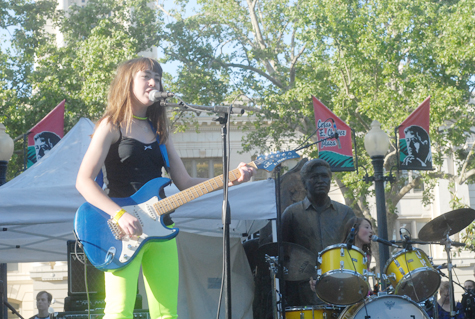
Dog Party
Concerts in the Park
Friday, May 7, 2010 – Cesar Chavez Park – Sacramento
Words & Photos by Vincent Girimonte
Two things to take away from last Friday’s edition of Concerts in the Park: one, Sacramento has some exceedingly hip youth; so hip, in fact, that I felt like a tool toting just one lens with my Nikon. Seriously though, I saw way too many kids with thousands of dollars-worth of camera gear dangling from their thin little necks. And second, make sure to buy a beer ticket before you get into the beer line–just a friendly reminder I wish someone would have given me.
Full disclosure: this was my first CIP, and for all my faux curmudgoenliness (I still get carded, for everything) it was a genuinely unique and jovial Sacramento on display in Cesar Chavez Park. Young professionals rejoiced in public consumption as kids pranced around and people were wearing balloons as hats, which would be ridiculous if it weren’t a Friday signaling the beginning of our glorious summer.

Dotting the park were food carts of all shapes and specialties, reminding Sacramentans of a culture largely prohibited to them and satiating drunks and kids alike with fatty eats such as lumpia, rice bowls, Cajun crawfish and the night’s hot seller, tamales for $1.75. About the crawfish: “They’re back” announced promoter Jerry Perry from the stage, gleefully, but at $10 a basket, I was left to lick shells off the lawn. There was plenty of affordable grub to be had, though, and $4 domestics shouldn’t elicit too much whining from anyone, though it inevitably will.
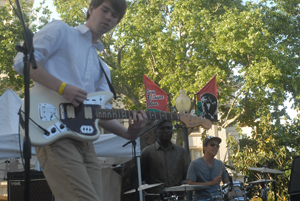
Simpl3Jack
2010’s first Concerts in the Park, now in its 18th year, was mostly about Perry and his talented lineup of youngsters, including Simpl3Jack and Dog Party of
Sacramento News & Review Jammies fame and The Kelps. The show was headlined by the sugar-spiked Kepi Ghoulie, the biggest kids of them all, who played a lengthy set of punk nostalgia piped over zany PG lyrics.
If you don’t know Dog Party, you’re likely so thoroughly out of it, you probably didn’t even know they’re just a couple of adolescent girls with a penchant for neon. Gwen “Don’t call me Meg” Giles beat drums behind her sister Lucy, who strummed her Fender, playing original tracks off their debut album and then rocking a cover of Tegan and Sara’s “Walking With a Ghost.” Two men wrestled for a T-shirt after Dog Party threw out one of their sweet XL tees–such is the zeal of their following, or perhaps the state of things these days.
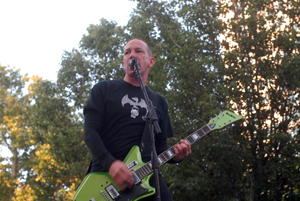
Kepi
Part Pauly Shore, part Flea in the vein of Yo Gabba Gabba, Kepi shut things down with tunes about supermodels (gross!), chupacabras (ew, yuck!) and rabid monkeys (whaaa?!). He called on the beer garden for a sing-a-long, and they reciprocated like good sports without a worry on Friday night. “Man,” he said, clearly appreciative. “We got a pretty good town.”
Chelsea Wolfe’s The Grime and the Glow dresses folk music in a black cloak
Ravens perched on bare branches, snow falling on tombstones, wooden shutters clattering against cloudy window panes in a strong gale–these are just some of the visuals The Grime and the Glow, the latest fulllength album from Sacramento songwriter Chelsea Wolfe, may conjure in the imagination of the listener. Songs such as “Cousins of the Antichrist,” on which Wolfe intones “All in vain” in a steady refrain as the song ends, reinforce descriptions of her music as dark or goth folk. Wolfe herself describes another selection from the album, “Halfsleeper,” as “a slow-motion painting of what it’s like to die in a car accident with your loved one.” Wolfe, however, admits that The Grime and the Glow isn’t necessarily all doom and gloom–not that she’d mind if it were. She says that songs “Advice & Vices” and “The Whys” are more playful lyrically than she’d normally write. Wolfe describes the latter as “a song making fun of myself for taking everything so seriously.” But these concessions aren’t in hopes of lightening the album’s dark mood.
“I don’t mind it getting too dire,” Wolfe says in a recent interview with Submerge.
From the album cover, to the videos made for the songs, to the music itself, The Grime and the Glow seems born from a single cohesive vision. Wolfe says that the theme for the album came to her once its title was in place. She says the title is taken from the introduction to the novel Death on the Installment Plan, by French author Louis-Ferdinand Celine. The darkly humorous novel had quite an effect on Wolfe, even though she wasn’t able to finish it.
“I…read most of [it], but had to stop because of the dark place it puts my head space,” she explains. “I didn’t really need to dig any deeper into understanding that much of the beauty in the world is crawling with worms beneath the surface.”
To get the dark and distant sound that permeates the album, Wolfe took a much more stripped down approach compared to that of her previous release, Soundtrack VHS/Gold. For that album, Wolfe says she went into a nice studio in order to create a “tapenoise- sounding” album, but she “eventually realized how illogical that was.”
“It’s a very different album,” Wolfe says of her previous effort. “I wanted to get an eight-track sounding record in a nice studio. Didn’t make any sense, but we did mix it down to tape.”
Wolfe says she wasn’t unhappy with the results, but instead with the lengthy recording process leading up to the release of Soundtrack VHS/Gold, which was released in an extremely limited run of about 50 CDs on Chicago-based indie label Jeune Été Records.
This time, Wolfe took a more “logical” approach to making an eight-track sounding album by using an actual eight-track machine. The Grime and the Glow was recorded by Wolfe on a Tascam 488, a handme- down from her musician father, that she says she’s recorded on for years. Wolfe says that doing the album herself, on a familiar machine, “made it sound exactly the strange and special fucked up way I wanted it to sound.”
Strange and fucked up are excellent adjectives for The Grime and the Glow. Though the mood is consistently dark, songs range from the wildly dissonant “Deep Talks,” which grates Wolfe’s bittersweet voice through layers of noise, to the aforementioned “Advice & Vices,” a catchy piece of dark pop that’s as tuneful as it is morose–and she sure doesn’t skimp on the reverb.
“I also like clean, straightforward vocals sometimes and will experiment with that someday,” Wolfe says, “But for these songs I wanted to capture my voice or the instruments, whatever, inside a certain soundbox, so when you have your headphones on listening to it you feel like you’re in a tiny, claustrophobic echoroom or a parking garage cathedral.”
Adding to the eerie, almost antique sound of the songs is the album’s format. The Grime and the Glow will be released some time in June–pushed back from the original May 18 release date–on limited edition vinyl by New York-based label Pendu Sound. Wolfe says that it was the label’s decision to release the album on vinyl, but it’s a decision she’s happy with.
“I don’t think this album would work as solely a CD release,” Wolfe says.
In addition to the music, Wolfe has also been busy working on visual companions to the songs. The Pendu Sound Web site for The Grime and the Glow features a series of four videos created for “Advice & Vices,” “Moses,” “The Whys” (featuring camera work by local horror filmmaker Jason Rudy) and “Bounce House Demons.” The videos for “Moses” and “Bounce House Demons” star Wolfe’s friend, writer Jessalyn Wakefield, whom Wolfe calls, “a perfect visual muse.” At the time of our interview, Wolfe also mentioned that she was working on a video for the song “Widow,” which will feature a “goth-glam girl lip-synching the song in a dark studio.”
“I like the element of darkness mixed with a bit of silliness,” she says.
This mix of music and film comes as no surprise as Wolfe states that movies had a big influence on her in the making of The Grime and the Glow.
“The Seventh Seal is my long-time favorite film,” says Wolfe, who also listed David Lynch’s Eraserhead and Jean Rollin’s French vampire movies as sources for inspiration. “The character of death in that film has forever been an influence in my creative life. Ingmar Bergman in general is a big inspiration for me. The portrayal of life in his films is so honest and desolate but rich at the same time. Another favorite is The American Astronaut (Cory McAbee), a dark space-western with hand-painted special effects and a pretty low budget that manages to get such a defined feel across, haunting but still silly, like so much of the folk art I love.”
In fact, Wolfe finds inspiration from most forms of art–but not so much with other music.
“Throughout my life and for this album I’ve been very inspired by authors, poets, painters and filmmakers, more so I’d say than any band or musician,” she explains. “In fact, for many years I wouldn’t allow myself to listen to music because I didn’t want to infuse anyone else’s sound into my own–I wanted to see what would happen without that influence.”
The Grime and the Glow is a solo project, but it was still a collaborative effort. Andrew Henderson of G.Green, Ian Bone from Darling Chemicalia and Ruven Reveles all made appearances on the album. Kevin Dockter, Drew Walker and Addison Quarles (collectively known as The Death) and Ben C. also played parts and have come together to form Wolfe’s band. Wolfe, Dockter, Walker, Quarles and C. will be heading into a proper studio in June to record a fivesong EP. Wolfe says her past experience working on Soundtrack VHS/Gold will inform her decisions on her upcoming trip to the studio.
“I’m much more focused, and I’m also giving this recording a deadline,” she says. “I’m going to try and finish up five songs in about a week and a half, which will mean lots of late nights and hard focus. This project will also be with my band mates–all five of the songs will have the same five people on them, which is a first for me. But I’m very excited about the challenge of finishing something on a fixed time limit.”
Until then, The Grime and the Glow should sate those with appetites for dark music, as long as they don’t mind the worms.

The Grime and the Glow is available for preorder through the Pendu Sound Web site. Go to pendusound.com/releases/psr-0040/. Those who pre-order the album will receive four free bonus songs for download.
Artist Robert Bowen returns to Sacramento for group show
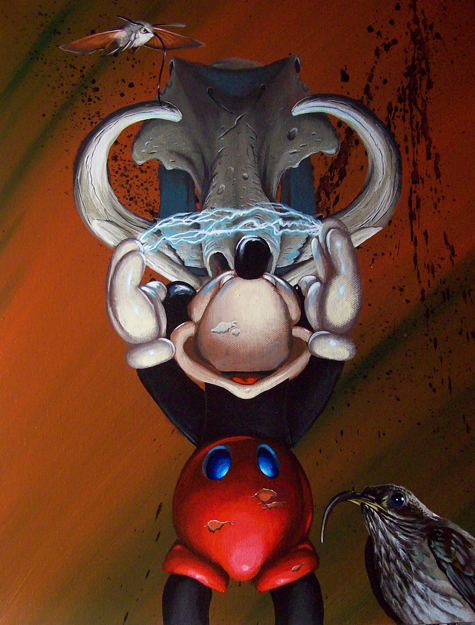
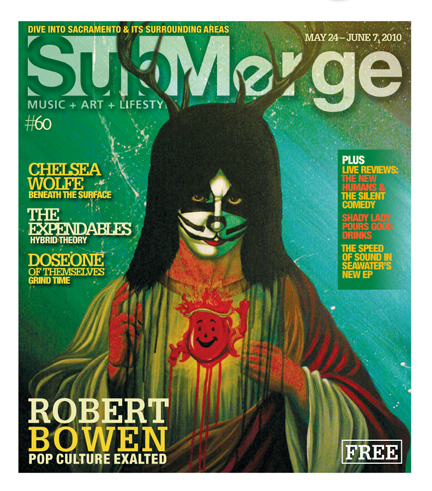
A collection of exotic colored butterflies and beetles mounted in simple black frames hangs on the studio walls of San Francisco based artist Robert Bowen. Scattered around the room are various other oddities: animal skulls and mounted antlers, curious antiques and Disney collectibles. The latter might not seem so odd in comparison to the others, but in Bowen’s paintings he reveals to us exactly how he feels about Mickey and friends. One in particular shows Mickey Mouse standing at the center of the composition, his cartoon white hands rise into the air and violent electricity passes between his eight fingers. His head is cocked up, revealing his iconic grin that now seems sinister. Behind him is an enormous elephant skull; the tusks curling and mimicking Mickey’s shocking arch.
Although it all seems dark and sick at first glance, it’s hard not to ponder his sense of humor in all of this. Who paints Mario Lanza next to a giant banana that peels to reveal octopus tentacles? Or, Peter Criss of KISS appearing as Jesus with two giant kittens resting innocently in the foreground? It’s completely twisted but in a way that you can feel alright about being totally invested in it. A painting like St. Elmo’s Fire shows Bowen’s hilarious generational approach to subject matter. The lovable Sesame Street character Elmo is pictured as a biblical saint breathing fire as a white dove flies overhead.
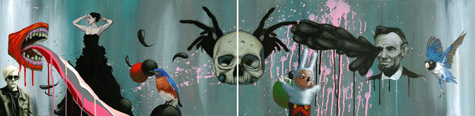
“It’s what I thought was a pretty silly joke and then it turns out to be a painting I’m kind of proud of,” says Bowen.
Bowen himself isn’t the only one impressed with his paintings. Recently, Juxtapoz magazine said that Bowen “is overdue to blow up in the art world.” Even genre superstars like Alex Pardee (whom Bowen has collaborated with) have chimed in on his skills with a paintbrush.
Juxtapoz is arguably one of the high ranking authorities on pop surrealism (lowbrow if you can get away with it, new contemporary if you’re selling to the big wigs) and a glance through the monthly publication will surely point you in the direction of who and what is making waves in the scene. And though Bowen has had his time to shine, many artists who have done so similarly are no longer new and interesting and have simply become a drop in that ocean past the breakers. The key is change and, furthermore, reinvention. Artists like Doze and Twist (the latter who was an important influence for Bowen) have continued to reinvent themselves along the way and have thus staked a future claim for themselves in an oversaturated genre. Bowen is on track to do just that. He has continued to evolve by incorporating stencil, mixed media and sculpture into his shows and isn’t stopping there.
“I want to have bronze works of some of the elements in my paintings,” says Bowen. “Some of the figures and whimsical characters would make really cool bronze sculptures. It’s always in the back of my mind.”
For Bowen, bronzing harks back to his art school days, when he learned quickly that the painting program wasn’t for him. With his introversion toward other students and an overbearing faculty, Bowen eventually “gave up on having art school teach” him how to paint. Since he was already enrolled, Bowen made the switch to a major in sculpture, hoping to have better luck with his formal art education.
A glance at Bowen’s own art history leaves me wondering why he chose to attend art school in the first place. Graffiti was Bowen’s first love and on the walls is where he learned to paint and where he studied color theory and composition. When Bowen was a kid, art programs were being cut (sound familiar?) and there weren’t many outlets for creative expression.
“When we were all growing up, public schools were falling by the wayside,” recalls Bowen. “It’s sad that kids have to resort to doing something that’s considered illegal to get an artistic background.”
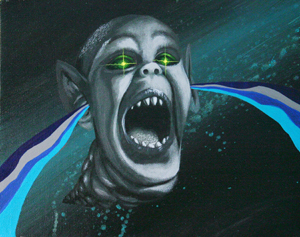
The graffiti influence is seen in Bowen’s paintings in a way that lends itself to his stylistic approach. The bright, bold colors of spray paint translate to acrylic selections on the canvas and what we see is beautifully rendered characters and natural world specimens mixed with lifelike portraits of pop icons like Schwarzenegger in Conan the Barbarian or Batboy from the pages of Weekly World News. What I like about Bowen is that he’s a sort of keeper of all things cool in pop culture. He paints them to mock them, yes, but he also paints to preserve them. The images from his childhood are sacred inside his own mind, and we’re offered an exclusive glance at what he chooses to unearth via these portraits. He’s not embarrassed about being a self-proclaimed pop culture geek, and he’s quick to defend his favorite relics. A recent Twitter post from Bowen reads, “Dear Hollywood, PLEASE stop ruining everything that was cool about my youth one shitty movie at a time. It’s getting really sad…”
It wouldn’t be fair to pigeonhole Bowen by only shining a spotlight on his horror-like characters or his pop culture icons, though. The Audubon Society is a peak interest for Bowen, and we see that abundantly in his paintings. Out of the 51 images in his online gallery, nearly a quarter of them feature some sort of bird or bird-like element. And it doesn’t end there. Sloth, ferrets, tarantulas, bees, what appears to be Bowen’s dog and even Bowen himself make regular appearances in his work. Those curious collections that decorate his studio are fodder for his creativity, and he has no problem locking himself away and painting whatever sparks his interest.
“I’m kind of a hermit and I stay home,” says Bowen. “I’m totally fine just sitting in here and painting.”
You’d think living in San Francisco would prove to be a distraction. I know many creative minds that have lost their way in a city that has way too much to do all time. But Bowen maintains his focus, and maybe he learned a thing or two by living in a city with a slower pace. Bowen lived in Sacramento for about seven years before he made the move back to the Bay Area where he grew up. While living in Sacramento, he crafted his painting style alongside talented locals like John Stuart Berger, Kim Scott and Skinner. The late and sorely missed Toyroom Gallery was an important meeting spot for all these artists and Bowen showed there often.
“They always wanted to put us in shows,” remembers Bowen. “I showed a lot with Alex Pardee and Poor Al.”
After the Toyroom closed, many of the artists who showed there frequently continued to produce art but all went off in their own directions. There were scattered galleries here and there that offered shows that were similar, but none offered the kind of regular support and progression that Toyroom did.
“They had a good eye at the time, and they brought to the town what was needed and what wasn’t there. It’s a shame that it didn’t last very long because I think it’s still needed,” says Bowen.
Even though Bowen is “the one that got away,” he still has a special place in his heart for Sacramento. He’ll return June 12 like a prodigal son for the opening reception of Beyond the Frame at the Solomon Dubnick Gallery. Also on board for the exhibit are John Stuart Berger, Kim Scott, Gale Hart, Joshua Silveira and many others. Come see for yourself what makes a Robert Bowen show so hard to look away from.
Dusty Brown Rides the Buzz of This City Is Killing Me Toward a New Album
Stolen gear, finicky crowds at shows and an anxiety toward giving his music to anyone he doesn’t call “friend” are just a few of the reasons Dusty Brown feels like this city is killing him. If the local scene is the cause of his suffering, why can’t Dusty Brown abandon Sacramento?
His insularity could be his greatest downfall, but in that apprehension to be seen or be the scene, he’s surrounded himself with friends within music who will gladly step in to exalt his art. After turning over a little five-song EP to his friend and electronic-colleague Scott “Tycho” Hansen, Dusty Brown was uncertain of his friend’s intentions. Hansen’s artistic talents stretch beyond his propensity for finely crafted down tempo IDM. Hansen fashioned the This City Is Killing Me with artwork based on photos by Raoul Ortega and put it on his ISO50 blog for free download.
Hansen was not bashful in introducing Brown to his fan base, as the post was accompanied by a three-paragraph salute to Brown. Hansen wrote, “I’ve learned more about music from Dusty than anyone else; his production style and methods are truly awe inspiring.”
Brown’s career arc illuminates the thought process behind naming a collection of songs This City Is Killing Me. After the dissolution of the electronica scene, Dusty’s band, consisting of his sister Jessica and cousin Zac, had its live equipment stolen in 2007. To recoup the losses, the band put out its Hope You’re Happy LP. “It succeeded in getting my money back to the dot,” he said. “I put a post out thanking everyone and the sales literally dropped flat, which was…great.” Since that record, the group limited itself to the studio and the occasional gig at The Press Club or The Hub.
Brown spoke as though he’s a man out of his proper time. He married at 18 years of age and now has four children with one more on the way. Brown said he understood the music business some in the ‘90s–the tour and make connections plan–but as a family man with hermetic impulses, he never thought that giving his music out for free would put a buzz into the band again. “Twenty-five hundred people downloaded it within three days, when before I was lucky to get one or two people to hit my Web site in that time,” he said.
With one stamp of approval blog post from Tycho, the band Dusty Brown went from strictly known in Northern California to receiving coverage from national music Web sites like XLR8R, Pitchfork Media and Yourstru.ly.
“It was a pretty incredible feeling that week,” Brown said. “Coming from a Sacramento guy, who nobody literally knows who we are outside of Sacramento, to have people donate from the Dominican Republic is crazy. The fact that it reached so many people so quickly, shows the old model of touring for months for people to hear your music is completely gone.”
The instant gratification benefited Dusty’s creativity, as he’s eager to finish a new full-length that’s nearly completed. And with the couple-hundred donated by downloaders of the EP, he’s toying with the idea of pressing This City Is Killing Me on vinyl.
Dusty Brown might be riding a high wave this month, but he’s grounded enough to recognize he still lives in Sacramento, a city that from his perspective is still trying to kill him. He played a capacity night with Tycho at the first annual Sacramento Electronica Music Festival in January, only to play again a week later to three people. “This month the NBA Finals will be the reason no one comes out,” he said. “But, I’ll end up playing for a random hippie that doesn’t care about sports.”
He went on to say, “I feel like there’s a superficial love for live music [here]. The minute you feel like it’s authentic you realize it’s not.”
It’s those one-off nights of capacity crowds, that lone hippie appreciator and the seclusion of Sacramento, where his family lives, that keeps Dusty Brown among us. He said that for all the depressive tones his music can take, he often describes it as “melancholy electronica.” “I’m not a very emotional person, so when it comes to music I kind of let it go a little bit,” Brown said. “I’m sad, then I’m pretty happy about the fact that I got over I was sad.”
This City Is Killing Me is Dusty’s passive aggressive bout with the naysayers that have hurt his feelings. But it’s when his sister Jessica takes cues from his sounds and applies them to her experiences that the Dusty Brown music finds its plateaus of euphoria. “I wouldn’t say we’re completely connected, but I think she listens to the frustrations I have,” he said.
At five songs the EP is concise, overlapping tones and instrumentation; but for every brooding moment, the band releases the tension with bursting chorus lines on “How’s That” or the glimmers of hope in the refrain of “Back to Back” as Jessica sings, “As we remember the light in our dark past.”
With the small window of hype surrounding This City Is Killing Me, Dusty said he’s ready to push ahead with the mountain of music he’s been keeping in the vaults. Dusty once employed a writing method in which he wrote three to four new songs for every live set, instilling a prolific work ethic. My phone call interrupted a recording session with Steve Borth of CHLLNGR, who uses Dusty’s home studio whenever he’s in town. In his three years of recording silence, Dusty produced a hefty chunk of the upcoming Who Cares record and prepared several EPs with Jacob Golden under the group moniker Little Foxes. “That EP was just a precursor to a full-length album,” he said. “I’ve got mass amounts of music I need to get out before the end of the summer because I’ve got a baby coming.”
Brown framed the buzz around his EP as “not much” in comparison to what most artists receive, shaming himself for strictly showing his music to people he deems “friends.” I jokingly asked if, after this surge of releases, it would be another three years before we hear from Dusty Brown again. He followed up with an anecdote about a night in the studio with Who Cares: “I was playing them some of the music I’d written over the last 10 years. I didn’t realize two hours went by. I wasn’t even halfway done. I’m starting to think I should create another name just to release all this lo-fi drum ‘n’ bass and hip-hop I wrote.”
Why not?
Catch Dusty Brown with Paper Pistols at Capital Garage on Saturday, June 26. Or you’ll be able to see them at their EP Release show Saturday, July 17 at the Townhouse.
Click to download Dusty Brown’s This City Is Killing Me
Golden Bear
2326 K Street, Sacramento
K Street seems like the place to be these spring days in Sacramento. Many shops, ventures, bike routes and bars are found from downtown to the Business 80 on-ramps.
However, most pertinently for our foodie purposes, a plethora of places to eat can be found on this path. As the season has coyly exhibited its sunny splendor, one eatery has emerged from a sort-of hibernation with a patron-pleasing epicurean sensibility.
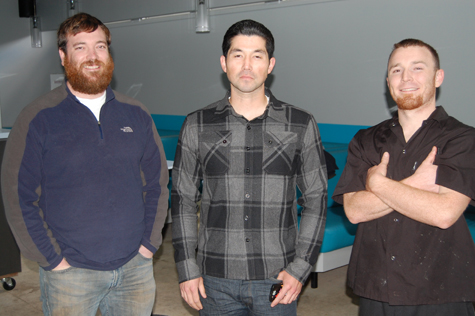
Although the Golden Bear didn’t completely stop selling pints of beer, it reopened in the middle of March with renovations done to its tail end. Owners Jon Modrow and Kimio Bazett kindly took time to chat with Submerge to give us the skinny. The location’s previous owners built an illegal patio addition to this 1840s structure, which ultimately came to be a fire-code violation and renovations were required, Bazett said.
For a bar with an obvious sense of California pride, Bazett and Modrow had a group of UC Davis design students and friends create branding and interior aesthetic. In complete concurrence, the owners jumped on board with the contemporary furniture and bright, inviting color splashes.
They wanted to keep design cohesive throughout their bar, using a “monster money budget” to remodel the indoor back patio.
Cool, custom upholstered booth-ettes are paired with sheen-y tables and accented by hanging cylindrical lights–the likes of the oil lamp’s electric brother. Removable skylights and high-powered fans to suck cigarette smoke out of the patio make the patio an indoor/outdoor hybrid.
The Golden Bear entrepreneurs seem to have no intention of letting any half-assing happen when it comes to food, and brought on a new chef to be the ultimate addition to the “top to bottom” renovations recently revealed.

From L-R: Owners Jon Modrow and Kimio Bazett with Chef Billy Zoellin
A few weeks fresh off a year cooking for the Highcroft Patrón Racing Team, passionate young Billy Zoellin is the new executive chef accomplishing clever culinary feats with his “punk food” and gastro-pub fare, something they all agree “seems to be what Sacramento is missing.”
The Golden Bear has one of the only chefs who shops personally at farmers markets. This act of taking that food and “making it your own” is what Chef Billy considers “punk food.”
Everything is prepared in-house, using local products (within a 100-mile radius) and consciously attempting to keep the bar’s carbon footprint as small as possible, Chef Billy said.
Having a clearer conscience about serving customers, patrons and friends healthier food is a bright point for Bazett, he said.
The kitchen serves filling American lunch classics like burgers (Juicy Lucy Burger), chicken sandwiches, meatball sandwiches, cheese appetizers and a form of fries; however, many options are light, bright, fresh and healthy.
For lunch, complex-yet-uncomplicated salads and vegetables are available. For brunch (Saturday and Sunday 10 a.m. to 3 p.m.), seasonal menus feature veggies, frittatas, a colorful Ahi bagelwich and ripe, sweet fruit.
Being a good little eater, I went with my gastro-instinct, trying the fried cheese curd small plate ($5), Bledsoe pork meatball sandwich ($9.50) and a few “smashed fries.”
Pan-seared and served with a romesco aoli, the melty drops of cheese had just the right amount of cheese crust crunch and creaminess. How can you not love cheese?
I’ve come to truly appreciate pork (thanks to the beau), and the pork flavor of the meatballs in the sandwich successfully tasted true. Seasonings, along with an understated “red sauce” clearly made from fresh tomatoes, accentuated the eight mini ping-pong ball-sized meatballs. Lightly pickled shallots offered a not-too-tangy, nor too-salty, vinegar tinge and complemented the meaty sandwich, topped with slightly pungent provolone cheese. Spongey Bella Bru streak roll worked nicely as an encapsulating bread bed, holding and absorbing sauce and flavors.
A choice of smashed fries or salad accompanies sandwiches. For a buck more, eaters can opt for the red leaf Caesar salad. It’s a rouge version of a Caesar, paying ode to such Tijuana origins by featuring Lola Rosa lettuce, crisp capers, Cotija cheese, toasted pepitas, croutons and a smokey achiote Caesar dressing. Pleasing in flavor and just the right amount of dulled lettuce crunch.
Investigating these “smashed” fries, I found that if a fingerling potato wanted to be like a popcorn kernel, it could. Only the smallest fingerlings are par-boiled then bashed a bit, then fried (the only deep-fried menu item) in soybean oil and lightly spicy seasoned. A house-made ketchup in deep maroon made from ground New Mexico chilies, must-have-been-roasted tomatoes and nice amounts of pepper hold the fries hand while doing the flavor dance in your mouth. So happy they are.
As for dessert? The dudes who call the shots maintain a great relationship with their neighbor, The Dessert Diner, located next door. After asking about the possibility of a donut, Chef Billy said if it ever happened, bacon would be integral.
Local, fresh, well intentioned, “punk” and with a sense of humor, Chef Billy has pizzazz. And his cuisine is so sexy in a realistic way, like the posh “girl next door” of food.
I’m so excited about the playfully salacious future creation of a palate-cleansing house-made gummy bear that the Golden Bear Chef Billy hinted at. I won’t apologize for finding the concept to be rather casually provocative.
I know that burgers have been talked about and talked about in our town; however, I look forward to trying the Lucy burger: Sacramento’s introspective version of the cheese skirt burger, with fontina cheese hidden on the Inside of the Niman Ranch Angus beef patty.

Golden Bear has emerged like a well-intentioned youth does from college–looking the same on the outside, but with internal improvements. With future plans for a front-of-house facelift, The Golden Bear will become an even spiffier looking bar. Featuring a pint of beer and a shot of Jameson as the proclaimed house drink, pours parallel those of everyone’s favorite dive bar, but with the panache of an ultra lounge. Like an ultra high-dive neighborhood lounge where everyone is a VIP, dress code is as you like (with respect) and there’s no cover.
It’s not likely that the Golden Bear will lose its reputation for being a solid spot to sip a drink, but its reputation for offering scrumptious gastro-pub eats will certainly come to precede itself.
HUMP (Apache Cleo, DJ Whores, Jonathan Francis)
The Press Club – Wednesday, March 24, 2010
When I used to hear the word “hump,” two things would come to mind. The first was those annoying dogs you don’t know that always want to mount your leg even though they’re neutered. Annoying. The second was being 13 and getting hot and heavy with my girlfriend Molly’s jean skirt while she was still wearing it. Awkward. Now, thanks to DJ Whores, HUMP conjures up a much happier memory for me. His Wednesday night slot at the Press Club is an oasis in the middle of the workweek.
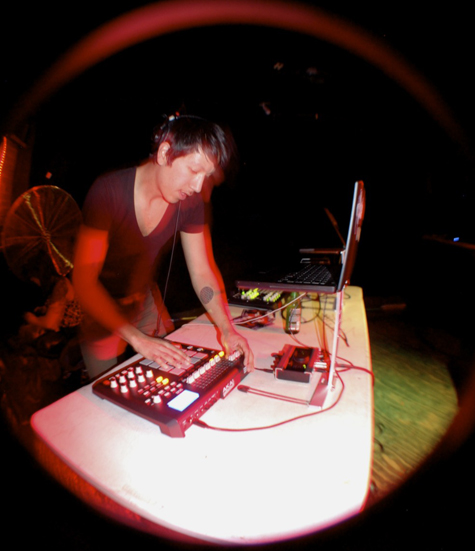
HUMP is a dance music night, for starters. It’s a night for the sweatmakers and the drinkers. DJ Jonathan Francis is towering over his laptop, face lit from the glow of his screen, and he’s busy selecting just the right tech-house and electro tracks. He likes variety, but tonight it’s funky bass lines cut with choppy vocal samples and noisy bridges with lots of cymbals. It’s hard not to move to this. The criticism is that it gets old after a while, but so does your grandma and you still love her. He throws on a Friendly Fires remix, and I’m sold.

DJ Whores steps up to the plate. It’s 11 p.m. and everybody is primed and ready for one of Sacramento’s best selectors. He opens up the sound, choosing big vocal house cuts with chewy bass lines and devastating kick drums. Whores’ track selection is like a binder full of hall of famers. You’re stoked on a Ted Williams and then he hits you with a Mickey Mantle. It’s tough to say that he’s “warming up” Apache Cleo, tonight’s headliners, because Sacramento shows up just to hear this guy spin on a regular basis. Tonight is no different and I hang on his every mix, watching his fader carefully, anticipating the change like a nervous prepubescent.
As per a typical Midtown crowd, the club starts filling up around 11:30 and all the nightowl regulars are starting to show their hoodie-shadowed faces. Whores is in full swing by now and the randoms attracted to the word “Club” on the marquis have filtered in, too. All the right players occupy the dance floor, and all the while the lights are spinning and the drinks are weighing in. The sub is rattling frames and feet are sashaying across the floor like cursors on a Ouija Board, their movements uncontrolled.

The stroke of midnight finds Apache Cleo poised and ready. The duo is an attractive, young couple, with cute matching his-and-her laptops, whose DJ merits are defined by their individual styles that sonically mesh. Usually they perform together, but due to issues with the airport on Cleo’s computer, they are unable to link up and will be performing separately. Apache makes his way up first, preparing for his intro cut. It’s a dark house break, dissident and not the friendliest dance floor groove. Cleo circles him, dancing behind him and snapping photos of his every move. She seems to lighten his mood a bit because the next track he mixes in is a funky, disco banger that changes the atmosphere entirely. This is his way of letting the dance floor know he still cares–but not for long. His next track is just as ominous as his opener. The rest of his set is equally as unpredictable, but still full of gems that separate him from the others. He finishes with a Blondie remix that seems to summon Cleo, who saunters to her laptop. Her opening track is a strange rock anthem that sounds as if Cookie Monster is the singer. Again, her set is scattered yet enjoyable, even though she seems to be suffering from some technical difficulties. By this point, a couple is damn near making babies on the dance floor as a Missy Elliot lyric rings out, “Doing it, and doing it, and doing it well.” That’s my cue. I’m all humped out.
Sacramento MC A.R.A.B. looks to infiltrate bigger markets with The Trojan Horse
Talk with any rapper or MC who’s been hustling in the music business for five or more years and they won’t hesitate to speak on the “salt in the game”—shifty promoters and snake managers trying to swindle for petty pocket money. Sacramento MC A.R.A.B. weathered his fair share of rats, which is why he could not have picked a better acronym (Always Rise Above Bullshit) to summarize the path leading to his new record, The Trojan Horse—even the album title is a proper foreshadowing of things to come.
Along with his crew/company First Dirt Republic, A.R.A.B. is approaching the business with a perspective not often exercised in hip-hop. The sub-genres of hip-hop (backpacker, club, street) rarely mix company, but A.R.A.B. aims to walk among the culture’s various factions, whether it’s the most underground coffee shop show, a neon lit dance floor with caged girls dancing or a high school auditorium—no frills.
He’s seen plenty of the ugly side of the business, and through that gauntlet he’s emerged with a trustworthy manager and publicist, as well as a crew of producers, MCs and various arts performers that he’s able to call family. “We try to keep it close-knit so everybody benefits,” he said. “If you see us together, we’re tight. There’s a core 12 of us that’s only been together officially for three months, but we call each other family.”
Prior to this record, you released several mixtapes; is The Trojan Horse your first official album?
I had one solo project that I put out, then I had two mixtapes following that. I try to stay away from the whole mixtape thing now. I’m just not a big fan of them. I’d rather put my time and energy into something I can put a barcode on. Mixtapes are sloppy and thrown together. I want to spit on my own beats.
Going into The Trojan Horse project, what were some of your goals?
I think every album I’ve done is a reflection of what I’m going through at the time. When I put out For My Culture I had just beat a case, so I had a lot of negativity on my chest. With The Trojan Horse, this is our push as a group. It’s still my music, but it’s [First Dirt Republic‘s] push to get our foot in the door. The idea of a few conquering many is the idea behind it.
With the Greek legend in mind, should Sacramentans fear the idea of a Trojan horse invading their city?
No, our whole purpose is to get out of Sac through the Trojan horse. In promoting this record we’ve gotten shows in Los Angeles, the Bay Area, I’m working on a show in New York. My producer just got back from India and he wants us to do a show out there. My two goals before this project happened were to do a show in New York and overseas. I wrote it down and it’s on my fridge. It just started happening, man. So, I’m a firm believer in writing my goals down and keeping them in mind.
The funny thing is whenever we promote The Trojan Horse it’s either taken as condoms or viruses.
People aren’t privy to the Greek legend behind it?
Not at all, man. We’ll hand out flyers at events and kids will ask where the condoms are at. This has happened several times. It’s kind of sad. I’d much rather have a young kid assume I’m talking about a virus than naturally equate it to sex and condoms. I guess I over-thought the concept.
Your record is club ready, but injects brief nods to your underground hip-hop beginnings. How important was it for you to maintain that balance?
To me, it’s always going to be there. It’s important that regardless how catchy my beats or my hooks are, that I never sacrifice any of my content. Even if I do talk about more catchy, mainstream stuff, I try to implement my wordplay to a point that if a real MC was listening, they’d appreciate that aspect.
That’s where I come from. I’m an underground MC still. The project after this called Vintage is bananas. It’s all stuff like “I’m a Monster.” It will be nothing but sampled stuff—Raekwon type beats. I understand having dealt with certain people in the business; I have different alleys now that if I make certain songs, I can do more than just stay in one market.
So is the goal to ensure there are no limitations on the venue play, be it a club or a dive, you’ve got the material to fit that market?
With The Trojan Horse alone, I can play a show at a club, I can do a show at an underground venue or I could do a show at a high school. It will be friendly to everybody at those three venues. My goal is to reach a larger demographic. For My Culture was just for underground street cats. In my mind at the time it was a big demographic, but now I see it as a pebble in a pond.
You mention your crew speaks and performs at high schools. What messages are you sending to the youth when you visit?
It started off being more of a personal thing. I come from a troubled background and I worked at a nonprofit organization that dealt with at-risk youth for four years of my life. I’ve always been around troubled kids. I always wanted to talk to young people to try to improve their situation.
It turned into something that’s more musically based. I go talk to performing arts kids or marketing kids or somebody who wants a career in the entertainment business, and we burst their bubbles. We let them know it’s not easy. These kids think if they put out a video on YouTube or one song, they’re golden. I don’t try to tell them they can’t make it like that. I share my experiences. You have to deal with a lot of B.S.
What was your first eye-opening experience that introduced you to the ugly side of the music business?
I’ve been approached by three or four different people that wanted to be my manager. Having dealt with those people really exposed me to a different side of the business. I like the music. I like working with other artists, shopping around for beats and creating songs. That’s one side. When you start looking at the side of being managed and getting promotions, more and more it became less of what I thought it was.
I thought going into hip-hop I could leave all the stuff I’ve been through alone. I didn’t think I’d have to be a jerk, be an asshole. I don’t have to show my fangs and be like that. I thought I could just do music. Come to realize more I got into the business, the more I had to do that to avoid getting eaten alive.
So I saw that you’ve got a clothing sponsor that keeps you in fresh clothes. Who’s keeping you stocked with gear?
Revolutionary Me is hooking us up with gear right now. The head guy there likes what we’re doing and keeps inviting us to events. He’s trying to get his line off the ground, we’re trying to elevate our sales, so it works out.
The people we’ve been meeting keep putting us on big shows with big names, names the sponsor wants to be affiliated with, so it works out. The sponsor gets the exposure, we get on the bill.
Ever get sent anything that you refused to wear?
When Tank Theory was still in Sacramento, they hooked us up with a bunch of stuff. I wasn’t rocking too much purple at the time, but I’ve accepted it now. [Tank Theory] gave me a purple hat and this other dude I was working with gave me some purple shoes. At first, I was like I’m not wearing that. I’m not wearing the hat. The longer it was in my closet, I started looking at it like it’s kinda tight. I rock it now.
Now, I got these Los Angeles Dodger blue shoes with white laces. I look at them, and I can’t do it. Eventually I probably will, but for now”¦
Don’t do it, man.

A.R.A.B. will celebrate the release of The Trojan Horse at Harlow’s on May 13. Tickets are $8 in advance and $10 at the door. This is a 21-and-over show.
Artist Jared Konopitski Makes Mixed Things Match
Maybe it’s just a negative stereotype that creative people—you know, musicians, artists and people who go out and get drunk alongside musicians and artists—just aren’t morning people. Artist Jared Konopitski, a Midtown boy, born and raised, was waiting for our phone call at 9 a.m—bright-eyed, bushy tailed and sounding rather chipper. So maybe he is a morning person, or maybe it was the sugar high from the bowl of mango ice cream he’d just eaten. Ice cream for breakfast—he is an artist after all.
Artist is perhaps too narrow a term for Konopitski. Polymath may be more apt. Colored pencils, paints, photography, pencil and ink, Shrinky Dinks (huh?) are just some of the media he’s used during his career. Often, these different media will blend and bleed into one another in Konopitski’s work.
“It’s something that I would say I’ve always done as far as multiple mediums,” he says of his artwork. “They crossover as I learn more mediums. I just get bored, I guess, so then I try to explore, and then I come across something like Shrinky Dinks, and then they come together and it creates all kinds of eclectic work.”
This sort of mixing and matching has made Konopitski’s work not so easy to categorize, even for the artist himself, though he says he tends to lean more toward tattoo culture, cartoon and comic art—and, though he’s a bit loathe to say it, lowbrow culture.
“I think [lowbrow] was a term created by that culture, and in retrospect, they wish they hadn’t come up with that term,” Konopitski says.
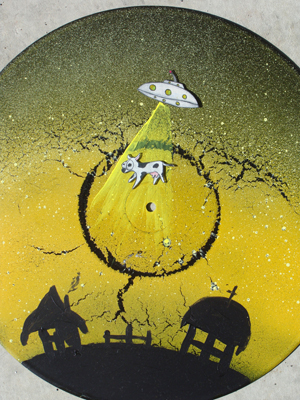
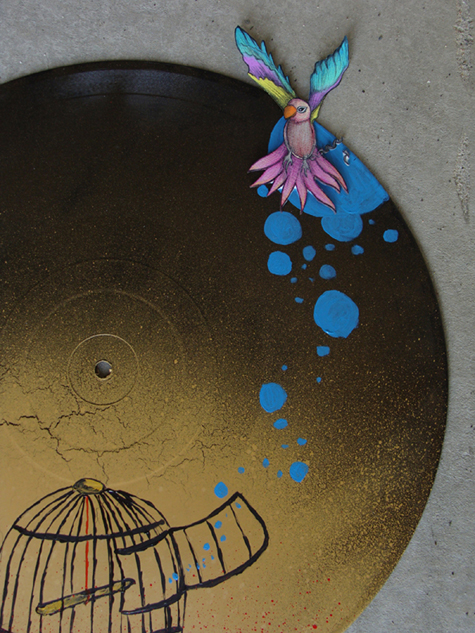
Whatever you call it, there’s no denying the charisma of Konopitski’s art. Whether it’s brightly colored illustrations, real-life photographs enhanced with his goofy characters, or the painted Scotch tape sculptures he created in collaboration with Danny Scheible, Konopitski’s work speaks of a limitless imagination and exudes a fun, lighthearted vibe. His latest solo show opens April 2, 2010 at Cuffs Urban Apparel in Midtown. When Submerge spoke with the artist, he was taking a much-needed break from preparing for the exhibition. He says he hopes to have 30 pieces done in time for the show. The works he’ll have on display will be mixed media pieces involving spray paint, vinyl records and Shrinky Dinks. Konopitski says that a few samples of the pieces can be seen on his Facebook page, but he urges those who are curious to check out the exhibit for themselves. We here at Submerge believe you should do the same. It’s a bizarre mixture of materials to be sure, but you know how those artist types are”¦
Are Shrinky Dinks something that you grew up with?
My mom actually introduced them to me. She pulled out her whole antiques there, her charms, and was showing me these little Shrinky Dinks, and I hadn’t heard of them since then.
I didn’t realize they still made them.
I actually ran into a place that was selling blank Shrinky Dinks sheets—just blank sheets like paper. But yeah, I just started making them myself and cutting them out. They’re awesome.
Does the medium you’re working with inform the artwork at all? Does it shape how you create a piece?
Absolutely. Say if I’m working with pen and ink—I don’t know if you’ve seen the tribal works I do—but they become more tedious, more detailed. If I’m working with colored pencils or Shrinky Dinks, they become more cartoonish. I made these sun prints”¦ That’s a whole different technique right there. Those result in creating cutout, silhouette styles and putting them on this paper that’s been chemically laced to react to the sun. So the medium dictates the style I’m going to do.
I saw that you work as a curator also. Is that a big separation for you, working as an artist and working as a curator?
Actually, that’s something I haven’t done frequently, but I have done for a few years. Basically, it’s a thing where I want to see this show, and I want to put this show somewhere, let me find a venue and put this call for art out to all kinds of people and put out a show I want to see, really. It’s like, this kind of show doesn’t exist and I want to see it.

Has working as a curator opened your eyes to how to present your work to other curators?
It helps with networking, I’d say, because then you’re working with other artists, and you’re giving back to them a little. As they find other shows that they’re curating themselves—I’ve found that a lot of artists, once they’ve been showing for so long, they’re also asked to put on shows as well, and they’ll say, “Hey, he gave me a show, why don’t I get him involved too.”
Was it something you went to school for?
I graduated with an AA from the community college, and I was going to move on to the Art Institute, but it seemed at that point that school was going to distract me from what I wanted to do, looking at the students’ work and such. Some of my favorite artists didn’t even go to school. They were all self-taught, so I thought I would save some money and not get all those student loans and try it myself.
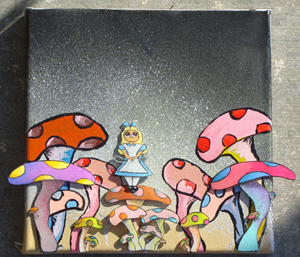
We were talking about how the materials you use inspire your artwork. How did working with Shrinky Dinks and records shape your work for this upcoming exhibit?
As far as that goes, it’s kind of a new medium working with acrylic and Shrinky Dink combined. These are the most I’ve done in that way, I guess. They’re all vinyl records, so they’re all circular canvases, and for some reason, I don’t know if it’s because it’s a different shape, but it’s inspired me more than a square canvas. I can’t stop coming up with ideas for it. It’s been a blast. I have more ideas than time.
Has it been a lot of trial and error working with the Shrinky Dinks? I remember when I’d put them in the oven, they’d get all curled up.
This is true. In fact, I didn’t even know that they got so curled up so much at first, so I would take them out of the oven and they’d just be round, curved balls of plastic. I almost gave up, but then I read the instructions, which I don’t do too often, and it actually said to leave them in there longer and they’ll flatten out. I guess that helped out there.
What excites you most about working in the Sacramento art community?
What excites me most is that the artists are so talented. The city is full of talented artists. But what the city doesn’t know, and I didn’t even realize this until I started showing art more, is there aren’t only immensely talented artists, but there are also people who are either traveling through or live here and don’t want people to know that they live here who are big in the art world. There’s folks who have been shown in Juxtapose, High Fructose and those art magazines; there are folks who’ve worked for DC Comics and Marvel Comics, there are folks who know people who make the Cartoon Network shows and Pixar and stuff. I had no idea I’d get to meet these people. I thought I’d show some art in the little town I grew up in, but I had no idea Sacramento secretly harbors these people.

Check out Jared Konopitski’s work at Cuffs Urban Apparel starting April 2, 2010. For more information, go to www.jareko.com or look him up on Facebook at www.facebook.com/ people/Jared-Konopitski/838283475.