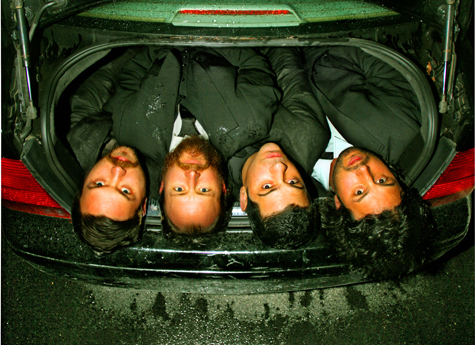
Pocket for Corduroy Reunites, Ponders Next Step
Long before Nevada City, Calif. attained national notoriety as a hotbed for the anti-folk scene of the mid-’00s—a breeding ground for the disciplined howls of the Russian River kids—the city’s musical landscape thrived not unlike that of the monolithic post-punk scene in Sacramento. In the late ’90s and into 2002, Pocket for Corduroy erupted like Vesuvius on an unsuspecting Pompeii, eschewing conventional rock ‘n’ roll chasms to forge an inventive urgency to their sonic explosion. In five years they played alongside some of underground rock’s biggest bands (or those who would go on to become some of its biggest bands)—Pinback, Guided By Voices and The Velvet Teen, among others. And then in 2002, it was over.
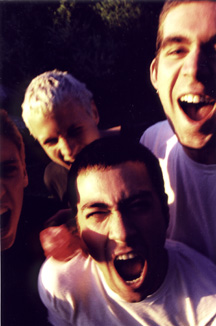
Pocket for Corduroy—Andrew Hodgson (vocals, guitar), Dan Elkan (vocals, guitar), Peter Newsom (drums), and Thad Stoenner (bass)—splintered into myriad other projects, including Black Bear, Daycare, Millionaireplanes, Holy Smokes, Hella, Casual Fog and Newsom eventually recorded and toured with Devendra Banhart. Elkan and Stoenner have been busy with the experimental pop-psych of Them Hills as well, but it wasn’t until an old friend, publicist and booking agent (the absolutely darling Jesse Locks) asked the band to play for her 30th birthday party that the band decided to dust off the PFC catalogue and reunite.
There’s no telling how long this reunion will last. As you’ll read in this exclusive Submerge interview with Elkan, the band does have one other show booked aside from the private affair of Locks’ party, at Harlow’s on Sept. 10 with By Sunlight, Bright Light Fever and Silian Rail. But one thing’s for sure: Sacramento is in for a reawakening of one of the brightest bulbs in its flickering history.
How did it feel to be back in the same room rehearsing with all of the original members of Pocket for Corduroy after seven years?
We all currently live in the same town again and are all still friends, but for whatever reason don’t get to see each other that often. I mean, we see each other at shows and barbecues and such. We’ve all played music with each other in some combination or another, but never the four of us, never playing these songs that are all between 8 and 12 years old now.
Being back in the same room with everyone, playing the old songs, felt very natural, actually. In the first practice there was a lot of smiling and laughing. Something about it feels very familiar, but at the same time there’s nothing about getting back inside of your brain of 10 years ago that is not bizarre. The way we wrote, the way Andrew and I formed the guitar structures; all of it feels pretty foreign. That being said, a couple songs into the first rehearsal and it sounded exactly like what you might expect: a Pocket for Corduroy practice.
Do you see the band possibly moving on with some more shows if the first two are very successful?
Great question. None of us know the answer. The original plan was to rehearse and play for Jesse’s birthday [on Sept. 12]. I think we figured that if we were going to put the work in for one show, we might as well do one more. I don’t think it’d feel right to any of us if we didn’t play a Sacramento show this time around. We received so much love from Sacramento at the time we were a band. It really did feel like home every time we played, sometimes even more so. We changed our plans and added another show for that reason. At this time we’ve got two shows booked and that’s it.
We hope the shows are successful in that we hope that some people (including ourselves, and hopefully some new faces) have a good time and enjoy the flashback. My hope is that anyone who wants to check it out will be able to. I’m not sure if any other measure of success with the shows would affect our decision to play more, one way or the other.
In what kind of musical climate do you find Pocket for Corduroy reuniting (if even briefly), and do you find a similarity to the contrast of how you fit in when you began and even now during this reunion?
I haven’t really given much thought to the musical climate in regards to Pocket for Corduroy in 2009. I haven’t considered the context, because I don’t feel like there is one. The fact of the matter is that we started this band about 12 years ago now and the last time we played was over seven years ago. This is a band, like any other, from a time and place. A lot of people have told me over the years that they thought we were ahead of our time and referenced that they felt that following our breakup, there were a lot of bands that were very successful with a similar but more commercial sound than we had at the time. I don’t agree, but I’ve never been a great judge of my music in that way. I never felt like we fit into any scene then, and I certainly don’t feel like we fit into what’s going on in music now. We were always just trying to write good songs and never identified with any genre or fad, probably as a reaction. Maybe that was our mistake. Depends on what you’re going for, I guess.
In what ways did you attempt to distance yourselves from the artistic mark you left with Pocket for Corduroy when you began Them Hills?
I don’t think I ever tried to distance myself stylistically from the work I did with Pocket for Corduroy. I feel like my approach has always been the same. I’m always trying to write a better song than the one I just wrote. When I started Them Hills, I definitely and consciously made the decision to have less going on, hence the three-piece, but other than that, I don’t feel like I’ve made any attempt to distance myself drastically from anything I’ve done musically in the past.
What is on the horizon currently for Them Hills?
We just finished a new Them Hills record that we’re calling Process. We recorded it all on analog tape with a friend of mine, Manny Nieto, in Los Angeles. He did a bunch of work on the last Breeders record, Mountain Battles. We were sold with the sound of it and made arrangements to go record it with Manny, raw style. We are looking for someone to help us release the record on CD and vinyl, but in the meantime we’re pre-releasing it ourselves by having the first half of the record available at shows on CD and the rest of it available soon digitally through the iTunes music store and other digital retailers. It’s already up on Emusic, but iTunes is slow to get it happening. We’ve been laying low-ish but we’re planning on playing out a bunch, and we’re excited about the new record and are getting ready to start writing the next one.
What is your overall goal with regard to this reunion? Would you like to record again, tour again, play again with this band?
The initial goal was to play for Jesse’s birthday. It turned out to be a great excuse for the four of us to spend some time together again, which has been great. We’re going to try to throw together a limited release, a CD that will compile all of our recordings plus a few more that no one has heard. We’ve got a couple shows to play. We want them to be cool. That’s really it as far as we know right now. Though, it has been pretty fun so far!
Ross Hammond and the Tao of Improvisation
At this year’s SXSW, Ross Hammond, performing with Teakayo Mission, put his rockist touch on the traditional hymn, “Let Us Go Into the House of the Lord,” leading a 14-minute tour of the heavenly kingdom. The live recording sounds as though he and his band mates reached nirvana; but for Hammond, this was just another night of performing in one of his many side projects.
It is tough to say why I feel this way, but the guitar has always been a spiritual instrument in my mind. Perhaps it is images of Jimi Hendrix kneeling in a prayer position, conjuring flames from a burning broken instrument, or the intoxicating feelings that come from Eddie Hazel’s 10-minute guitar soliloquy on Funkadelic’s “Maggot Brain.” A guitar is especially powerful when improvisation is introduced, allowing a guitarist to operate on instinct and inspiration—it is in these delicate moments that musicians seem touched by a divine muse.
Pulling the pomp from these circumstances, such musings can be reduced to just another good night for improvisational jazz—a scene that is garnering some attention in Sacramento. Ross Hammond has been operating within the limitless art form for over a decade, dividing time between improvisational groups, working as a sideman for singers and songwriters, teaching private lessons and curating local jazz shows. Some of his current projects, whether as a leader or session player, include RACE!!!, Teakayo Mission, V-Neck, Lovely Builders and Joaquin’s Night Train. Even with such a prolific resume, he’s reluctant to be dubbed torchbearer for the scene. “A lot of these projects that I’m playing in aren’t mine,” Hammond said. “There’s a lot of passing the leader title around in different projects. Usually a new project is from meeting someone new that’s into a similar idea or finding a new concept about how to present your music.”
Even in the most possessed thralls of improvisation, an artist cannot reach this higher ground without an intense dedication to the craft and community—one monk can’t run a monastery. Hammond views his eagerness to continually invite new musicians into his circle part of this ideal. “Playing with all kinds of different musicians and styles keeps you sharp,” he said. “That’s really the whole idea, in being able to play as much as I can in as many styles as I can.”
Hammond’s predilection for an unabashed marriage of style and technique are the principles for his latest solo record, An Effective Use of Space, a title penned by his wife. “It’s a phrase [she] likes to use when we talk about how things should be arranged in our house,” he said. “I’m sure someone could make a good musical meaning for it too. But it was more of a title that was given after the fact.”
Essentially, his wife has unwittingly helped this writer do just that, as his album suggests jazz feng shui. In a traditional sense, feng shui is an ancient Chinese system of aesthetics for improving ones life through placements of positive energy, but Hammond’s feng shui comes from his guitar-plucking intuition. The record also features several stylistic choices that require delicate placement.
[audio:Heaven Was Getting Crowded.mp3]
Hammond occasionally deviates from his signature sound to pose dedications to friends and family. One of his favorite songs is “Heaven Was Getting Crowded,” which features his recently departed grandmother—Hammond recorded her delivering this joke during her final stay in the hospital. “I wanted to get a recording of her telling her favorite joke, so that’s pretty much how it came out,” he said. “She was a very loving and supportive lady, and she loved to make people laugh. She would tell us and the doctors and medical staff jokes up to her final days.” Without overshadowing the recording, he supports his grandmother’s joke with a bittersweet mood created from solo electric and lap steel guitar loops. “The song is meant as a way to remember her jovial side,” he said.
Once again, I recall Hammond’s SXSW recording. It is as though his guitar is in deep meditation, yet there’s an unspoken connection with his band mates. The spiritual is the constant, while the exploration of a deeper understanding is ritually being sought throughout the performance. “I try to communicate whatever I’m feeling in the moment,” Hammond said. “That obviously has some day to day changes, but there are some parts of my personality that are pretty much constant.” Originally from Lexington, Ky. and raised in the church, Hammond’s spirituality is connected to his guitar playing. “I think most improvisers are that way,” he said. “You should be able to get an idea of what a person is feeling by listening to them play. I think that’s what keeps improvised music honest. But there’s also the factor of what your other band mates are doing. So, it is definitely a balance of trying to get across what you feel while still listening to what’s going on around you.”
The practice of meditation in Eastern religions holds relevance to the improvised jazz performer. Obtaining Zen through meditation involves intense mental stamina as a person directs awareness toward breathing or counting until he or she establishes a trance state. Improvised music shares principles with meditation, as the beat is the groundwork for the journey that comes from reacting to your group and the impulses you feel in the moment. “It’s like you are an antenna that is channeling the music from somewhere else,” he said. “When I play, I’m definitely not thinking about scales or keys. There’s an old adage that says if you are thinking when you play, then you’re gonna muck it up.” Once again, Hammond likened it to his personal experience of participating communally in church, “I think that is a very spiritual thing, because in that sense the music is something that is bigger than just me and whoever I’m playing with. It’s definitely greater than the sum of its parts. I think it’s a similar feeling as being in church, or meditating or whatever else people do to escape. When you are improvising it’s a timeless feeling in that it’s hard to tell if the song you just played was five minutes or 45 minutes.”
Hammond stresses that, though time loses its relevance while performing and the transcendental progression is intoxicating, it is important to hold dear to your purpose. For Hammond, creating is far beyond notes on staff paper, matching scales to chords and counting beats. He spoke with restraint, worried he’d sound too “new age-y,” relating that he created “to convey a sense of unity and harmony in the world we live in.”
Finally, I asked Hammond if he thought his style of improv-jazz was less intimidating than most jazz because of its focus on the guitar and crafting soliloquies. He resisted my hypothesis stating, “I don’t see jazz artists like John Coltrane or Pharoah Sanders being that much different than Pete Seeger or Bob Dylan,” he said. “They are all trying to convey a message through their music. That’s the important part. I think at this point jazz just means ‘not pop.’ Just play what you are feeling. That’s where the real music lies.”
Keith Lowell Jensen takes off with a new stand-up CD
A comedian walks into a bar and says—well, he says lots of things, actually. The comedian is Keith Lowell Jensen and the bar is actually a juice bar: Luna’s Café, to be exact. Jensen’s new stand-up CD titled To the Moon was recorded live at Luna’s Café back in April of this year and features an hour of Jensen’s signature lowbrow, indie comedy. Jensen is typically known for his atheist, Christian-bashing humor that has grown in popularity due to the success of the Coexist? Comedy Tour that Jensen is a part of. The tour is a motley crew consisting of a Muslim, a Christian, a Hindu, a Jew, an atheist and a Buddhist. Jensen, along with fellow Coexist? comedian Tapan Trivedi, founded the tour after realizing their shared affinity for blasphemy.
To the Moon finds Jensen rocketing his material to new heights, touching upon anything from having a kid to the costumes in porn. Jensen gets introspective too, poking fun at his experience of attending continuation school as well as the constant confusion of whether or not he’s gay. But the most poignant moment on the CD is the closing track, a nine-minute story describing a childhood memory in which Jensen was duped by his older brother first into sitting in a pile of German Shepherd feces and then making his own deposit in a can, all to the dismay and laughter of his mother. What starts off sounding like a poop joke ends up being a window into the early developmental influences of a talented, comedic mind.
Standing at about 6 feet tall, with low maintenance attire and a unique voice that’s been described as “Muppet-like,” Keith Lowell Jensen is a true performer. He got his start in his early 20s when he was put on stage as an MC for the infamous Spike and Mike Festival of Animation, which reached the height of its popularity by showcasing shorts by such industry greats like Bill Plympton, John Kricfalusi, John Lasseter and Nick Park, just to name a handful.
“That to me is when I started doing stand-up.” says Jensen about his beginnings. “I could have said longer, because I was a ventriloquist in the fourth grade.”
From there his love of performing took him in the direction of sketch comedy, which would put his MC personality on the back burner. But for Jensen, being pulled away from stand-up to do sketch was all part of the process to becoming a better comedian. Biographies of other comedians that Jensen grew to love all had one thing in common: some kind of sketch comedy experience. Jensen wanted that experience too. So in 2001, Jensen formed the sketch comedy troupe I Can’t Believe It’s Not Comedy and focused his attention on writing, acting and directing.
“I just fell in love with it,” reminisces Jensen. “And not just performing it but when you write and direct something and someone else performs it; it’s a really satisfying feeling.”
ICBINC has performed all over Sacramento and also found its way up north to Seattle and down south to Los Angeles. The troupe, although currently on hiatus, is still in existence and all but one of the members is part of the original cast.
During the course of performing heavily with ICBINC, Jensen still found time for stand-up when he could.
“I did it once in a while to keep my chops up.” says Jensen.
Jensen made the jump back into stand-up when his friend and fellow comedian Brent Weinbach needed his help with booking a gig. One of the comedians on the bill, Tapan Trivedi, asked Jensen to share the bill with them and he agreed.
“I didn’t know what I wanted to talk about, it had been so long. So I did half the show on homophobia and half the show on religion.”
That night, his atheist comedy was born—and not long after, so was Coexist?. Trivedi and Jensen assembled four other comedians for the tour and what followed were gigs at some of the top comedy clubs on the West Coast including the Hollywood Improv and San Francisco’s Punchline. What also contributed to the success of Jensen’s atheist brand of humor was his use of YouTube as a means to broadcast his stand-up to a larger audience. Fan bases around the world have popped up, especially in Sweden, where his Swedish last name rings bells with the locals.
Since the conception of the Coexist? Comedy Tour, the past two and half years have been a learning process for Jensen, who has been extremely focused on his stand-up, always looking to improve upon his jokes and build upon the foundation that was formed from doing years of sketch.
“Sketch gave me a freedom in stand-up to play characters a little bit more, to change my voice when I’m giving the words of another person or in quotes within a joke. I think sketch certainly helped me with pacing,” he says.
For Jensen, the writing and performing process is ever changing and spontaneous. Some of the material on To the Moon was written the day it was recorded. Depending on how the crowd is that night, Jensen can add or subtract material at a whim.
“It’s just an interesting part of this art form; it’s so fluid and it’s such a back and forth with the audience. There are very few art forms where you put it in front of the audience and you go back and forth and you keep molding it and changing it according to how it sits with them,” says Jensen.
With a tour schedule that has brought him attention outside of Sacramento and the Internet at his disposal for promoting his stand-up, its seems that at this point in his career it would make sense for Keith Lowell Jensen to move to where there’s more work and a bigger market. But making the move to somewhere like Los Angeles just isn’t in the cards. In fact, being from Sacramento is part of his brand, says Jensen.
“It’s an unusual identity to be from somewhere like Sacramento, and to be proud of where you’re from and not feel the need to switch it up and go down to L.A. I don’t want to be an L.A. comic, I’m a Sacramento comic,” says Jensen.
Sacramento is lucky to have Jensen, who is more than qualified to be an ambassador for the River City. He’s practically a household name in the arts community, and for good reason. This past March saw the release of his documentary, Why Lie? I Need a Drink, a hilarious look at panhandling from a homeless and non-homeless perspective. The non-homeless perspective showcased Jensen in various costumes with a multitude of signs bearing clever phrases like, “Large bills OK, can make change.” It premiered at The Crest Theatre and had quite a successful run; look for a DVD release this September. And if a tour, a CD and a documentary weren’t enough, Jensen authored a book titled The Atheist Survival Guide: A Humorous Guide to Getting By in a God Fearing World that is slated for release in November.
Considering the breadth of his undertakings, it may seem like there’s no rest in sight for Jensen. However, he might have to take a break after all with the arrival of another important something—a baby girl due in October. With the success of all his other endeavors, fatherhood should be a walk in the park. Or should I say, a trip to the moon.
Sister Crayon to Release Its First Album as a Full Band
When Submerge spoke to Sister Crayon’s Terra Lopez, she and the band were mired in Southern California traffic. Currently on the road on the Broke Bitches tour along with fellow Sacramentans Agent Ribbons, Sister Crayon weren’t holed up “in a big van” like their tourmates. Instead, Lopez and company were situated in a cozy station wagon—a red Volvo.

Genaro in The Crawdad, a reliable yet cramped tour vehicle. She got us to where we needed to be
“It’s all over the place, actually,” Lopez says of Sister Crayon’s modest transportation. “But it’s been really good overall.”
Sister Crayon is still relatively young. The seeds for the band were first sown three years ago when Lopez’s prior band broke up and left her performing solo. She went on alone for about a year until she met Dani Fernandez, who plays drum machine and synthesizer for Sister Crayon. It was through this pairing that Sister Crayon’s sound began to take shape. Lopez says that when she was on her own, her music was “very quiet”—just Lopez and her guitar. Though she had used loop pedals and beat machines in her previous band, it wasn’t until she started working with Fernandez that Lopez began pooling all of her influences into her music. Lopez says that she and Fernandez “just clicked” and the two began incorporating hip-hop elements into Lopez’s not-quite-folksy singer/songwriter material.
“We both love hip-hop, but we like just all kinds of different music,” Lopez explains. “The first song we wrote together was ‘Lavender Liars'”¦ I played this weird organ and she just played beats over it, and it just stuck. We figured out that was what we wanted to do. When I met Dani, that’s when things changed. I was like, ‘I finally met someone who could help me out with the sounds I had.'”

Chelsea Wolfe and I at the Smell in L.A. This show was with VOICEs VOICEs
and had Keith Haring murals!
Even when Lopez was performing on her own, she recalls that she always felt as if her music would lend itself to a bigger sound.
“When I was playing by myself, I liked what I was doing, but I always heard more,” Lopez says. “I always wanted more.”
Sister Crayon’s sound became even fuller with the addition of keyboardist Genaro Ulloa-Juno. The band operated as a twosome for about a year until Ulloa-Juno entered into the mix. Lopez says that the multi-instrumentalist was an easy fit into the band’s dynamic.
“It came together really simply, actually,” she says. “I asked him over to my house one day to listen to some stuff and see if he could add any thing, and we just hit it off.”
The band grew even further only just recently. Nicholas Suhr hopped on board only a few months ago. Hailing from the Bay Area, Suhr is now Sister Crayon’s drummer, adding a visceral snap to the band’s ethereal electronic beats.

Dani at a mansion (literally) 5 houses down from Snoop Dogg. Crazy story how we ended up staying at a mansion but it was by far the best night on tour. Thank you Pomona, Calif.!
“It’s really awesome to have a fuller sound,” Lopez says.
Suhr’s drumming came at a crucial time for the band as they were preparing their first proper CD release. Lopez released a Sister Crayon album, Loneliness Is My Mother’s Gun, earlier in 2009 via Chicago indie label Juene Été Records; however, she says their upcoming effort will be more indicative of Sister Crayon’s current sound.
“That album is just my stuff; they’re bedroom recordings,” Lopez says of Loneliness”¦. “Dani’s on a couple of tracks on that as well. I never intended to put that out. I was just going to sell that for $5 at shows”¦but the label contacted me and they were like, ‘We really like what you’re doing. Can we put this out?’ And I was like, ‘Wow.’ They paid for it all, so I was like, ‘Sure.'”
On the other hand, Enter Into Holy (Or)ders, Sister Crayon’s upcoming release, features the entire band—including Suhr, who had only joined the group a “week or two” before they went into the studio.

Chelsea Wolfe, Nicholas Suhr and I passed out after the house party in Pomona, Calif. We were up until 5 a.m. with the most amazing new friends we met earlier that night.
“He had to learn and write all of his parts while we were recording,” Lopez says of Suhr’s kind of trial by fire. “It was really cool that he was able to do that, because we had all been playing those songs for months, and he had to learn everything in the studio.” Lopez called the recording sessions for the album “intense,” saying that the band was logging 14 – 18 hour days at The Hangar, where “¦Holy (Or)ders was recorded, produced by the band with help from Scott McChane, including “really long practices.”
The intensity with which “¦Holy (Or)ders was recorded is reflected in the music. Though Lopez says her lyrics and vocals are important to her, she says the album’s focus was more on the music.
“For me, for this album, I wanted the music to be the main focus because it was finally getting more intense, which is what I think we all wanted,” she explains.
Though her lyrics may have been more of an appetizer than “¦Holy (Or)ders‘s main course, Lopez believes the force of the band’s music has definitely rubbed off on her lyric writing. She says that her lyrics may have been more personal when Sister Crayon was a one-woman show; and though they still pull from her private life, her writing has become more aggressive. She says that the lyrics she wrote to the songs on “¦Holy (Or)ders revolve around the events of this past summer: including a relationship she’d entered into and a book she had been reading by controversial 20th century French writer Jean Genet. In fact, the title of the album is taken from a line in one of Genet’s books.
“He was one of the first French homosexual writers,” Lopez says. “His writing is really dirty and really aggressive. That kind of intrigued me.”
Performance-wise, Lopez is also no longer the quiet singer/songwriter with a guitar. She says that now that she has the power of a full band behind her, she’s had to become more assertive on stage.
“I sing a lot louder than I used to,” Lopez says through laughter.
Blessed with a stirring and soulful voice, a louder Lopez can only be considered a good thing. The band should be back home from the Broke Bitches Tour by the time this issue hits the streets. However, the band won’t be able to relax once they’re back in Sacramento. Lopez says Sister Crayon will quickly return to The Hangar to finish mixing “¦Holy (Or)ders so that it’s done by their CD release party on Aug. 21. Further on the horizon, Lopez says the band is hoping to have more of a nationwide tour, and in January, the band will perform in Spain, where their album will also see release.
Wednesday Market at Cesar Chavez Park
I don’t especially like rural or country areas. I like the vibrancy, diversity and speed of the city. However, my Sacramentans, there is one place that the two converge in delight of one another; a place where the best aspects of country and city living come together to inspire and satiate our engagement in life. That place is the farmers market.
My favorite cities in the world are cities where I remember happening upon a display and splendor of crop and crowd—a farmers market, marché ouvert, le Suk.
You may be walking along a dull outdoor cement corridor, and all of a sudden stumble into an open market, with life colorfully exploding all around you. You see every color, smell life emanating from fresh foods, hear varied voices interacting, feel the thick swell of interaction between those alive and those things keeping us alive.
At Cesar Chavez Park on a recent Wednesday, I experienced that beloved sentiment and always-unexpected rush of connectivity to the living world.
As I entered from the northeast corner of the park off of I Street around 12:30 p.m., the farmers market was bustling with people, colors, smells of fresh and cooking food, and soothing sounds of sax and guitar music.
Among an assortment of the normal summer fruits that I got for $1.50 at the J & J Ramos Farms stand (each stand has a banner with the farm the produce came from, so you can remember your fave and make friends), I found a few new treasures.
My very first purchase was an impulsive one. I’m a firm believer in comparison shopping, but with enough practice, a good comparison shopper will know when they stumbled upon a deal sans comparison. V.F. Garden had a pesticide-free serrated-edged deep purple Thai basil for only a buck per generous bushel (what could you really do with a large amount of basil before it went bad anyway?). It was so fragrant and vibrant and tasted slightly of black licorice.
Another one that was new to me was quark from Spring Hill Jersey Cheese in Petaluma. Since I’d never heard of quark, Matt, the young, friendly gentleman behind the table, filled me in. While handing me a half-strawberry filled with the creamy, spread-like cheese, Matt explained how quark is like a German style cream cheese, but unlike cream cheese, this spread is derived from yogurt cultures.
I’d describe quark as certainly tasty with a slight distinctive flavor like that of an extremely mild, chevre frais (fresh goat cheese), but with a delicate subtlety that only fine, fresh, thick cream produces. In fact, Spring Hill Jersey Cheese makes their cheeses with milk from Jersey cows, which produce milk that is typically creamier (or higher in butterfat, for those in the know), than that of their larger bovine counterparts.
At $5 for a mini tub, this fresh quark is a touch pricey, but for a dinner party or date, it could be a great and fairly un-pretentious way to impress.
Although I had a seedless watermelon chilling in my fridge, my very last purchase was a light-rinded yellow watermelon. At $1 per pound, this seemed like an expensive purchase, except that the full size of this watermelon was the size of a large grapefruit. It ended up being a touch tart and soft, but when mixed with seedless watermelon and chopped purple basil in the salad I made when I got home, it paired nicely.
Patrick’s Garden brought berries galore from Placerville for Sacramentans. Along with the usual berry brigade, the selection included golden raspberries, olallieberries and tayberries (both variations of black/raspberry blends). They were a bit pricey, but no more so than at the super market and probably fresher and healthier. I thought it was funny that Patrick’s Garden also had huge red and yellow onions the size of big boobs. Berries and onions? I guess there have been stranger accompaniments.
Just because produce is at farmers market doesn’t mean that it is all good. When picking any fresh produce, think about your selection process to ensure the best of the fresh.
Like anything in life that inspires any sort of feeling, make sure that the produce you pick is inspiring—at least to your appetite. Pick a bushel of spinach that looks green, vibrant and flavorful. Make sure you don’t grab thin-fleshed fruit, like peaches, plums, tomatoes, apricots or nectarines that look like they’ve been involved in some intense bouts of domestic violence. If you have to put them in a bag for a walk or bike ride back, you’ll surely end up with the baby food equivalent of what you’d hoped would be a tasty treat.
Fruit should speak to your senses, saying, “I smell like a sweet invigorating bite of life! Pick me!” Oftentimes, people are off-put by anything that has a very strong smell, so they’re inclined to choose nearly odor-less produce. Unlike fish, the stronger a fruits’ sweet smell is, the fresher the fruit is and the better it will taste. Try it.
I encourage anyone who can make it down to the farmers market to do so and see what kind of inspiration hits you, such as the inspiration to respect connections in the living world; or the inspiration to begin or finish a project that results in positive contributions. Or maybe you’ll feel inspired to eat, which wouldn’t be all that bad either.
If you can’t make it to the Wednesday market from 10 a.m. to 2 p.m. at Cesar Chavez, you can find listings of other farmer’s markets online at california-grown.com, click “market times & locations.”

If they say the music industry is in a bit of a bind, Coldplay wouldn’t know the first thing about it. The London-based alternative rock quartet has sold tens of millions of records worldwide and consistently draws enormous crowds wherever they perform. This night was no different; Sacramento and its surrounding areas had shown up in full force. As the blistering sun descended behind Sleeptrain Amphitheatre, a sea of Coldplay fans geared up for a performance they will not soon forget.
The smell of beer and “other substances” filled the packed amphitheatre. As segue music halted and the lights dimmed, it was finally show time. A couple flame twirlers briefly occupied the stage, mesmerizing the crowd as the band members took their positions behind a giant see-through curtain. Without any sort of introduction, they immediately went into the song “Life in Technicolor,” the first track off of 2008’s Viva La Vida. It’s mostly an instrumental track (it features a couple whoas from all four band members) and served as a great warm-up for the crowd. Fans swayed back and forth to the up-tempo beat as they watched Chris Martin, Coldplay’s bouncy frontman, dance around the stage. The second song, “Violet Hill,” really got the crowd into it. As the mass of fans sang back every word, it was hard not to get the goose bumps. You have a good voice, Sacramento! Martin did a fantastic job making the crowd feel appreciated by changing up the final line of the song that originally goes, “If you love me, won’t you let me know,” to, “If you love me, won’t you take me to Sacramento.“ Clever little bug.
For the next 30 minutes or so the band proceeded to bombard fans with hit song after hit song, including “Yellow,” off their 2000 debut Parachutes, in which dozens of giant yellow balloons were unleashed throughout the crowd. It was quite a sight to see, adding immensely to the awesome light show and videos projecting behind the stage. At the end of the song, Martin popped a couple of the confetti-filled balloons with the sharp, cut-off strings on the head of his guitar, coaxing laughs out of the crowd. The next highlight was when the band completely left the stage and ran into the audience, where there was a miniature stage set up in the upper lawn section, turning the nose bleed seats into the front row. Blankets and chairs were trampled as crazed fans rushed the mini-stage to get closer to the band. They played a few tunes, all acoustic, including a cover of the late Michael Jackson’s “Billy Jean.” Although I will admit I knew the cover song was coming (someone on my Twitter feed spilled the beans the night before when Coldplay performed at Shoreline Amphitheatre—Twitter needs a spoiler alert), it was still a pleasant surprise and Martin sang the difficult melodies quite well.
After the band proceeded back down to the main stage, they played a few more tunes. Then came the obligatory leaving of the stage only to get cheered back on for an encore. After the entire crowd chanted, “Coldplay, Coldplay!” for a few minutes, the band came back out and Martin announced they had just two more songs left. The first of the two was “The Scientist,” the second single off their 2002 album, A Rush of Blood to the Head, and it again enticed the crowd to sing back every word. The final song of the night, “Life in Technicolor II,” is a different version of the set opener (it includes lyrics). It was a great way to bring everything full circle and wrap up an amazing show. Just before exiting the stage for good, Martin explained that they would be giving away CDs for “zero dollars and zero cents,” and thanked fans for “giving us our jobs.” It’s good to know they’re grateful. Everyone walked away satisfied and eager to pop their free CDs into their car stereos.
Justin Lovato to Unveil His Latest Series of Paintings, Infinite Bewilderment
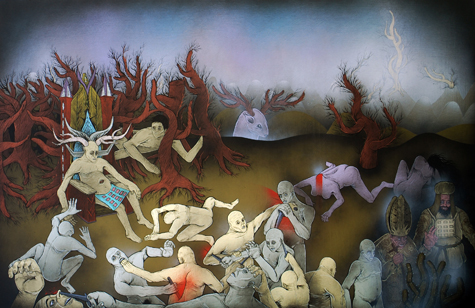
“People generally are unaware of their environment or how their everyday decisions might be affecting somebody thousands of miles away,” says Sacramento painter Justin Lovato, 23, whose latest series, Infinite Bewilderment, predominantly features images of jesters pulled from tarot cards, influential hands that tug at his characters like ventriloquists and symbols borrowed from the Freemason and Illuminati cults.
The series, opening Aug. 8 at Upper Playground on J Street, is challenging the notion that depictions of feudalist peasants might seem dated or have little relevance to modern life. “I like to use a lot of old symbolism in my art,” he says. “I am fascinated with religious-based art. Medieval art is a big influence on me. The whole idea of people in feudalism at that time, I think we live in a neo-feudalist society right now. Everyone is in a constant state of confusion.”
Lovato admits his art can be somewhat blatant, but he would rather the message be obvious than lost. “I think people are psychologically damaged due to a lack of good information and a lack of speculation about why we’re here and what they should be focusing on. I think if people lived moment to moment and redefined ‘need’ they might be more content, focusing positive energy elsewhere.”
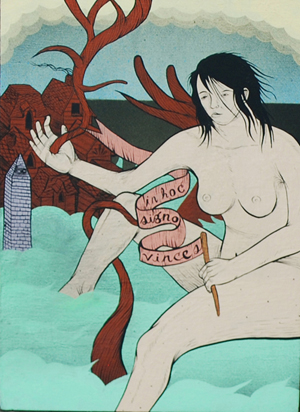
His work borrows medieval art techniques, all the way down to a disregard (although at the time it was lack of understanding) for perspective and dimension. “I like that it’s not very advanced,” he said. “It’s really flat looking, but the point is the imagery is blatant, which I am definitely guilty of. It’s aesthetically pleasing to me.” He also is enamored with the prerequisite of including religious themes. “The idea that you could be chastised for making art that didn’t revere God is intriguing to me,” he said.
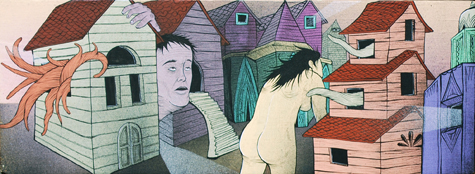
Lovato appreciates the plight of the juggler, who is relegated to “grab ahold of everything all the time.” “It represents the things that are deified to grab hold of people’s energies,” he said.
As for the archetypes of secret societies, Lovato swears he is not a conspiracy junkie. “I use that stuff because it makes for a good metaphor,” he said. “I don’t believe there’s an Illuminati. I think more out in the open there’s a subsection of rich industrialists that make the large decisions that affect the bottom tier, but I don’t believe in a mystical force.”
For Lovato, the unseen hand of influence is more visible than we are often willing to admit. He has a series of paintings in which a ubiquitous hand guides fountain streams of pills to lethargic characters, filling up their stomachs, heads and backs. “It’s a funny take on where we obtain our ideals,” he said.
“Whether it’s from other people pushing you along, or respecting someone else’s opinion who happens to have a print magazine or be on TV. It’s about the general influences that guide our ideals.”
The most controversial of his techniques could be his stripped depictions of the female form. In several of Lovato’s portraits the women are chopped down to the sexual torso. But is Lovato a mysogynist? “I want people to be confused at the image,” he said. “I am portraying the disgusting, abusive, offensive way that we view woman in our society by displaying it in a way that might make a woman feel offended by looking at it.”
Many of Lovato’s characters seem to be obese figures with pattern baldness, lumbering in a glum haze. But he resists a notion that it’s his view of typical Americans. “I don’t think people seem unhappy,” he says. “I enjoy people and talking to people I meet no matter who they are or what they might think or buy into.” He is aware that while he has his convictions, he is not a man with all the answers. “I am [trying to be] more suspicious of my everyday surroundings, and archetypes, and people’s expectations of me as a member of this hive.”
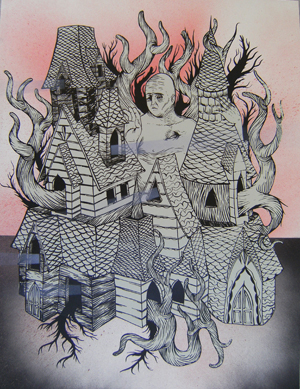
Lovato, who admits to listening to everything from ’60s and ’70s jazz and old punk rock to hip-hop and even lectures (“It keeps your mind occupied, while you’re meditating over a painting,” he explains), got his first show three years ago at The Toy Room from owners John Soldano and Craig Maclaine. Lovato recalls being 16, making trips to the alleyway gallery and gaining a fascination with the lowbrow art featured there. “I started hanging out there when I was a kid,” he said. “I got my first show when I was 20. I actually sold a few pieces, which was encouraging. I started doing it consistently ever since.”
“Consistently” rounds out to six shows a year. Most recently his work traveled to the Washington D.C. area after selling three pieces from a Toy Room show to a gallery called Art Whino. “Craig and John were a huge help in first getting my shit out there,” he said. “That’s the good thing about showing at gallery spots, there’s usually someone there who wants to help you get your name out there.”
When Lovato unveils his pieces Aug. 8, expect a remodeling of the Upper Playground boutique. Lovato plans to repaint the space and include interactive art. “I’ve been fucking around with animation,” he said. “I started looking at old toys from the 1800s. I’ve made these flipbook machines for people to play with.”

Dad’s Kitchen
2983 Freeport Blvd., Sacramento
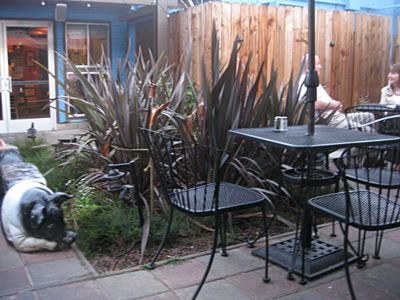
It was a picturesque summer evening. The sun had just gone down and a mild breeze moved about the quaint patio in the rear of Dad’s Kitchen. At the 8 o’clock hour, the 10 black tables that angled along large gray tiles were filled with couples and families, stuffed happily and enjoying the seclusion of what seemed like a backyard get together at an old friend’s house.
For owners Zac and Ali England, it seems like that’s the point. Dad’s is comfort food at its finest, offering patrons a home away from home where they can relax and enjoy some great cooking, a to-the-point alcohol selection and staff members that, if you were so inclined, could be your new best friends—or bandmates, for that matter, since members of the wait staff and kitchen also happen to be local musicians. In fact, when I arrived on a Tuesday night, an open mic night had just gotten under way. If you show up and realize you didn’t get the memo, don’t fret. An array of musical instruments including a guitar, banjo and mandolin are mounted on the wall and can be taken down for a pick or a strum. In fact, it’s encouraged.
Dad’s also carries offerings from Two Rivers Cider, a local brewery that embraces a classic approach to making hard apple cider, crafting it to be dry and crisp—reminiscent of a chardonnay. In addition to the apple, Two Rivers brews up seasonal ciders that will spark true romance in your mouth. Dad’s currently serves their blood orange cider that I’m convinced glows in the dark; the beverage is an electric shade of neon fuchsia. Naturally, I ordered one to start out the evening and my friend who accompanied me ordered a Monkey Knife Fight, an India pale ale that local brewery Rubicon produces. Tapping into the local community for alcohol as well as fresh produce and meats is an important facet of Dad’s that the restaurant proudly wears on its sleeve.
We clanked our glasses and set out on our culinary journey by ordering a starter of Dad’s infamous mac ‘n’ cheese, a menu staple that’s won a few awards for being the best in town. I found this out after I complimented chefs Beau and Mick on how their rendition of an American classic wasn’t too rich and was portioned just right for two. Bread crumbs and parmesan cheese were a nice topping and brought the dish to life, adding a crunch to the bite and sharpness to the aftertaste. Our vixen server, Anna, who is known for her high-kicking antics in the local burlesque troupe the Sizzling Sirens, suggested we spice it up a bit with a side of pepper plant sauce.
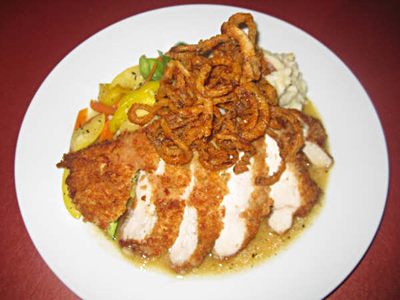
Dad’s menu is really an anomaly. If you are familiar with their sandwiches, you’d most likely think of Dad’s as an edgy, tattoo-friendly dive—especially with sandwiches that have names like “Bikini Kill,” “Angry Road Man” or my favorite, “Hot Blonde.” But if you come in for dinner and keep your ears peeled for the Blue Plate Special, you’ll more than likely be treated to one of the best meals in town. This particular evening’s was a lightly friend chicken breast with chunky mashed potatoes and a lemon gravy, summer veggies sautéed in olive oil with salt and pepper, and topped with curly fried onions that twisted like a redhead’s locks. The presentation was fantastic; my chicken fanned out amongst the tangy lemon gravy that perfectly complemented the tender white meat of the breast. A blast of color came from orange carrots, green and yellow squash and bell peppers—all of them fresh and crisp. My mashed potatoes were just like I like them: hearty and full of skins.
At the close of our meal, I leaned back in my seat, rubbing my belly like a crystal ball. It’s clear that there are many more trips to Dad’s Kitchen in my future.
E-40 on the Changing Tides and Staying on Top
I’m not a trained journalist so all the rules of being unbiased are out the window over here. Pound for pound, album to album there isn’t an MC who can match E-40. For a musician of any genre to stay relevant through 11 albums is an accomplishment on its own, but to remain creative and continue to innovate for that many moons is (and to quote the man) as “rare as white running backs.” He’ll even tell you he’s years beyond the rap pack, and the crazy part is he’s slowed down the flow with hopes that everyone else will catch up.
Off Warner Brothers after two albums, 40 is back to work and enjoying the freedom of not having to be forced into a square FM hole, vowing to return as the mobbed out slang spitter for a whole album with Revenue Retrieving this November. Yes, you read that correctly: new album coming in a few months, don’t forget where you read it first! In the meantime, 40 is staying on the road, sliding through Orangevale on Aug. 15, 2009 for a show at the Boardwalk. Getting him on the phone is nearly impossible, but as he does with his live performances he puts it all out on the table when he does surface. You’d be hard-pressed to find a more well-rounded rapper”¦and his interviews are hotter.
Alright, I want to talk about your latest album, The Ball Street Journal. Do you feel the album got a fair chance?
Nah, it didn’t. I was with Warner Brothers”¦ They did a good job a couple years before that when Lil Jon was in the loop, but what happened was they got to this point”¦ You gotta understand, I’ve had some radio play, but not always. In my earlier days, even when I signed with Jive in 1994, I had gotten a little radio play but not as much as I could have because of lot of my songs were so soil radio was scared of it. I’ve always been an underdog, and all the odds have been against me for years. With Warner though, I think they meant well, but they were looking for a big blowout hit. That is something that’s rare. It’s not that easy to come up with a hit. The song that you think might be that one, everybody might not think it’s the one. Then the one you think ain’t the one, ends up being the one for everybody else. It’s a catch 22. You roll the dice in the studio. But nah, I didn’t think the album got a fair chance, because Warner Brothers wasn’t in synch. It just didn’t work. They were trying to get me to do nothing but radio songs. I had to argue for the hood songs that I had on there! That’s the past, though. I’m on Revenue Retrieving right now. But The Ball Street Journal was a slappin’ album, and it still is!
I’m saying. I talk to folks and they didn’t even give it a chance, but if you listen to the album as a whole it’s classic 40.
It really is. A lot of shit like “Tell It Like It Is,” I tell it like it is. That’s one of the realest songs in like the past 10 years. It’s not toward nobody—if the shoe fits wear it—but a lot of people are feeling the way I feel. But you know, people don’t want to hear real songs. They don’t want to hear stuff that goes right to the point and tells the real. There is so much game involved in every line that I say that each line can be a title. I promise. Go back and listen to it, there is so much game and punchlines. It’s gonna end up being one of those songs in the future people will be like this dude was way ahead of his time. They’ll be like whoever this was rapping was retarded, you smell me? In a good way [laughs]!
Yeah, I mean “Tell It Like It Is” for all the game, but the one that bugs me out on a creative level with the wordplay and whole concept is “40 Water.” People don’t make songs and flip shit lyrically like that anymore.
Yup, they don’t, man. That’s what I’m saying. All that stuff, they don’t get like that anymore. It’s gotta be all dance. They want it to be all dance. It’s a trip. What it is though, like, who wouldn’t want to put Akon on their album? Especially at that time. And you know, I’ve been at this for 20 years, so OK, let me roll the dice and try some different stuff. The “Wake It Up” record was a good record, but my fanbase”¦ Fanbases can be stubborn. They don’t want me to do a song like that. They would accept it from anybody else, but they didn’t want me to expand and go beyond what I’ve been doing, and that’s keeping it all the way mobbed out. And even my fanbase turned its back on mob music, which is the heavy basslines and the certain sound we were rolling with in the ’90s. My fanbase, being the Bay Area, started buying up Southern music. They turned their back on the sound that we were doing, so I had to readjust and do whatever I had to do as far as music and adjust, but not go too far out of my jurisdiction. Do just enough to get by and for my fanbase to accept me. Basically, it’s a tricky a game. It’s either turn with the times, or the times will turn on you. A lot of times, the way hip-hop is, and I’m not griping, but I just feel like I’m way way way ahead of my time. I know people think I’m wack. Like a lot of cats on the East Coast think I’m wack, and the reason is because you can’t comprehend what you don’t know. And if you don’t know, how can you comprehend it? You know what I mean? It goes over their heads like a flying saucer. Then, a lot of cats don’t have the patience to look at creative rappers. They want you to rap a certain way, because that’s the only way they know it. They want you to rap like all the other rappers, and I’m not going to do that. I want to be in a class by myself. It’s fucked up that I have to readjust or downplay my skills to adjust to today’s listeners. You smell me? It ain’t cool. On this upcoming album, though, I’m free. I can do what I want. I can just be me and if a motherfucker don’t like it, they don’t gotta buy it. I’m gonna be the E-40 from the beginning. Mr. Flamboyant.
To switch things up you come from the era where MCing was about being unique and going out there to be the best rapper. Is there a point you reach where you kinda give up trying to prove that you are the best?
I feel like there isn’t a best rapper in the world. Everyone has their own category, and styles, and way they spit it. You’ve got backpackers, cats that just spit gangsta rap, cats that spit straight dope game shit, cats that have mastered radio. As far as being the best game spitter of all time, me personally, and I’m sure there are a lot that do agree some might not, but I have to give that title to E-40. As far as being one of the most unique rappers, I’m definitely one of the most if not the most. And I’ve got one of the most distinctive voices in rap. But I don’t care who the best is. When I was younger I did, because that’s all you want to be, the best, but there are different opinions out there. The people who they say are the best, I can’t agree with them. I have my top 5, but I know it ain’t the ones they’re saying. People roll with what the majority says.
You mentioned the ’90s stuff. I’ve been going back and revisiting albums like The Element of Surprise and Charlie Hustle, and stylistically you were on a whole other level with those two albums. Where were you at mentally and artistically at the time when you were recording those albums?
Music was changing at that time. People didn’t want to hear that. The industry was on some other shit. They were leaning toward the South, and the West Coast wasn’t hot. And even when we were, we had a few people that were selfish saying Los Angeles is the West Coast and that’s all it’s gonna be. They left the bologna for the Bay Area, so we were out here going through it. I just held on like a hubcap in the fast lane and said I’m gonna do what I do.
I don’t know, on those two albums you seemed to be in another place style-wise. And then after that in like 2000 with Loyalty and Betrayal you kinda went back to a more controlled flow.
I had to. Now you see where I’m at with it. The game is goofy. The goofy ears”¦ music changed. Music started getting watered down and dumbed down, and now they want that shit back. I figured if I would have kept doing it, shit, I probably still wouldn’t be on right now. I had to hold on like that hubcap. It’s like, if I didn’t do it, adjust to the ears and slow down my flow, I probably wouldn’t still be able to eat right now. I wouldn’t have had a Gold album two years ago at 39 years old. I wouldn’t have sold a million ringtones. It’s a trip ain’t it?
I do believe that things come around. And like you said, you’re getting back to it so I think it’s that time.
It is that time. I see exactly where you’re at with it. Trust me. I look at all angles.
Last question, I know you’re a big Rossi drinker to this day, especially the Burgundy. Why the Burgundy over any of the other kinds?
I’ll put it this way, when I was a little young moustache—and I’m not going to say what age—I would sneak into my mom’s little Rossi wine sitting on the counter. I’m not telling kids to do this, please don’t do this, but you know, that just became my drink of choice later in life. I drank 40s, though; they were in when I was a youngster. That’s how I got my name, E-40, because I would drink like 8 or 9 of those things throughout the whole day. You know how everytime you’d see a cat he’d have a 40 in his hand? That’s how we used to roll. Everytime I’m in the traffic in my Cougar, I got a 40 in my hand. DUIs weren’t that serious back then. You didn’t even have to wear seat belts then. But yeah, with the Rossi, the Burgundy has anti-oxidants in it, and it goes down smooth. And it gets you right! You can drink throughout the day with it. I love Landy, I love cognac, but I don’t drink cognac all day. When I drink, I like to drink to get drunk. I don’t like to drink to drink. When I drink, I maintain. I’m a social drinker—not an alcoholic, though.
I know this isn’t an issue for you, but I was telling my boy the other day as far as bang for your buck, the Burgundy Rossi is the best you can get.
$5.99 for a big ass bottle of Rossi wine/It’s right on time [laughs].

Dredg Digs Deep on New Album The Pariah, The Parrot, The Delusion
When used properly, words have immense power. Whether written, spoken or sung, they can and will affect people’s thoughts and actions. Perhaps no one is as familiar with this as British Indian novelist and essayist Salman Rushdie, whose controversial works (mainly his 1988 novel, The Satanic Verses) have sparked protests, uproars and even death threats against him. More recently one of Rushdie’s essays, titled “Imagine There’s No Heaven: A Letter to the 6 Billionth World Citizen,” had a profound effect on the members of Bay Area-based progressive rock band Dredg. After the writing process had already begun for what would become the band’s fourth studio album, The Pariah, the Parrot, the Delusion, guitarist Mark Engles came upon the letter and knew that he had to share it with the rest of the band, especially lyricist and vocalist Gavin Hayes. “Mark found it in a book he was reading called The Atheist Handbook,” remembers Hayes. “It’s like a chronological depiction of agnostic and atheistic beliefs. It was within that book, and he thought it was pretty relative to a lot of the lyrical content that I had already. So he forwarded it to me and I checked it out and was like, ‘Yeah, this is perfect.'”
Dredg is known for producing concept albums: 1998’s Lietmotif focused upon one man’s existential journey, 2002’s El Cielo is loosely based on sleep paralysis and was inspired by a Salvador Dali painting and 2005’s Catch Without Arms is about opposites and is divided into two “perspectives.” It was almost an immediate decision then for the group to loosely base their new record around Rushdie’s essay. “Imagine There’s No Heaven”¦” is best described as a beautifully written, daring letter that warns of different religious stories and beliefs and opines that one should instead learn for themselves through life’s experiences what to believe in. According to Hayes, “It’s about thinking for yourself.” He expands with, “It’s basically saying to go out, learn as much as you can, expand your mind and then develop your own belief system from there.”
Dredg, which has been a band since its members were in high school, is in the midst of a national tour in support of their new record that will bring them to the Empire Events Center in downtown Sacramento on Aug. 17, 2009. Submerge had a chance to catch up with Hayes via telephone from Jacksonville, Fla. to chat about the letter that inspired their new record, the band’s extensive recording process and what it feels like to be dropped from a major label.
Imagine you are a kid again, and someone read “Imagine There’s No Heaven”¦” to you. How much do you think it would it freak you out?
[Laughs] I don’t know if I’d actually understand it to be honest. I guess it would depend where I was at, if I was raised believing that there was this one God and that Jesus came back to life and saved everyone; then I might think, “Oh wow, that’s scary.” When that’s all you know, then everything else is scary, and it seems evil or something. But if I weren’t raised with it, it would probably be fine. I wish someone did read it to me when I was young.
The letter and the overall theme obviously influenced the artwork and packaging for The Pariah“¦. I read online that it was done by someone from the Bay Area band Division Day. How did that come about?
They’re actually based in Los Angeles now, but they’re all originally from the Bay Area. We went to high school with them. Their singer, Rohner Segnitz, he’s done a lot of work with us. He’s done a lot of our Web sites and he did El Cielo‘s artwork, so he knows our band really well. We obviously gave him the essay and a bunch of lyrics and an outline of how we wanted it packaged. We all knew we wanted it kind of to look like a letter. We went through a lot of different options before we even did the artwork. I had thoughts of putting it in an actual envelope and things like that. It just didn’t seem feasible; to stock that on a shelf, you know, stores get weird about that stuff. There are so many different variables that it definitely affects the decisions.
Producer Matt Radosevich said this of you guys, “Dredg is a band that looks at the recording process as limitless.” I found that interesting; could you elaborate on that?
That’s probably derived from all the experimentation we do in the studio. We try to create sounds that are unique to us. At least speaking for myself as a vocalist, I used tunnels outside and natural reverbs like that to get sounds for my voice rather than using a rack or a pedal or something like that. Things like that are more unique and special and actually make the recording process that much more fun. We worked at a few studios in San Francisco, one being Tiny Telephone that John Vanderslice owns, and he’s got a lot of cool toys in there. We’re really into getting unique sounds. The “Stamps of Origin” on the record, those little snippets, that’s like a Wurlitzer with all these crazy effects. We found that sound just by trial and error, I don’t want to say by accident, but just like tweaking a bunch of stuff. I had the idea of just having really intimate vocals over it, with no effects just really dry and personal. It kind of gelled the record together. We record a lot of ambient sounds in the studio, anything to make the process more exciting and to make everything more unique for the record.
The Pariah“¦ was released through your own label, Ohlone Recordings. Do you mind if I ask what happened with your relationship with Interscope?
Basically, we had been with their label for over eight years, and when we got signed to Interscope it was kind of the peak of CD sales, or I guess I should say the end of its peak. It’s a much different business, a much different label. Their business model has changed drastically; they’re much more focused on pop and R&B and stuff now. If you look at their roster, it’s either very established rock bands or more of a pop-, R&B-focused roster. There were bands around us that were getting dropped that were selling way more records than we were, so it wasn’t a surprise; that’s just the way the business is. That’s basically how it happened. It was nothing more than a logical move for what they were doing as a label. Eight years with a label is a good run. They helped us build, and we are where we are. We’re in a good position. On our own label partnering with ILG, Independent Label Group, out of New York. They’re Warner distribution, that’s something that we really couldn’t do on our own. I think it’s a great model actually; it’s just a one-record deal with them so we can see how it goes.
At least you’re in a good position now, stepping out on your own probably isn’t as terrifying as it might have been years ago.
Yeah, but still, when it initially happened it was somewhat of a letdown, and I felt like I was getting laid off on some level. I don’t know, we’ll see. There are pros and cons to it. Interscope was very beneficial for promotion and things like that. It’s a pretty big monster, so it can make things happen”¦ It feels good to be independent and to be running your own business and so on, but it’s also a little more stressful and it’s a little more work to make things happen and to get people to listen.
Have you been pleased with the reaction to the new record so far?
Yeah, so far at least the fans that we have are really digging it. I think 90 percent of them are really enjoying it, I mean of course there’s always people that are like, “Oh I like your first record, or your second record,” and so on. To be honest, I wish we were getting a little more exposure on this record. I feel like this is our best record. A friend of mine in New York called and was like, “Dude when is your record out?” and I’m like, “Yeah, it’s actually been out for like three weeks.” Obviously we’re not touching all the markets yet. This tour might be helping a little bit. I think we at least, with the amount of time we’ve invested in this band, deserve a shot at getting people to decide whether they like it or not. If they don’t, then that’s our fault and there’s nothing you can do about that. It can be frustrating if you feel like it’s not getting a shot and people aren’t having the opportunity to listen to it. That’s how our band has been our whole career; it’s been a very gradual, snail’s pace momentum.
At the end of your bio, it says of The Pariah“¦, “It’s the album Dredg has been working toward their entire career.” Would you agree with that?
Yeah I think it’s a great balance of our career, it has elements from our whole career mixed into one record as well as some progressive elements. At least personally speaking, these are some of my best vocal performances. I’m pretty happy overall with the record. I’m probably more content with this record than I’ve been with any record we’ve done. Whether or not people agree, I think that’s where all of us are in the band, we’re really happy with this record, it turned out exactly the way we envisioned it, which is rare.