The Art of Being Fluid
While skateboarders across the world might regard him as a living legend, San Francisco native Tommy Guerrero doesn’t want that label for himself just yet.
“I hate that the term is thrown around so loosely,” he says over the phone. “And secondly, it’s usually used when people pass on. It’s like, ‘Fuck, I’m still here!’”
Instead, Guerrero—now a 49-year-old father of one—prefers to keep rolling with what he’s always known best: skating and music.
During his tenure as a professional rider and competitor for Powell Peralta’s Bones Brigade skate team in the ‘80s, Guerrero says he would always make time to come home and play his bass “for hours on end.” Although Guerrero currently serves as an art director for Krooked skateboards, as well as a member (but mostly an ambassador, he says) of the Converse CONS pro skate team, he’s also grown into a multi-instrumentalist who plays guitar, keys and percussion, in addition to bass.
Music, he explains, was a childhood passion that he began taking seriously as early as 1978, when the Ramones came and put on a show in front of San Francisco’s City Hall.
“It changed my life,” Guerrero says. “Being a skateboarder was already kind of an outlaw, rebel thing to do. And the punk ethos went hand-in-hand with skating … So me and my brother instantly were just enamored.”
Skating by day and rehearsing by night, Guerrero ended up forming a few different punk bands throughout the ‘80s—Free Beer perhaps being the most well-known. As a new decade trickled in, however, Guerrero says his band-playing days slowly came to an end while his skating career soldiered on. But that didn’t mean he was done with music.
Investing in a drum machine and a 4-track recorder—the very first Portastudio, as he recalls—Guerrero continued recording his own tunes, until eventually he got featured on a jazz compilation album in 1995.
Around the same time, Guerrero also provided the soundtrack for a skate video in promotion of a clothing company he had started called Forties, which caught the attention of Galaxia and Mo’ Wax Records. Guerrero produced three projects under those two labels at first, and then a slew of others throughout the 2000s and 2010s—he now has 11 albums in the bank, according to his website.
His latest release, 2015’s Perpetual, is an extension of sorts to the album prior, No Man’s Land, which he characterizes as a “break-beat spaghetti-western noir.” Both albums stem from desert rock and world music influences, including Tinariwen, Bombino, Gabor Szabo and John Zorn, among others.
Now, about six months after Perpetual dropped, Guerrero is embarking on a very brief tour up north to Oregon and back down again to San Francisco: a “run,” he calls it.
“This is just to go and play some music,” he says, “just to go do something, really.”
Before he stops off at the Shady Lady Saloon later this month with drummer Chuck Treece and bassist Josh Lippi, Submerge was able to chat with Guerrero about music, skateboarding and his surprising ties to Sacramento.
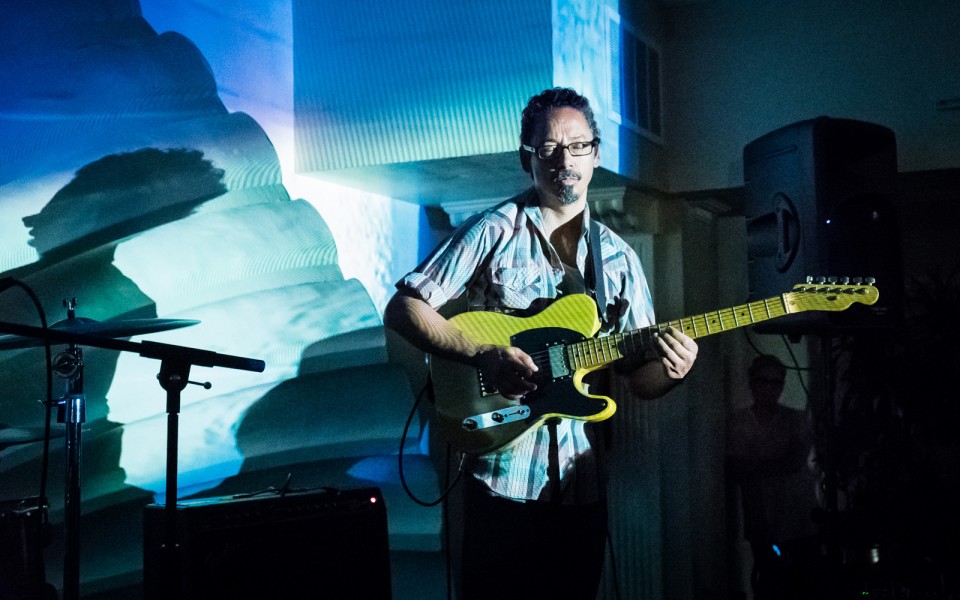
Photo by Claudine Gossett
Would you consider your music to be tailored toward skateboarders, or that specific culture at all? Or is it just music for a general audience?
Music is for anyone, just as anything is. And I really can’t stand the way people need to pigeonhole you so they can market you in a specific way. That’s what so many people try to do in the music world … which I don’t agree with. It’s either art, or not. And it’s either good or bad, you know, depending on your taste … And, you know, I get a lot of support from the skate and art and surf community, which is great. I love it, that’s my family. But I would hate to be limited to such things, because I’ve met people anywhere from, literally, 5 [years old] to 65 who dig my music. It’s for everyone and anyone.
Would you say that your musical style is along the same lines as your skateboarding style? Your music, to me, has somewhat of a laid-back, free-form feel to it. And your skate style also seems very free and loose, but fast-paced at the same time.
I think the correlation is more about being in the moment. The thing about street skating … everything is in the moment. It’s very off-the-cuff; you’re improvising as you go down. You see a curb, you hit it. You see a stairwell, you see a driveway, you see a bench. Whatever it is, you’re hitting it along the way. And none of this is pre-planned. So music is kind of like that for me … I just want everything to be fluid and seemingly organic and seemingly natural—not forced. And that’s kind of how I approach everything. But I think that’s kind of the thread within skating.
I’m curious to know if you ever wish you were as well-known or famous for your musical prowess as opposed to your skateboarding career.
No. I identify myself, if I have to, as a skateboarder. And that’s just fine. The music thing for me—I’m not looking for accolades from that world. I don’t even really orbit in that world or have anything to do with the music industry. I’m removed from it, which is fine.
Is there anything you wish you could change about the music industry as a whole? Other than the blanket labeling and branding, I mean.
My only thing, truly, with the business end of music is that it would be nice if the people who are trying to run the industry would understand that without the artists, there is no art. So by not paying them what they deserve for their art, or their product or whatever people want to call it, it’s doing a huge disservice to the community. Even [for] people who have my music and dig it. You know, I’ve had people tell me, “Oh, I love your stuff. I just downloaded it from blah blah blah.” And it’s like, “Cool. I’m glad you dig it. It would be nice if you supported me financially.” Just because of the cost of making a record … The cost of me recording, the mixing, the mastering, the art and design and then the final production of the CD or vinyl and/or a digital release [is high]. There’s lawyer fees, publishing fees—it all adds up. I mean, I can’t get away with making a record for less than $10,000 … It’s always difficult to get people to understand that in this day and age, with technology being what it is. Everyone just thinks that music comes out of the ether into their computer somehow, or into their phone. And they don’t even think about the creation of it … So that’s just my thing—trying to get people to be aware of supporting these artists.
I wanted to ask about Sacramento a little bit. Why was Sacramento included on this run? And also, what are some memories you have of Sacramento, if any?
Well, of course I’ve been to Sacramento—many, many, many times. But the idea as we’re coming back [to California]—because we’re gonna hit Bend [Oregon] first, then Portland and then Medford—was to have sort of a stopping point. And since Josh is from Sacramento … why not just play [there]? I’ve never properly played a gig in Sac, and I thought it would be fun. And I know so many skaters there—just so many people—that it just made sense. I grew up in San Francisco, and so we knew a lot of skaters from Sac. We’d actually go up there and skate all the time.
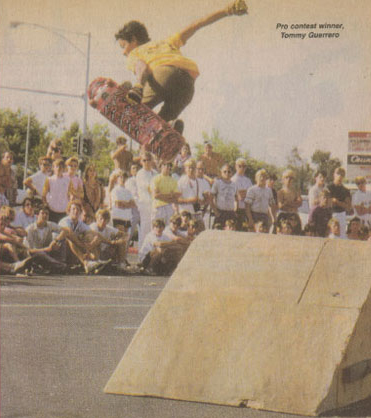
{Photo courtesy of Thrasher Magazine, July 1985}
Wow, really? Any specific spots you’d skate back then?
Not specifically. There were some curbs, some banks. I forget the names of them. But in 1985, Sacramento held a street-style skate contest … I think it was my third street contest ever. And I turned pro there. And that was sort of the launching pad to everything I do with skateboarding. So I turned pro in ’85 in the Tower Records parking lot [off of Watt Avenue]. And what’s interesting is that they just did the Tower documentary … So that was super cool to be part of that, kind of coming full circle. I have a photo of me in 1985 standing in Tower Records next to a stack of Thrasher magazines.
That’s amazing! So you’re saying that contest in Sac was the turning point in your skate career?
Yeah, it was. Because I won the contest and turned pro. And then the next year my [Powell Peralta] board came out and everything happened. So yeah, I know a lot of cats up in Sac, all the old skaters.
See Tommy Guerrero live when he and his band play the Shady Lady Saloon on April 22, 2016. Soak up good vibes, great drinks and copious amounts of old school skater cred. Shady Lady is located at 1409 R Street in Sacramento. For more info, go to Shadyladybar.com.
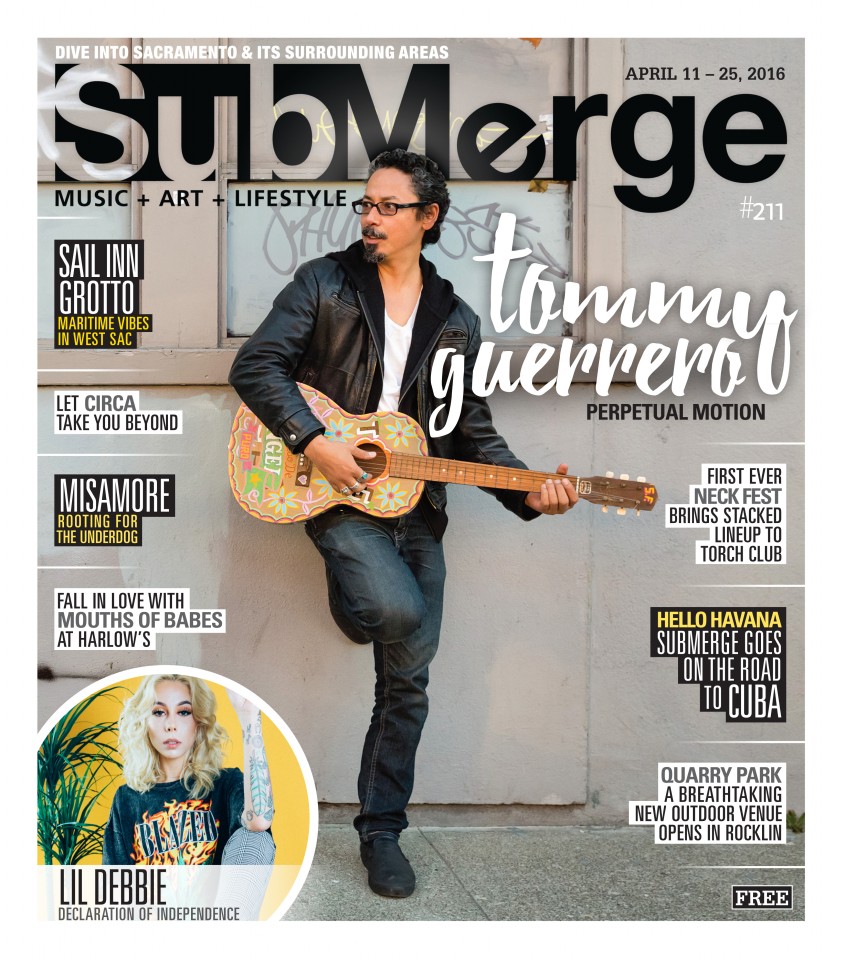
Sacramento artist taps into a childhood obsession for his latest show
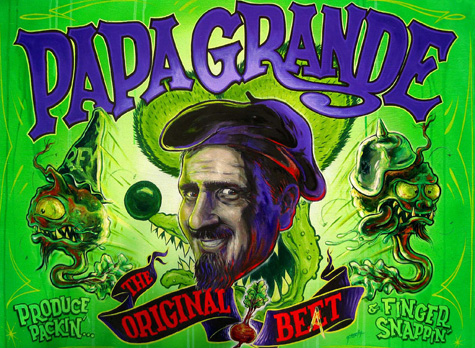
Pop art in the ‘60s and a growing critique of consumer culture at the end of modernism led art into an aesthetic of mash ups, parodies and pastiche. Pulp art, comic books, baseball cards and the developments of global branding strategies all collided into Wacky Packs, a series of stickers that mocked consumer goods through parody, produced by Topps Trading Company in 1967, and originally illustrated by Art Spiegelman (writer/artist of the graphic novel Maus) and Norman Saunders. Fast forward 45 years, the influence of these seemingly benign stickers can be found in the artwork of Bruce Gossett.
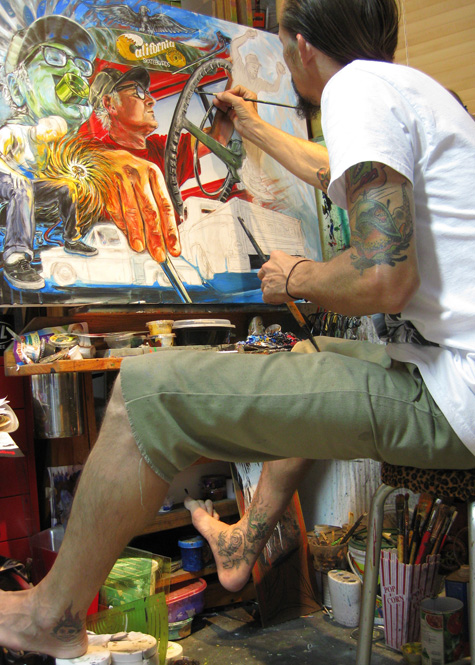
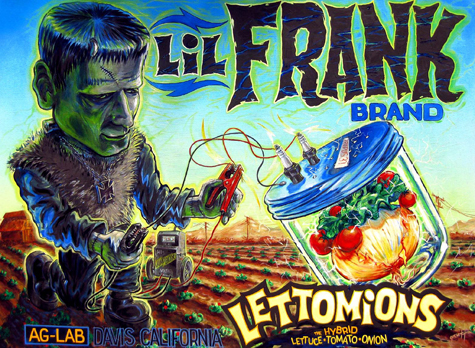
Gossett’s works have been seen at a few select galleries around Sacramento and sold at various car shows over the past decade, but his current work draws specifically on the playfulness and base impulses of a childhood fascination: Wacky Packs. His artwork follows this tradition of plagiarism and parody, using existing advertisements and iconography from the custom car world to create tongue-in-cheek fine art works that connect an adult world of masculine custom hot rods with the juvenile playfulness of puns and gore.
Gossett has developed his art over the years working with multiple graphic forms, all of which have influenced his relationship to the canvas, his preferred medium. He’s printed T-shirts, rock and car show posters, stickers and done customized airbrushing and detailing on cars. He once tried his hand at stand-up comedy, only to realize he didn’t like the spotlight and has since found his calling in a small, insulated shed-studio in the back yard of his West Sacramento home. Gossett spent years going up and down California, attending car shows, selling his works: T-shirts, posters, stickers, fine arts. And the influence of this culture has been foundational to his development as a graphic and fine artist.
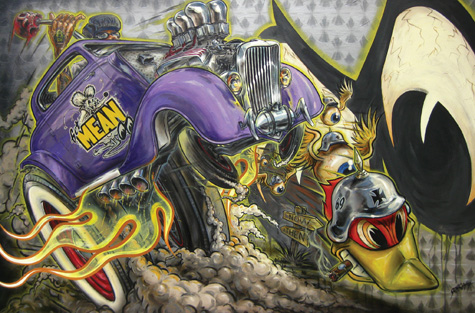
But it’s not just car culture in general that Gossett finds alluring, it’s a specific subspecies of that broader category, those custom car creators, the seedy underbelly of that combination of Detroit automobiles and California counter culture. This DIY renaissance of the automobile, the material object that transported America from farmlands to urban spaces, appears in the work of Gossett as an image set to be appropriated and employed according to a particular set of aesthetics.
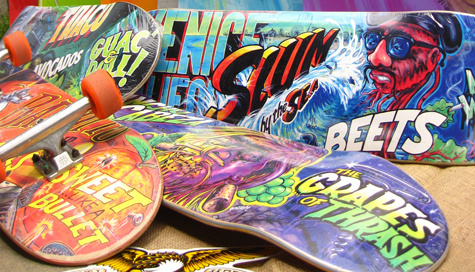
These counter culture references are manifest in his current work, the Speed Equipped series, which will be shown for Second Saturday in October at So-Cal Speed Shop on Del Paso Boulevard. The Speed Equipped show focuses specifically on parodies of logos for hot-rodding companies like Moon Speed Equipment, from which the show takes its name. Gossett has created a set of produce brands with the low-brow humor of those Wacky Packs, and he has even been tapped by Anti-Hero Skateboards and local John Cardiel to create the artwork for a pro-series of decks. Gossett’s works span multiple culture groups and as such he’s a significant contributor in the battle against bourgeois ideals and high-art. He’s a working class artist, and that’s just why we like him.

Tell me about your new show, Speed Equipped.
I was obsessed with Wacky Packs in the ‘70s. They were parodies of national products. You know, household products, Windex and stuff like that. They basically mocked them and made fun of them. They were stickers in chewing gum packs. I remember kids covering their closet doors with them, much to the chagrin of their parents. I got obsessed with them. It was funny. The imagery was so base and crude, like it was painted with a broomstick or something. The humor was just great.
Finally, I thought about it one day, and I’ve never seen parodies of the speed equipment. I’ve always been immersed in the car thing, and I thought why not make fun of the icons of the rod and custom world. It’s something I’ve been working on over a two-year period. I’d like to get them out there and get them seen. I think there’s a generation that grew up in the ‘70s around Wacky Packs, skateboarding, punk, irreverence and that audience totally would get it.
I’m also showing some of my Builders Series. It’s the guys that build cars that I dig, but they’re the new generation of builders as opposed to the old generation. It’s not fair cars and Sunday drives, lawn chairs and car shows. There’s a new generation of builders and hot-rodders and the vast majority of them are coming out of the skateboarding world.
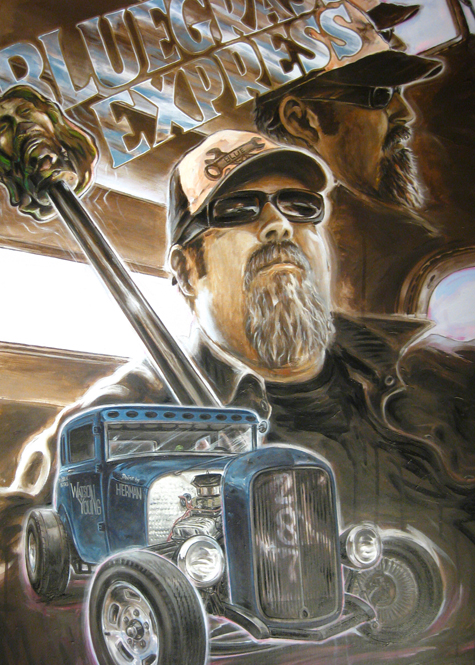
Can you explain how that series is different for you? How it’s a change of direction from your previous work?
The Builders Series is more photo-based. Sometimes it’s the vehicles they build, and I’ll focus on that. Other times I’ll start introducing images of the builder, so it’s a little more personal. It’s difficult, painting portraitures and capturing likenesses. It’s more representational, photo-realistic, but I’m making them psychedelic, lots of drips, lots of maneuvering of the surfaces so that you know it’s a painting as opposed to an airbrushed, photo-realistic work.
What’s the best and worst parts about being an artist?
Being locked in the studio is boring, frankly. There’s nothing more I’d like to do than be in the studio for 10 hours and paint. But by that eighth hour, I’m probably pretty sick of it. The days are weird. There are times when it’s fun; there are times when it’s work. I think I like the beginning and the end best. I like when it hasn’t been touched and I first lay in backgrounds, working from the rear forward. You’re establishing a mood when you first start, so it’s fun. Anything is possible. And in the end, it’s always nice to finish something. You’re happy it’s out of the way.
Once I finish something, I don’t want to look at it for a while. Then a week later I’ll obsess over it for about a week, and then I’m usually pretty good with it. For that reason I always have half a dozen paintings going at any given time.
How do other forms, graphic design, T-shirt printing, etc., influence your work?
These are like complex graphics really. My knowledge and experience over the years from different industries, sign painting, pin-striping, graphic applications for hot rods, on vehicles, I get a lot of influence from those other forms. To produce really clean graphics you work rear forward. Do your infill colors and then hit the black lining. It’s really the cleanest way of producing stuff.
When did you decide to take your artwork seriously?
After about the first year, I took it seriously. I started in 1989. I’ve always designed stuff and did things with paint. We stole Testors paints from Thrifty’s and pay for a ten-cent ice-cream cone, and we’d customize our skateboards. I’ve always been around cars, my family was in the car industry. I wanted to get away from it, so I actually tried my hand at stand-up comedy. That didn’t go real well. Then I took a class at City College, the material was stale but I took to it real easy. I realized not only that I had an aptitude for it, but that I enjoyed it. And I was useless in other areas. I just had a short attention span, and the art thing seemed limitless. It really took off in the mid 90s when I really started pursuing more of a car based or an automotive bend.
What is it about cars and hot rod culture that you find so alluring?
I’ve always had old cars. My first car was a 1972 Chevelle I fixed up before I had my license. It seemed like a meathead world to me. You’ve got to understand the ‘80s. It was the dark days for this car thing. There was a renaissance in the ‘90s, and I got introduced to Big Daddy Roth and that whole world. It was like the thinking man’s hot rod. It was the Bad News Bears, and I missed that from when I was a kid. I realized there were these weirdo hot-rodders, and it totally clicked with me. I decided to get back into it. I built a few cars. I just jumped in.
Even if it doesn’t have cars, I still call some stuff hot rod art. It’s just got an aesthetic. Even a portrait or something, just the way the paint’s moved, it screams hot rod to me. I like a lot of aggression in my art, a lot of action and movement.
How’d you get hooked up with Anti-Hero Skateboards and John Cardiel?
Cardiel saw my Fresh Ripe and Delicious show at A Bitchin Space. He saw the preview in the University Art window, and he totally got it. He totally remembered the Wacky Packs. He said, “I’ve got six riders and I want you to personalize a piece for each one.” I got where each rider was from, their hometown, where they were born. I did a bit of research and developed ideas. It was crude, tounge-in-cheek, vulgar, but it was a skateboard company, no holds barred, and he totally got it. He’s a squirrel; he’s cooler than shit. It was the most perfect client you could ever ask for.

Bruce Gossett’s Speed Equipped opens at So-Cal Speed Shop in Sacramento on Oct. 6, 2012 from 4—9 p.m. The Second Saturday reception will take place the following week, Oct. 13, 2012 from 5—10 p.m. While there, check out a preview of Gossett’s Builders Series. For more info, contact Gossett via http://www.facebook.com/BruceGossettStudios.
International Skateboarding star Joey Brezinski’s Manny Mania returns to Sacramento
Guangzhou, China, is a prime location for skateboarding. Everything is brand new, there is marble everywhere and the likelihood of getting kicked out for pushing around on a board is slim. That’s because security guards are too busy watching in awe. So says pro rider Joey Brezinski, anyway, who visited there recently.
“It is one of the best places I’ve ever skated in the world,” he says over the phone from his home in Venice, Calif.
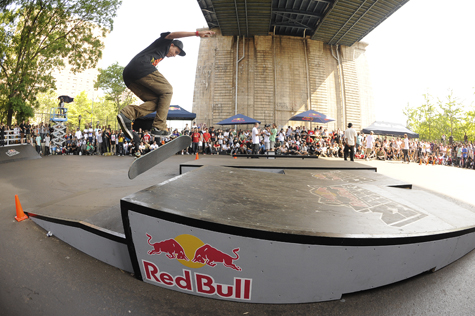
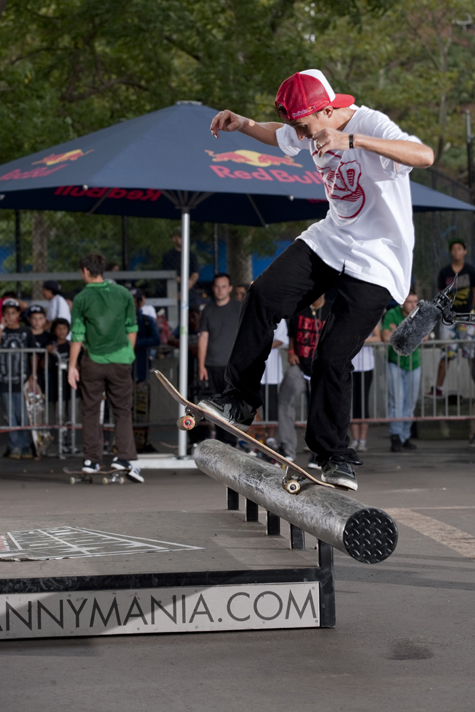
While the sight of Brezinski flipping tricks may be foreign in parts of China, skateboarding is catching on in many regions around the world. Whether he intended to or not, Brezinski has facilitated the process by coming up with a unique skate contest that, in its sixth year running, now spans five continents and 12 countries, attracting participants anywhere from the United States and Chile to Sweden, South Africa and the United Arab Emirates. Red Bull Manny Mania is a skating competition concentrated on the manual, one of the most basic, fundamental skating tricks around.
There are nine amateur qualifiers taking place in the United States alone. Sacramento will host a Manny Mania qualifier this month for the first time in three years, being the only qualifier taking place on the West Coast in 2012.
For those unfamiliar with skate-speak, a manual means that a skateboarder balances on one end of the board while the other end comes off the ground, moving forward all the while. In other words, it’s the skateboard version of a wheelie.
It may seem relatively straightforward, but it’s harder than it sounds.
“It’s a lot more technical,” Brezinski explains. “Instead of having to go big or find a gnarly ramp or handrail, I try to stay low to the ground and maneuver the board more.”

(Photo by Giovanni Reda/Red Bull Content Pool)
The competition demands creativity. Beyond performing the manual, competitors are expected to tie in a variety of other skate tricks into a smooth combo. A sequence might sound something like: a perfect nose manual to late flip on the high box. Again, to the non-skater this is gibberish. The bottom line is, this stuff gets complex.
To top it off, each round lasts eight minutes, during which the rider has to maintain fluidity. The rider who demonstrates the most consistency and control, in addition to the most tricks, wins.
“It’s a lot of balance and endurance, I like to say, because the contest is like running a marathon,” Brezinski explains. “You try to do as many tricks in eight minutes as you can, and it’s pretty exhausting.”
Thus skaters like Youness Amrani come forward–the 2009 Manny Mania championship winner–who, according to Brezinski, are taking things to the next level. One of the most memorable big stints Amrani pulled involved a kickflip manual backsmith, Brezinski says.
As the competition has gained popularity, more and more riders have come to the table to compete at both the professional and amateur level. Big names like Kenny Anderson, Danny Montoya, Daniel Castilo, Brandon Biebel, Jason Dill, Eric Koston and Stevie Williams have shown up in past years. The contest has also brought names like Sewa Kroetkov to light. He was relatively unknown in the skating world until he gave Brezinksi a run for his money in last year’s competition.
What started out as a skate contest in Venice, Brezinski’s hometown, has evolved into a worldwide competition. Brezinski, who made his name debuting in the film Hello JoJo for the French company Cliché Skateboards in 2006, approached Red Bull in 2007 with the idea of creating a manual skating contest. Red Bull was immediately on board, and the result was Manny Mania.
“It was something I always wanted to do,” Brezinski says of the competition.
In addition to the nine amateur qualifiers taking place in the United States, others are cropping up across the globe to draw new talent into the competition. Riders as young as 14 are entering the contest. Each nation’s finalist will compete in New York’s world final in August at Coleman Park; and the winner of the world final will return the next day to compete in the Manny Mania Pro Event.
Since its inception, winners have included Ronnie Creager and Eli Reed. Brezinski won the Venice competition in 2007, in addition to the pro final in 2008 and again last year.
Some years have proven more challenging than others. For instance, in 2009, Brezinski tore ligaments in his ankle prior to the competition while shooting the TransWorld skate video Right Foot Forward.
(Photo by Jody Morris/Red Bull Content Pool)
Last year he shot another video for the X Games Real Street contest. Aside from Manny Mania, Brezinski isn’t one to enter skate contests (it means more time spent traveling and less time skating the streets), but last year he made the exception to shoot the one minute of skate footage that, if it had been chosen, would have aired on NBC during the X Games.
“It was insane,” he recalls.
This year he is shooting yet another video, apparently, this time for Cliché. It’s for a sponsor he loves. Whereas other brands don’t provide him many travel opportunities, Cliché allows him to head to Europe every year for a visit. Still, anticipating this year’s competition, he vows to take it easier than he did in 2009.
Plus, he has energy to save for another big endeavor, namely his new business, Andale Bearings, which he just started with co-owner Paul Rodriguez earlier this year.
For Brezinski, the business world is new territory.
“Like skating, every day is a new trick,” he says.
Commanding a business with a mission to put the best bearings into skate wheels means fewer hours on the road and more hours at home in Venice. That leaves a couple hours a day at the skate park.
Yet, while exotic locations like Guangzhou will always have skating allure, Los Angeles remains one of his favorite spots to skate. Not only is it where the first Manny Mania went down, it’s also where he started out on a board at age 8 or 9.
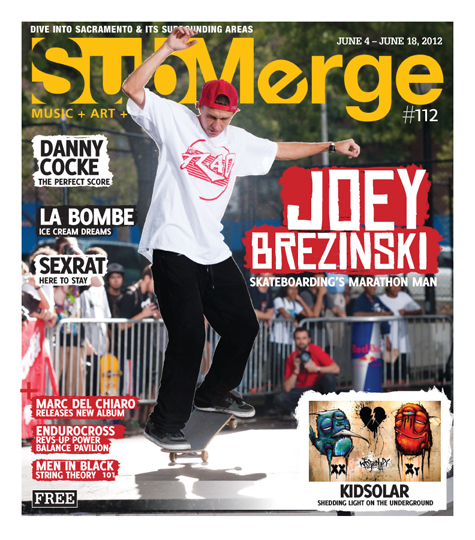
Red Bull Manny Mania’s only West Coast qualifier will take place in Sacramento on June 9, 2012 in front of the MARRS Building (1050 20th Street). The event is free and open to the public. Skaters can register ahead of time at FTC in Sacramento, PLA in Folsom or at the event starting at 3 p.m. Skating starts at 4 p.m. To keep abreast of all things Joey Brezinski, follow him on Twitter @joeybrezinski.
Sacramento Skimfest Puts The River City on the International Skimboarding Map
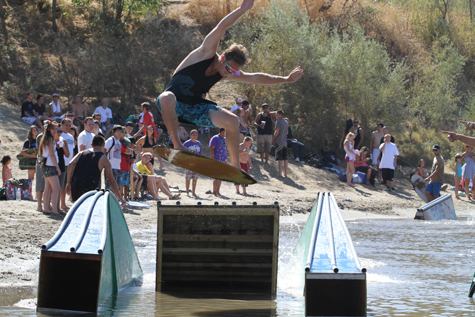
One day every summer, people line the American River to watch guys, and the occasional girl, go airborne on skimboards at Paradise Beach. Riders, as they’re called, propel themselves along the water before launching off ramps and grinding rails.
This is Sacramento Skimfest, a flatland skimboard competition that attracts sponsored riders from as far away as Ontario, Canada, to compete. Running on its 15th year, it is known for attracting some of the best skimboarders in the world, as well as being one of the longest running flatland skimboard competitions to date.
“Skimfest has I think the best reputation of any flatland comp in the world so it’s quite a big deal,” Sam Price, owner of New Zealand board company OXS Skimboards, said via e-mail.
Greg Krolczyk, director of the skimboard retailer Skim City, is a wave rider himself, but he expressed mad respect for Sacramento’s flatland riders over the phone.
“I’ve seen the videos. They’re killing themselves. They’re skimming on nothing,” he said. “God bless them. I appreciate their imagination and dedication.”
Think of flatland skimming as skateboarding just beyond the water’s shore, minus the wheels.
Riding a wooden board over hand-built ramps made of wood and PVC, in water that is only inches deep, is risky business as far as Krolczyk is concerned.

Lon Porteous
Little did Skimfest cofounders Lon Porteous and Mark Robinson realize that when they began blending the features of skateboarding with flatland skimboarding in the ‘90s, they were pushing the sport into new territory that would have wide-reaching influence.
It is the innovation and longevity of Skimfest that has put Sacramento on the map in the skim world.
Unlike wave riders, who flock to Laguna, Malibu and Florida to skimboard, flatland riders can ride on any large body of water.
“Ninety percent of the people in the world don’t live near a break you can skimboard at,” Porteous said, but most people live near a lake or river where you can set up skim ramps.
And Paradise Beach along the American River has been a hotspot for flatland skimming for years.
This is where the new school of flatland skimboarding started, Porteous said. He has been skimboarding for the past 25 years, starting in his teens. At that time, performing an ollie on a skimboard was unheard of.
These days, Sacramento Skimfest draws an average of 60 competitors, including about 30 sponsored riders, to Paradise Beach each year. Competitors travel from nearby locations like Granite Bay and Yuba City, and further locations like Utah, Washington and Vancouver, British Columbia. Competitors are broken up into the beginner, intermediate or pro division, which consists entirely of sponsored riders.
Pro flatland riders like Blake Zimmerman and Lexi Hutchings have shown up to compete in past years, in addition to pro ocean riders like Brandon Rothe and Morgan Just.
Matt Matteucci, a local flatland rider whose past sponsors have included Kayotics Skimboards and Ground Zero Boardshop, is currently the primary organizer of Skimfest. After competing in 2005 he became increasingly involved with Skimfest in the following years.

Matt Matteucci. Skimfest, 2010.
Along with Porteous, he did most of the legwork to produce Nothing Is Cool, a film of the flatland skimboarding scene in Sacramento that came out under Blister Productions in 2007.
Though Robinson is no longer involved, Porteous has recruited other local riders like Matteucci to help keep the competition going. At this point, Skimfest is the only flatland skimboarding competition run by riders, Porteous said.
Each year, a couple of weeks before Skimfest, Matteucci, Porteous and other riders build the ramps, which are often inspired from setups used for skateboarding or snowboarding.
The event has been on the up and up as the skimboarding scene has continued to grow over the past five years, Porteous and Matteucci agree. The event’s increase in popularity, along with its generous first place prize, has doubled the number of sponsored riders since its early years. Last year, the first place winner of the competition received $1000.
Submerge had an opportunity to speak with Porteous and Matteucci about the evolution of Sacramento’s skim scene, the shortage of female competitors and the far-reaching influence of Skimfest. The following is an excerpt from the conversation.
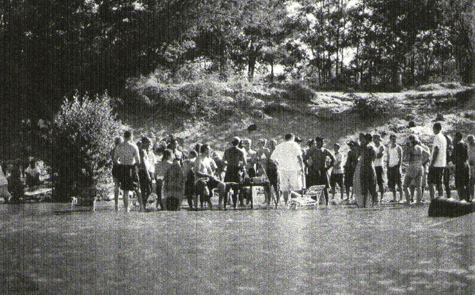
2nd Annual Sacramento Skimfest, 1998.
So tell me a little bit about the scene, the skimboarding scene here.
Lon Porteous: In the ‘20s, they started flatland skimboarding down South, the lifeguards did, so they could travel faster up and down the beach. So from there, flatland skimboarding started. It progressed in the ‘70s. It went more toward ocean skimboarding, which is more, “OK, let’s ride out into some waves.”
So, where I come in, is growing up in Sacramento, part of the skateboard side of it [was] we realized we could do a lot of our skateboard tricks on our skimboards. So, we ended up taking a lot of stuff and crossing it over, at a time where people were just basically sliding down the beach or trying to do headstands or basic tricks.
We turned around and were like, wait, we could ollie a board, we could make rails. You know, we could do a rail slide, we could do everything we do on a skateboard. So me and a guy named Mark Robinson… we ended up progressing it.
In terms of who’s putting together all the ramps and stuff…
Matt Matteucci: You’re looking at us right here. I mean we have other people that build. Most of the time we build at [Porteous’] house.
So I get the impression that this is more of a guy’s sport. Is that accurate?
LP: Yes. And no. We had more girls in our first year at Skimfest than we have now, which was great. There are some really, really talented girls that skimboard. Unfortunately, the girls that came through in Sacramento are no longer living in Sacramento. They have also progressed. There was a girl on my skimboard team, and she is now an ocean skimboarder. She competes.
And so, I think it just depends, because without a major influence like that, you know, somebody that a lot of girls can look up to and say, “Yeah, I could be as good as her,” or “I can do that” … they don’t have anybody to really be that role model. But there are scenes that have a really good girl turnout, like Washington, Vancouver. I would even say Utah had a pretty decent girl turnout.
I would be happy if I could just have four girls come that want to compete. I would bend over backwards to do whatever they want. But you go down to the river and it is all guys.
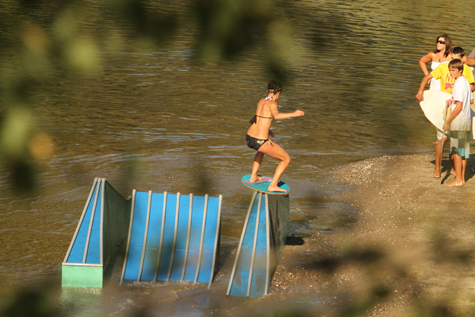
Lexi Hutchings. Skimfest, 2010. Photo by Kevin Fiscus - www.kevinfiscus.com
Yeah. I was hanging out over there one day, and some guy tried to show my friend how to skimboard. She got a nice red raspberry on her ass. I mean, it was her first time.
LP: Yeah, and I have the same raspberries, so tell her not to feel bad about it.
Speaking of [that], I was looking at some of those videos, there are some really crazy ways that people go down on those boards. Do you get people who are really injured, or …
LP: We never, ever, ever have had people get really messed up or anything. I mean, yeah, the normal rashes, scrapes. Most of the time, the worst thing that happens are elements in the water. So glass or something like that. Or nails. Like I’ve seen one kid have a nail go completely through the bottom of his foot. Yeah, and there’s nothing better than a rusty nail that’s been lying in the water. You probably end up with the same injuries you’d get skateboarding, like you break your hand or you break your wrist.
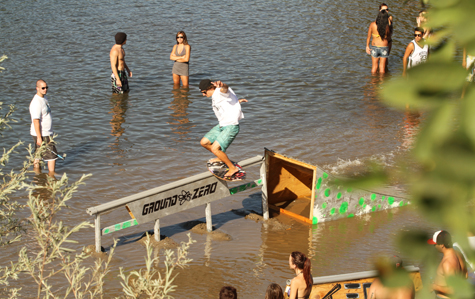
Brent Lippincott. Skimfest, 2010. Photo by Kevin Fiscus - www.kevinfiscus.com
Would it be accurate or fair to say that more people know about Skimfest outside of Sacramento than the people in Sacramento? And how far out do we have a reputation?
LP: Global. Worldwide.
Put it this way, you don’t know how big of an influence you have on other places until you go.
When [Price] got here, I had chests of old swag, Skimfest shirts, stuff like that, that are new. And he said, “You don’t even understand how much this stuff would be worth [in New Zealand].” And I was like, “What do you mean?” [He said] “People covet you guys, you don’t even know, because you’re from Sac.”
And so here are these people saying how much influence we’ve had on their scenes. And it was nuts, because I just thought I was giving him some Skimfest shirt.
Sacramento Skimfest 2011 will celebrate its 15th year on Sept. 10 at Paradise Beach (Glenn Hall Park). Registration runs from 9—11 a.m. and the competition will take place from 12—4 p.m. Registration fees vary depending upon your level.
Sacramento-based clothing company Lurk Hard turns heads with their designs and their skate team
Over the years, the greater Sacramento area has bred or been home to some incredibly talented skateboarders: John Cardiel is quite literally a legend; ESPN called Matt Rodriguez “one of skateboarding’s unsung godfathers of style”; Brandon Biebel is a worldwide name; Omar Salazar and Stefan Janoski have their own Nike signature shoes, for crying out loud. This list could go on and on. There are a lot of rippers from around here making waves in the skate scene; currently, the Lurk Hard crew is a huge part of that. If you’re asking yourself, “What is this ‘Lurk Hard?’ And does it have anything to do with how much time I spend on Facebook creepily looking up people?” you’re wrong, sort of.
 Lurk Hard is a Sacramento-based clothing company that makes T-shirts, sweatshirts, hats, beanies, etc. that was started by longtime skateboard enthusiast and Fresno, Calif., native Geno Failla. The company’s website, Lurkhard.com, offers up this description: “Lurk Hard offers an innovative style solution for your everyday lurker by offering affordable, quality clothing products that skateboarders can connect with to complement and enhance the lurker lifestyle.” Since the company’s 2008 inception, Failla has built a solid team of talent to rep his brand. The team’s second video, Summer Boyz, was recently uploaded online in its entirety to Lurk Hard’s site in a six-part series. In celebration of the film’s free digital release as well as Lurk Hard’s spring/summer 2011 collection being released soon, Submerge hooked up with Failla and team shredder Chuck Donnatin, arguably one of Sacramento’s biggest contenders to be “the next big thing,” for a couple separate interviews.

Lurk Hard owner Geno Failla sipping coffee in Spain
Geno Failla,
Owner of Lurk Hard
When did you start Lurk Hard? What was your motivation behind starting your own clothing company?
I started the brand in January 2008 with my ex-girlfriend Jeanie Sriboon. Shortly before the conception of a brand, I wanted to do something that involved skateboarding and have an outlet for my creative ideas. We made some stickers and a few shirts and things just started to develop from there.
How many stores can your stuff be found in now? You guys are all over, right?
We’re in about 30 stores throughout the United States; our own online store, Shop.lurkhard.com; FTC in Barcelona, Spain; and Animism in Australia.
How many skaters are a part of your team?
The Lurk fam consist of Chuck Donnatin, Clyde Moore, Mark Dillon, Rob Mason, Nicholas Silva, Blue Turner, Aric Hondel, JR Dias and a few others on our flow program.
How long have you known Jack Mansfield, the filmmaker who’s done both Lurk Hard videos? What draws you to his filming style?
I met Jack shortly after moving to Sacramento in 2005 through Rob Mason at Flatspot skate shop one day. Jack’s whole entire creative process from start to finish with any project he does is amazing. It’s rad that he still uses Super 8 film nowadays, considering most people have moved on to using only HD cameras. I love the way Super 8 looks! I know that if Jack is going to do a video with us, it will be top quality. He doesn’t do anything half ass at all.
Summer Boyz is the second official Lurk Hard video. Why did you guys ultimately decide to upload it online instead of putting it out on DVD?
Yes, Summer Boyz is the second video that we’ve done with Jack Mansfield. The first one was 19 Years Young. We decided to put it online for everyone because we wanted more people to see it worldwide. If we decided to sell it, there’s a lot more to deal with in getting the rights to music that we used as well.
Can you hint at anything else exciting on the horizon for Lurk Hard? What about the next video project? Have you started thinking about that yet?
We have our first part of our spring/summer 2011 line coming out in stores and online in about a week. I can’t say much about some of our upcoming collaborations with other brands, but I’m pretty excited about doing them. We’ll be working with new designers as well. Stay tuned for more on that. As for another video, we never stopped filming after we finished Summer Boyz. But I’m not sure when the next project will be out. We’ll always have short videos on our site; check it out at Lurkhard.com.

Chuck Donnatin,
Lurk Hard team skater
How old are you? How long have you been skating?
I am 21 years of age. I’ve been skating for about 11 years now, about half of my life.
How long have you lived in Sacramento? What brought you here?
I moved down here about eight or nine months ago. Skateboarding and filming out here, you know, I thought I’d cut out the two-hour drive from Gardnerville to Sacramento.
You were making that commute a lot, huh?
Dude, wintertime, summertime, all the time. So I moved out here with the boys, and I’m just going to school out here and working.
How did you connect with the Lurk Hard crew?
Well I’d been skating with a few of the guys, Rob Mason and Mark Dillon. They are good friends with Geno. I’d just come down here and film and just meet up with the guys. It was before my first knee surgery, right when I got out of it I was down in Sac, and Geno had heard about me through word of mouth and he was like, “You know what, I’m starting up this company called Lurk Hard and you’ve been shredding, so…”
So when you first met him you weren’t even skating because you were hurt?
I forgot exactly when it was. It was before my surgery or right afterwards, but I wasn’t skating for like a year, because that’s how long it takes. He was like, “When you get back at it, let’s do it.” It’s been good since then. He’s been good to me.
What happened with your knee? In Summer Boyz you’re wearing a gnarly brace.
Originally I tore my ACL skating, which was about three years ago, right around the beginnings of Lurk Hard. Yeah, I’m just misfortunate, you know? I’ve been through multiple knee surgeries now. The reason I was wearing that knee brace was because I had my second surgery about a year-and-a-half ago, and it’s just to be supportive of the knee. But just jumping down all that crap, you know? I don’t wear that now, though.
Oh, so you’re out of the brace now?
Yeah, I’ve been working it out, building up that muscle. Got to keep on doing that, it’s crucial. But I feel comfortable to not wear it now, so we’ll see how it goes.

Screen capture from Lurk Hard’s new film Summer Boyz
Lets talk about the Summer Boyz video, the most recent Lurk Hard flick. Are you stoked on how your part came out?
Not really [laughs], to tell you the truth. I could have done a lot better. I came out of that surgery and it was right when I moved down to Sac, that’s when I started getting back into filming and pushing it… And that damn knee brace looks so goofy.
Well I thought your part was sick. And just in general the whole film is really well shot and edited and everybody’s parts are pretty rad. How long have you known Jack Mansfield?
Mark Dillon pretty much introduced me to Jack and his work and that was about three years ago, it was a while ago. Ever since then I’ve loved his work. He’s an amazing filmmaker. He’s got his shit down.
Who are your sponsors right now? Who is hooking you up with gear?
Lurk Hard, The Company Skateboards, American Icon Wheels out of Stockton, those are good wheels. They are killing it. And Converse, I’m getting some shoes from them. It’s just team manager type shit, but you know, I’m getting some shoes from them. Trying to build on that is another thing that’s on my plate.
That’s a legit connection; do you think it will lead to a full-fledged sponsorship?
We’ll have to see.
How did you get hooked up with them?
There’s a rep up in Seattle I believe it is, he’s been shooting me the shoes. He knows Eddy at FTC and Darnell with The Company, they are his homies and were like, “This kid is skating hard and likes Converse, so shoot him some shoes.”
So it sounds like you’re definitely on their radar?
Kind of, yeah, not big time.
When we were trying to set up this interview you mentioned something about how you have to go to a yoga class. How long have you been doing that and does it play into your skating at all?
It’s new. My body is toast, you know? Between skating, working, just getting after it, I don’t like resting. Plus since I went through the knee surgeries and all that stuff, I feel like I need to be flexible on my skateboard with my balance and all that. I’ve been getting really into skating, my body and taking care of myself. I’ve been doing it for about two months now. It just feels like I’m more limber. I drink a lot, you know [laughs], and drinking is terrible for your muscles. It’s terrible for the day after as far as being one with your board. Yoga is a good way to just keep limber and, well, the girls are gorgeous in there too.
Do you ever think about your goals for your skateboarding career?
Oh God yes, all the time. That’s pretty much what keeps me going. I always got the plan on the calendar, what’s going down. Omar [Salazar] was telling me before he did it big, he had this plan of what he was going to do and when he was going to do it. I think you need that. Because whenever I step on a skateboard, I’m having the most fun I’ve ever had, so I might as well take that and make a plan with it–you know, organize it. Everybody is like, “Oh, I just skate for fun,” and I’m like, “Every time I step on my skateboard I’m having fun so I might as well make a business out of it.”
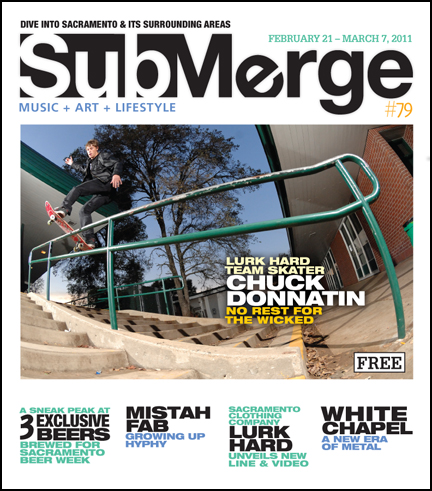
Check out Lurkhard.com to view Donnatin and the Lurk Hard crew in Summer Boyz, a Super 8 film by Jack Mansfield. To grab some Lurk Hard gear locally, hit up FTC, Nine16 Skate Shop, Getta Clue or any Ground Zero location.
Flip AM team member Louie Lopez is on the up
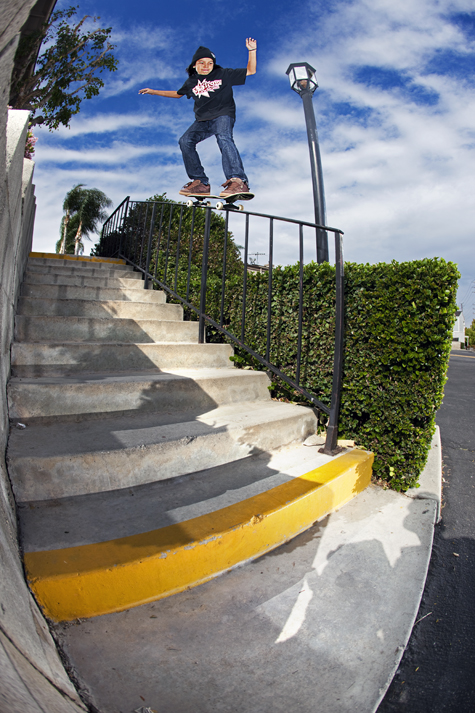
Amateur Flip Team skater and big air-grabbing 16-year-old Louie Lopez is one rad little grom on the board. So gnarly, he and his Flip buddy Curren Caples take trick requests via text message. Sporting a regular stance, Lopez is stands under 5-feet, with a mane of black hair that trails behind him like a super hero’s cape when he is on the move.
Days before Lopez’ buttery-ass 16th birthday, because there’s nothing sweet about skating, he will be tearing up B Street Skate Park with Geoff Rowley and others as the Flip West Coast Represent Tour hits Sacramento.
Lopez came up in Hawthorne, Calif., honing his skills at the local skate park he fondly refers to as “The Dirty.” After being discovered by Lance Mountain of Flip Skateboarding, in a kind of creepy manner (keep reading on), Lopez signed on with the AM team. Besides being a member of the Flip team, he’s secured endorsements with Volcom Clothing, Globe Shoes, Fury Trucks and Madrid Fly Paper. The kid is bringing the ruckus, so to speak, to skating at an exceptionally young age. Two years ago he took sixth at the Dam Am in Costa Mesa and at this year’s Amsterdam Am he took second to Alec Majerus. He’s been on Fuel TV as part of its New Pollution series, Thrasher Magazine videos and has a role in Flip’s Extremely Sorry.
I was struck by Lopez’s favorite music to throw on his iPod when he’s out grinding; a 16-year-old who listens to Wu-Tang Clan? Enter the Wu-tang: 36 Chambers came out a year before he was born.

What is your favorite Wu-Tang song?
My favorite Wu-Tang song would have to be either “C.R.E.A.M.” or “Protect Ya Neck.”
Wow, selecting two off the first album.
I haven’t been listening to Wu-Tang for too long, maybe like two years or something. A lot of my friends used to listen to it. I started listening to it and I liked it.
How did you get on the Flip team?
It was through Lance Mountain. I used to skate with him at this skate park called Vance Park in Orange County. He called the owner [of Flip Skateboards] to go watch me skate. I didn’t even know who he was. It was really crazy, because he didn’t look like a skater. He was just watching me skate. Wherever I’d skate, he’d appear. It was just like, what’s going on? Then he asked me to join Flip.
Were you creeped out by him at first?
Not really creeped out. I just didn’t know what was going on.
So you’re on the Flip AM team right now. What’s it going to take for you to advance to the pro squad?
To be a pro, I guess you have to keep skating, put in your work and when your sponsors think you’re ready to go pro they make the move, I guess. I’ve been skating for Flip since I was 11 or 12. I’m about to turn 16 now, on Nov. 26.
You’ve skated Steve Berra and Eric Koston’s skate park, the Berrics. What’s your favorite part of that indoor park?
They have the best flat bar ever. It’s really long and circular. It’s the funnest thing there.
You made it into the Sorry video series. Did you ever think you’d see a claymation version of yourself?
No. I would never have thought that. I was extremely happy to know about them and be in the video. I didn’t have any idea what it was going to look like. When you don’t have any idea, you’re antsy to see it and nervous because you don’t know what to expect.
Being a skater and having braces, are your parents concerned about their investment in keeping your teeth straight?
Actually I just got my braces [taken] off like three weeks ago. It feels weird. You keep playing with your teeth with your tongue. At first you feel like you have the biggest lips because they flap over more on your teeth. I don’t think [my parents] are concerned, though. If it happens, it happens, I guess.
You were able to pull off grinds on some pretty lengthy stairs. Have you ever challenged Geoff Rowley or any of the Flip team to a stairs-off?
No. I’ve never done that. They’d probably take me. They’ve tried to ollie 20 stairs and stuff. The most I’ve ollied is probably 14.
Is there a chance that when you come to Sacramento on the tour that you could lay down a buttery-ass heel flip and give a shout out to Submerge?
Yeah. I’ll try to do one, but I don’t know how buttery it will be. I won’t pop high off the ground, that’s for sure. But, I’ll try one.
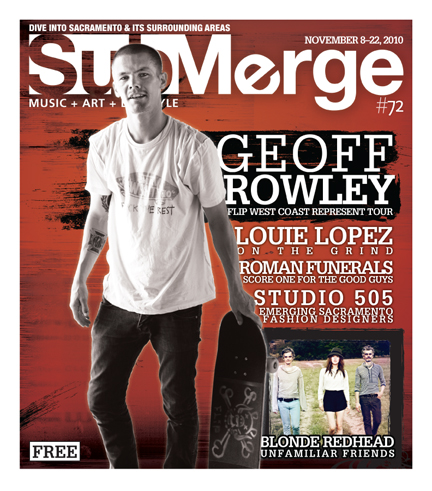
Geoff Rowley on Skateboarding…Mostly
If you know anything about skating, you don’t say “who” when Geoff Rowley’s name is mentioned, nor do you casually agree to an interview with him. The proper reaction should be similar to the yells and panty tossing that boy bands typically receive… or a cavalier, but cool reply of “gnarly.”
Rowley was Thrasher magazine’s Skater of the Year in 2000 and one of the few blokes lucky enough to have a trick named after him, the Rowley Darkslide, a variation of a trick created by the great Rodney Mullen. Rowley’s legendary video parts showed him going huge since 1994, back in Liverpool before he jumped the pond.
Now of the old guard, he’s bringing his tour to Sacramento, tearing up B-Street Skate Park on the Flip West Coast Represent Tour. The tour features pros and amateurs of the Flip team, including Curren Caples, Andrew Langi, Lance Mountain, Luan Oliveira, David Gonzalez, Ben Nordberg, Rune Glifberg and Louie Lopez (also featured interviewed).
Rowley’s name rings in the urban jungle and in the actual jungle. In fact, a hobby of his is to track big game in the wild. This juxtaposition of interests was the source of my intrigue, thus it was my first question for Mr. Rowley.
When did your fascination with wild beasts start?
I probably couldn’t put an age to it, but just before my teen years my friend, who I skated with, was friends with the chief game warden up north of England. I’d been skating with that guy so much, and he’d been skating since 1972, so he was a lot older than me. But I had fun skating with him, got on a roll with him. We were into all the same skaters–shit like that. So I ended up hanging out with him outside of skating. We went up into the north country of England one time and just enjoyed it–basically stalking deer. That’s kind of where it started. I’ve been doing it for over 20 years since then.
Do you have any stories of you hunting/stalking trips going awry?
No. I wouldn’t say anything’s been that close. I’ve had friends who have been in some bad situations. This is about skateboarding; what’s going on here?
Have you ever skated in Sacramento? What’s your favorite spot here?
Hundreds of times, all over the city, even way up in Placerville. I know the area really well. John Cardiel and Omar Salazar are from out that way. I’ve skated with those guys many times.
I wouldn’t say I have one favorite spot. There was this one rad car park with…barriers on the top, but they took it out. It was pretty rad and unique. A lot of the stuff downtown when I was first going to Sacramento, you can’t skate anymore. Downtown isn’t really skateable.
There’s good stuff in Davis. All over the place. It’s a big suburban area with a lot of skate parks. So there’s plenty of good stuff to skate with a good scene as well.
Do you have any plans to continue the Sorry series?
We just finished the third video last year, which was Extremely Sorry. It was only kind of intended to be a trilogy. So I would say we’re moving forward now as far as any other videos we’re working on in the future. They’re going to be new and fresh. It’s important to evolve. We had fun with that and that was a chapter of our company, but it’s reinvigorating to have a new start. Change is good. Unless we’re talking about Obama, then change doesn’t appear to be that good so far.
Do you want to make this a political discussion?
No I don’t.
Would you care to say a few kind words about Louie Lopez, since he’s joining you in Sacramento?
You can’t say anything but good things about that kid. He’s rad and super progressive. The raddest thing about Louie is that he smiles. He loves it and that’s going to take him to the end of the earth. If I could have one young kid riding for Flip as an amateur, it would be Louie Lopez.
He’s constantly learning new tricks and out skating all the time. He lives in Hawthorne, Calif., so he’s around a pretty good scene. There are a lot of kids that skate. A lot of kids don’t have a lot of money in that area so they’re a little more humble. He’s just around good people, down-to-earth people. It shows in his skating.
There’s a guy who taught his dog to skate. Considering you’re a man fascinated with animals, what animal would you teach to skate?
It would have to be a full-size, maybe 6-foot-long weasel. That’s the only thing that could go fast enough, I would say. It would be the only thing that would have the same kind of control on a skateboard.
Last question. You’re at the Pearly Gates and St. Peter demands you do one trick to get into Skatepark Heaven. What do you pull?
Probably turn around and go fakie.
Put professional skateboarder Omar Salazar on the phone for an interview, even while he’s in Australia on a Nike Skateboarding team trip, and you’ve got one of the nicest dudes you’ll ever meet; caring, witty and all around fun to talk to. Put Salazar on a skateboard, assuredly where he’d rather be than on the phone, and you’ve got a savage on wheels; a straight-up wild man that charges at his tricks with relentless speed, dedication and concentration. The 26-year-old skater from Sacramento has made quite a name for himself in the industry, especially within the last couple years with his part in Alien Workshop’s video Mind Field, making the March 2009 cover of Thrasher and the announcement from Nike that Salazar will have his own signature shoe. But all the success hasn’t come easily.
Salazar was raised by loving and supportive parents who fled to the States from their home country of Chile. Pursuing a career in skateboarding, though, was not exactly what they had in mind for their son in this so-called land of opportunity. “They were always like, ‘Hey look, you’re lucky you have opportunities here, you need to go to school and you need to work for a big company,” said Salazar of his parents outlook on his skating. I was always like, ËœYeah, but I don’t want to do that; I’m not good at that. This is what I want to do.”
Salazar remembers having to hide his skateboards and boxes of products that companies were sending him so his parents didn’t get suspicious. “I didn’t want to disappoint nobody, but I was never good in school,” he admitted. “I mean, I finished high school, but I was never good as far as book smarts goes, I’m better at street smarts.” Those early years also consisted of a lot of couch surfing, riling up change from said couches to hit up Del Taco, raiding Safeway’s sample tables and bombarding open house food platters. “Yeah, I’ve come a long way,” Salazar said with a laugh, looking back.
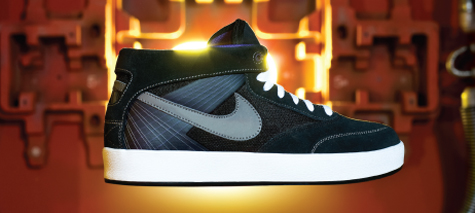
A long way is an understatement, as this month Nike will release Salazar’s first signature shoe, a career milestone for any athlete involved in any sport. Salazar will be the second Sacramento-area skater to get his own Nike shoe, as teammate and close friend Stefan Janoski did so just last year.
“In the beginning,” Salazar remembered, “Before Nike gave anyone shoes, Stefan and I, we’d had offers before in the past from other shoe companies, but I always stick with what I believe in. I believe I’m a loyal rider. That’s just the most important thing. So, I figured if I kept loyal with Nike and the people I work with, then something good was going to happen.”
Even after Nike told them years ago that Paul Rodriguez would be the only team skater to get his own signature shoe, Salazar stuck it out, all the while telling Janoski, “We’re going to get shoes, trust me.” Eventually they both got the phone call and for Salazar, it was sort of an ‘I told you so’ moment when they did.
“I don’t want to sound cliché or lame, but in a way I kind of manifested it because I knew it was going to happen,” said Salazar, not in a cocky manner, but a confident one. “Even before they offered me a shoe, I drew up a design and straight up put one in my room, one in my bathroom and one in my closet.” Salazar would be gone for months on skating trips and he’d come home having forgotten about his dream shoe designs, which re-invigorated him to skate harder, to keep going so that one day it would be a reality. “Like a year later after working hard and having fun skating and stuff, they hit me up and were like, ‘Hey, we want to give you a shoe after Stefan.'”
When it came time to actually visit Nike HQ in Portland, Ore., to meet the people who would be designing his shoe, Salazar was well prepared with his sketches, his favorite color schemes and other things that represented him and his personal style. “When I first started working on the shoes, they were like, ‘Shoot us your favorite colors, your favorite objects, your favorite things around the house, bring us photos of them.’ I didn’t know what the hell they were talking about,” said Salazar. Nike was essentially asking for pieces of Omar so that his shoe “could tell a story.” Turns out, Nike doesn’t just give signature shoes to anyone and when they do, they always have little stamps of the athlete’s personality and style on them. Take for instance Michael Jordan’s famous Air Jordan logo, jersey number, etc. found on his shoes. Salazar wanted a classic-looking silhouette, but with Nike’s new technology infused.
“I’m really into the ’50s and oldies, and I like old tin cans and old rockets and outer space and all that stuff,” said Salazar of some of his personal interests. Hence the reason his shoe features a cool little rocket ship on the sole. Salazar also pointed out that he likes to surprise people, so he told Nike he wanted to make the tongue of his shoe interchangeable. “I wanted to have fun with the shoe and I wanted it to be functional for people,” said Salazar. “Some people like to tie their shoes real tight and some people keep their shoes real loose. Some people like a thin tongue, some people like a real thick tongue,” he said. He also wanted Sacramento-area residents to connect with the color scheme, so he included purples and blacks to match our beloved Kings’ colors.
What really makes Salazar’s signature shoe stand out, though, is the inclusion of Nike’s Flywire technology, something new to the world of skateboarding shoes. Basically, shoes with Flywire are really light, yet really supportive—two attributes not normally associated with one another in the sporting shoes industry. In the past, more material meant more support, but in turn the shoe got heavier. But with Flywire, Nike took Kevlar and spun it into an embroidery-thin thread for reinforcement, and then they added Lycra in areas that needed power and stretch. According to Salazar, they feel great. “Nike’s technology enables the shoe to be lighter and support your foot more and lock it down really well,” he said of the shoe’s feel.
Sacramentans will be able to witness Salazar ripping up B Street Skatepark in his new shoes on Sunday, March 7, at the official shoe launch demo along with Nike teammates Paul Rodriguez, Stefan Janoski, Brian Anderson, Justin Brock, Grant Taylor, Daryl Angel, David Clark, Elissa Steamer and Brad Staba. Anyone who knows anything about skateboarding knows those are some heavy hitters and that this event is will not be to miss. As our conversation was coming to an end, Salazar closed with a bit of advice for the young skaters out there. “The one most influential person that told me how to get shit was John Cardiel, Sacramento’s best skateboarder ever. Whenever I was trying something, just trying for hours and hours, he’d yell out, ‘You’ve got to want it! You’ve got to want it!’ That stuck in my head forever, so if there’s any message I’d give anyone, it’s that.”
Catch Salazar and the Nike SB team on Sunday, March 7, 2010 at B Street Skatepark. Demo starts at 2 p.m.
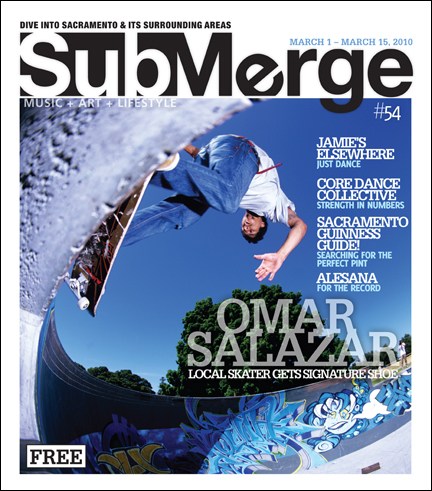
Cover photo by Jonathan Humphries