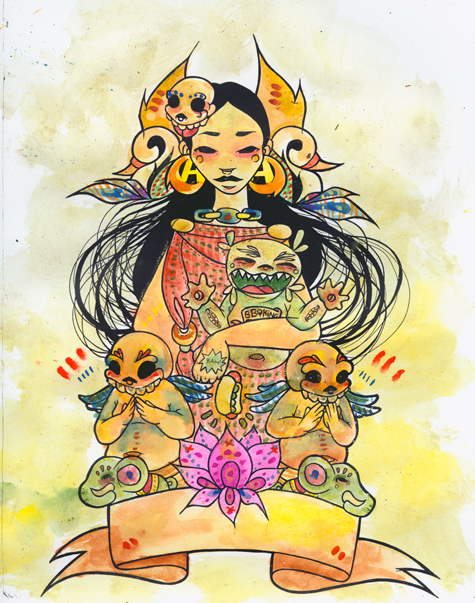
Ricky Watts’ relationship with art can most accurately be described as a lifelong, full-fledged obsession. Watts’ mom claims that he was drawing before he was even able to walk, and by the time he was a teen, he was funding his weekly lunches by selling doodles to classmates.
Fast-forward to the present: Watts has shown his pieces at a laundry list of galleries all over the country, and has expanded his clientele to include Google and Mercedes-Benz, among others. While he has gained prominence with his accomplishments in the graffiti world, Watts has a unique diversity in his body of work. He is an illustrator, a realist and a graffiti artist all in one.
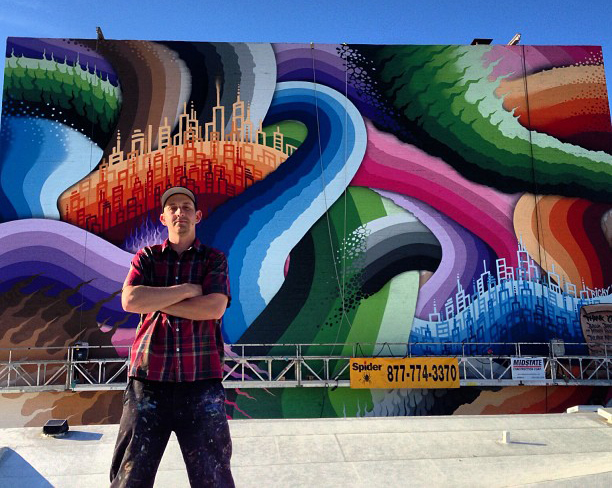
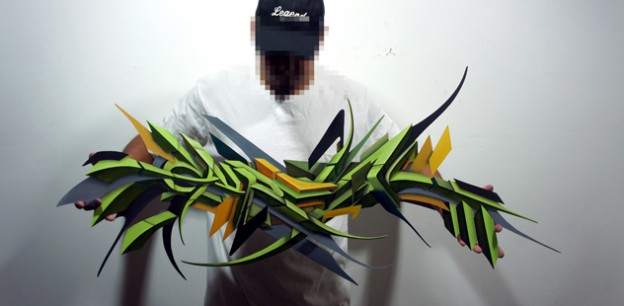
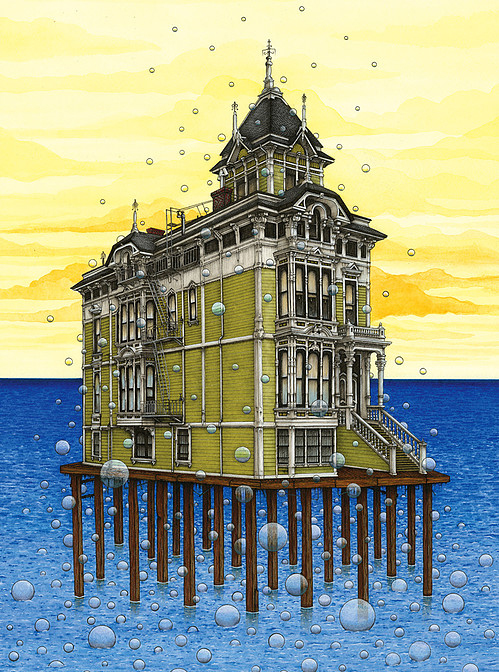
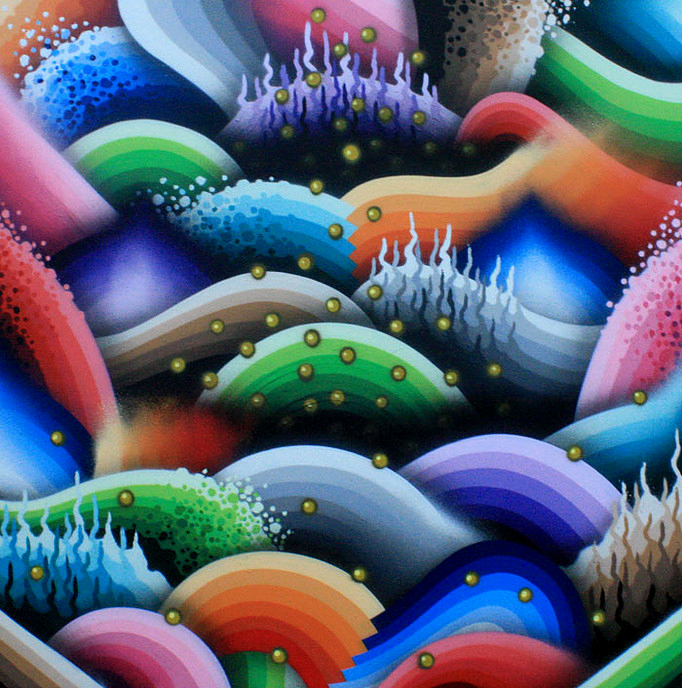
His spray painted pieces are bright with loud loops and textures that gracefully intertwine into a labyrinth and capture the forever-rebellious spirit of the graffiti artist, while other pieces include meticulous illustrations of Victorian architecture and landmarks that only the most disciplined penman could accomplish. Sometimes he combines these two styles and adds strong elements of fantasy, inspired by the world around him. His past series, Levitation, explored these two concepts by intertwining architecture with floating objects invented by Watts; it is an amazing culmination that exhibits his 20-plus years of experience as an artist.
During the month of January, Watts will be exhibiting his work at graffiti/art/clothing mecca, Leave Your Mark Sacramento. All pieces will be in aerosol spray paint and will be up for display for the entirety of the month.
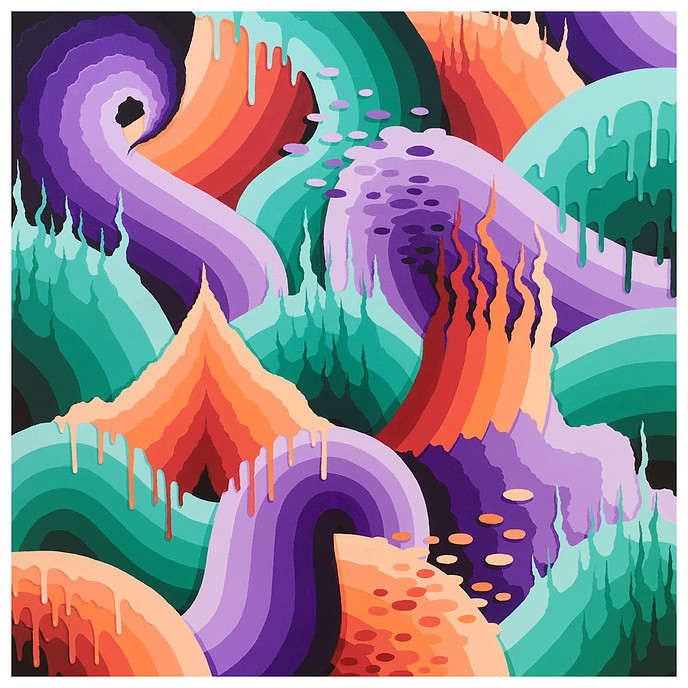
{Withering Prisms, Acrylic Paint, 2016}
Tell me about your exhibition at Leave Your Mark Sacramento.
I’ll be showing some of my studio work in January at Leave Your Mark in Midtown Sacramento. The exhibit will be paintings in aerosol spray paint, a favorite medium of mine. I’m a big supporter of Leave Your Mark so this is really exciting for me. This will be my first solo exhibit in Sacramento, although I’ve shown in group shows here a handful of times.
I’ve never physically lived in Sacramento, but I have spent a lot of time here and shown work here in six exhibitions. My very first showing in Sacramento was with Cool Cat Gallery back in 2007. I’ve also had recent exhibits at Sacramento State University and Lux Quaubas Gallery.
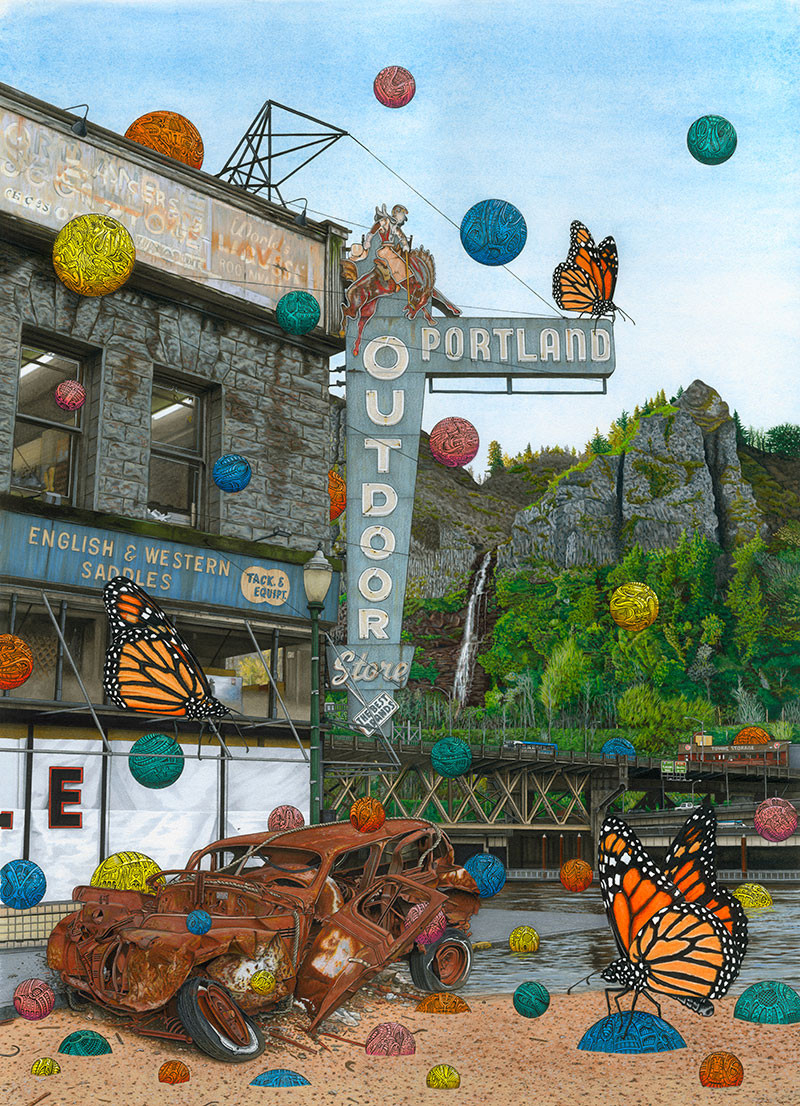
{Metamorphic Decay, Mixed Media, 2016}
I am so intrigued by the way you go from painting brain-meltingly colorful pieces to detailed illustrations and transporting images like those in Levitation; It’s crazy how diverse your art is. Are you self-taught for the most part? How did you become someone who can create with such variety?
My fine art is all self-taught. I did go to art school, but I focused on graphic design. Drawing is something I’ve always done. For as long as I can remember, I’ve always been drawing something. I draw things that interest me and that’s how it’s always been. As a kid I drew army men and nuclear dinosaurs. As a teenager, I was drawing biotechnical, H.R. Giger-looking art. As an adult, I’m intrigued by architecture and urban decay. The illustration work that I produce today is very challenging and rewarding for me. Every piece is like a marathon: physically taxing on my back and mentally exhausting. When I finish a drawing, though, it’s a very special moment. Spray painting is something that I love to do, and I have fun doing it, but it’s a different feeling I get when finished than I do completing an illustration.
What have some of your milestones as an artist been so far?
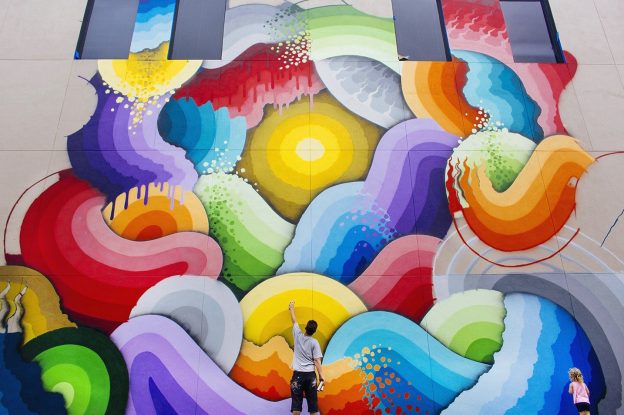
That’s hard to answer as a working artist. I think it’s easier for people on the outside to say “He’s accomplished this,” or “She’s accomplished that.” It’s challenging for an artist to really value and appreciate their achievements while in the trenches. I’ve done a lot of projects and it’s gotten me to where I am today, but I feel like it’s still just the beginning and there’s so much more I want to do in my career. I see accomplishments more as stepping stones. For me, it’s always been, “OK, that’s done, on to the next.” If I had to go back and think about what’s really stood out, there are three moments that have been instrumental to my path. The first was my very first art show in 2004 because it was such an adrenaline rush of emotion. It was terrifying and exciting all at the same time. All I wanted to do was get back in the studio so I could make more work to show in galleries and get back to that adrenaline rush of an opening reception. The second was my first “really big” mural that required a swing-stage to reach the top (what window washers use on skyscrapers). It was approximately 3000 square feet about 5 five stories tall. It’s special for me because I raised most of the funding through Kickstarter and it was the first time I really felt the community embrace what I was doing. There’s such a high from that feeling. I never wanted the project to end. The third would have to be the stage banner designs I did for the Outside Lands Music Festival in San Francisco. That exposure opened doors to commissions for Google, Mercedes-Benz and Anchor Brewing Company, among others.
What is your state of mind when you are making these massive and colorful murals or creating in general? Do you have any artist rituals?
I’m pretty clear headed when I’m working. I have a painting process and a bag of tricks, but there’s very little sketching that goes into it. My wife calls me a human typewriter because I’m very methodical while I work; left to right, back and forth like a typewriter. I like to listen to music, audiobooks or podcasts while I’m working; only when alone though. If I’m painting with friends or a group, I’ll never wear headphones. I enjoy interacting with other artists while painting. Artists have great stories. I’m not a very superstitious person, so there aren’t many rituals, although I do find myself stretching more before and after painting the older I get.
Tell me a little about artists who paint with spray. What sets them apart? Why is it a medium that you are drawn to?
I started using spray paint as a medium in my early teenage years. Back then it was exciting and rebellious. It was something I did with my friends. Almost like a secret language that we spoke. But I really fell in love with the process of spray painting. The techniques to get certain effects, the challenge to paint straight lines with no drips and the ability to work really big in a short amount of time. When I started to focus more on gallery work, I wanted to incorporate spray paint into my work. For a long time it was painting on canvas what I would typically paint on a wall, but I wasn’t getting the response I was looking for. So in 2010, I started to transition away from letter shapes and break it down to simple forms and movements using a wide assortment of colors. Eventually this style of work that I paint today developed. It’s spontaneous and free flowing. Very little planning ever goes into these paintings. I have my color palette and a painting process. I start at one location of the surface and it builds as I go. While I’m working, I’m thinking a step or two ahead but there’s rarely a sketch of the final outcome that I’m following.
What’s next for 2017?
You know, there’s not a lot in the pipe for 2017 yet. I’ll have work in a couple of shows around the country but that’s about it. Subconsciously, I think this is intentional. The past few years have been filled with traveling but I’ve started to feel artistically stagnant and I’ve craved that quiet studio time to push the boundaries of new work. 2017 will be time to realign the ideas in my head with the work being produced.
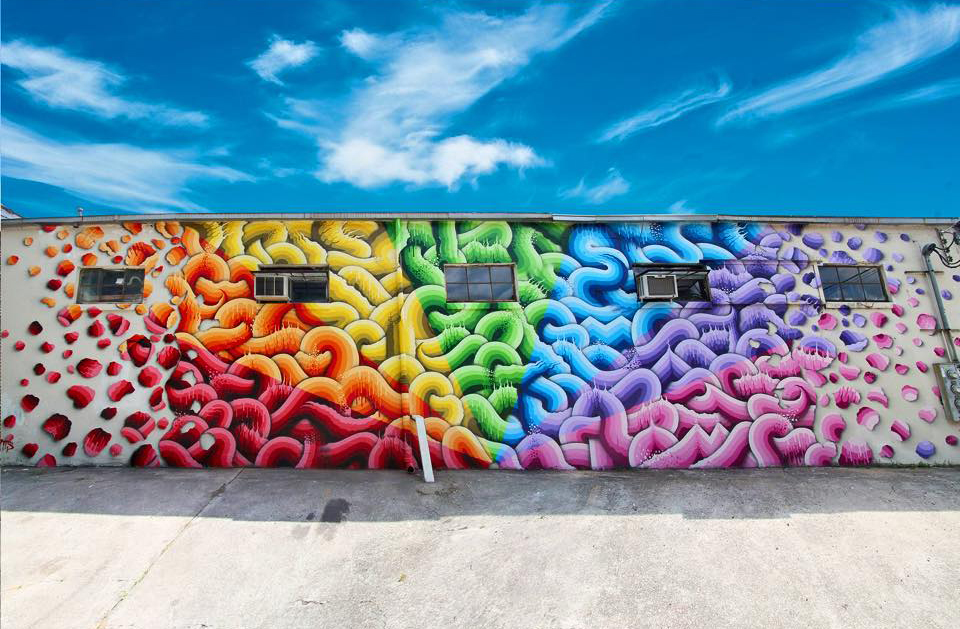
{Outerspace Project, Atlanta, GA, 2015}
Ricky Watts’ art will be on display throughout the month of January at Leave Your Mark Sacramento, located at 2627 J St. in Sacramento. The opening reception for the show goes down Friday, Jan. 6, 2017 from 6–9 p.m. Find out more about Ricky Watts at his website, Rickywatts.com.
Photographer Nicholas Wray showcases his journey to Japan in new exhibition and book
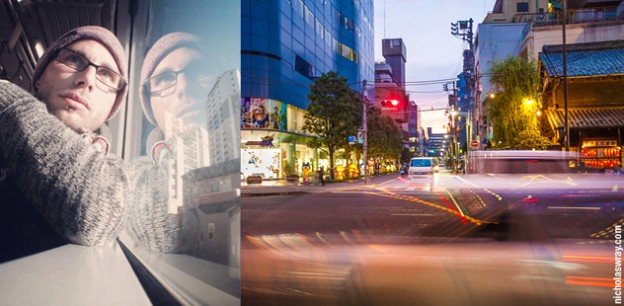
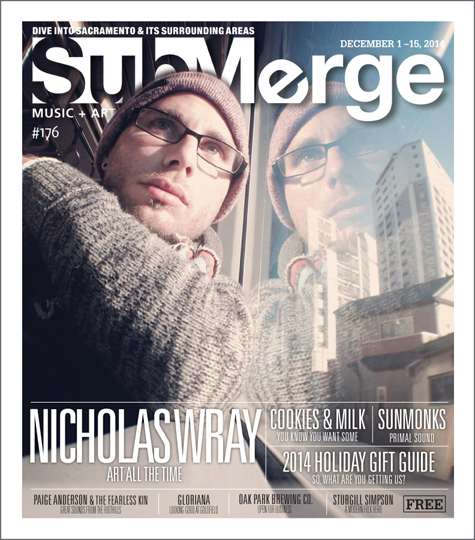
Hailing from the intersection of the Ohio and Licking rivers, former geographer-turned-photographer Nicholas Wray is no stranger to picking up and hitting the open road. From moving from Cincinnati to Sacramento in 2006 to shooting the arid plains of Zion National Park, Wray’s penchant for exploration doesn’t only fuel his artistic passion but feeds his professional endeavors as well.
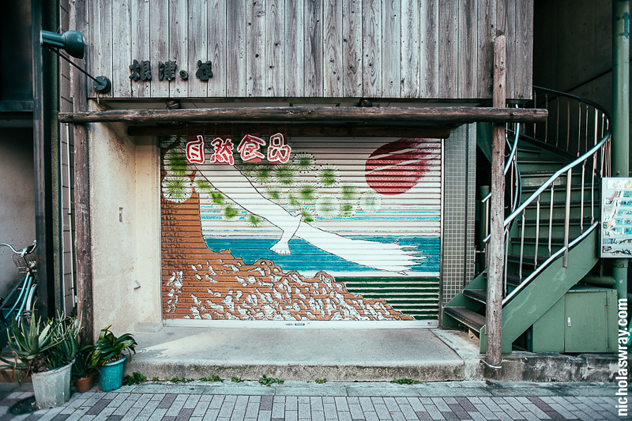
The proof is in his latest exhibition, simply titled Japan, in which his candid and colorful images of everyday street life in the Land of the Rising Sun adorn the walls of each of the three Insight Coffee Roasters locations. And, at the behest of a friend at the coffee shop, the photos were also assembled into a photo book worthy of adorning the best coffee tables in the world. The series, divided into five sections and scattered between the trio of coffee houses, touches on the many highlights of Wray’s travels: “Architecture,” “Culture,” “Street Life,” “Graffiti” and “Bicycles.”
“Whenever I travel I do this. I have a lot of prints at my studio and tons of photos that just kind of live on my server, so this was the first time that I have printed them super small and priced them super cheap so that people can afford them easily,” Wray explains.
Although the Ohio transplant rolled up to the interview on a motorcycle and sporting a weathered leather jacket, Wray isn’t brash or cocky. Quite the contrary, his quiet demeanor and unassuming nature bucks many of the stereotypes that are typically associated with those working behind the lens. You won’t find him sexually harassing models, attending the incessant parade of networking events that so many artists find themselves engaged in or stroking his own ego.
“This is the first time that I’ve done a show this big, like three coffee shops. I know it’s just coffee shops, it’s not a gallery—I mean I wish I was as cool as someone like Micah Crandall-Bear [and] had Elliott Fouts Gallery showing my stuff every month, but I’m just not that cool,” he says with a wry grin.

Wray’s journey into mastering shutter speeds and F-stops began as his college career was winding down at Northern Kentucky University. After applying for graduation he was advised, a few months shy of claiming his cap and gown, that he needed a minor in order to secure his degree. Uninterested in spending thousands more in man hours and cash, he leafed through the course catalog and it occurred to him that he could revisit his childhood hobby while locking down a minor—photography. He immersed himself in the course work: shooting in black and white film, rolling his own film, editing and enlarging images in the dark room and within a year acquired that prized piece of paper validating his education.

“I think I pretty much took really bad photos up until my very last class,” Wray muses. “That’s when I kind of started doing this street photography. I was in school, working like three jobs and the only time I had [to shoot] was at night. I was out in the snow at night without a tripod just shooting hand-held on film so I made this series of photos of laundromats all over Cincinnati.”
From skateboarders to musicians to commercial products, Wray’s professional portfolio is a robust exploration of the people and places that contribute to the diversity and color of Sacramento. If you’ve attended the annual summer concert series, Concerts in the Park, or witnessed the awesomeness that was this year’s TBD Fest, you may have even landed in the frame of one of his photos. But after years of hustling and struggling to turn his creative pursuits into a viable business, success brought with it an unexpected problem: He was overworked and in desperate need of a break.
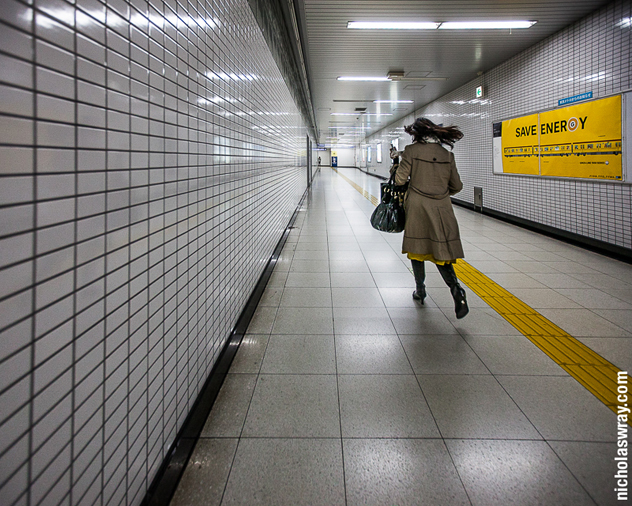
“So, I had been taking photos in Sacramento since 2009 and then after [my business] started to take off I was really, really busy for a couple of years,” Wray explains. “I was doing nothing but working—it felt like I was working 18-hour days, seven days a week—so I bought a plane ticket to Tokyo. I wanted to go somewhere super urban and really far away where I would have no understanding of the culture.”
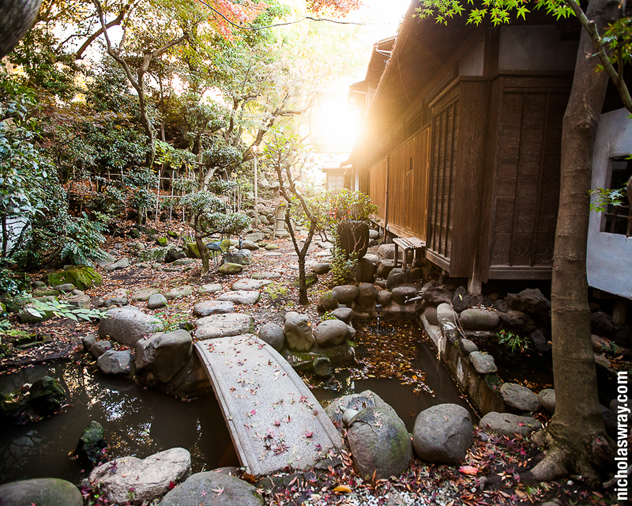
So last October, after booking a ticket and packing his gear—consisting only of a backpack filled with a change of clothes, his camera, a couple of lenses and a laptop computer—Wray set out on a two-week tour of Japan, immersing himself into the culture and shooting everything in sight. Five thousand shots later, Wray had a collection of images depicting shimmering seascapes, people scurrying around the city going about their daily business, bicyclists snaking through traffic and gleaming skyscrapers towering above it all. And while he didn’t speak the language, Wray says his experience with the locals was nothing short of wonderful—from the hostel mother who picked him up on the side of the road to the hospitality of strangers taking him into their homes and feeding him, Wray was in good hands for the entirety of his adventure.
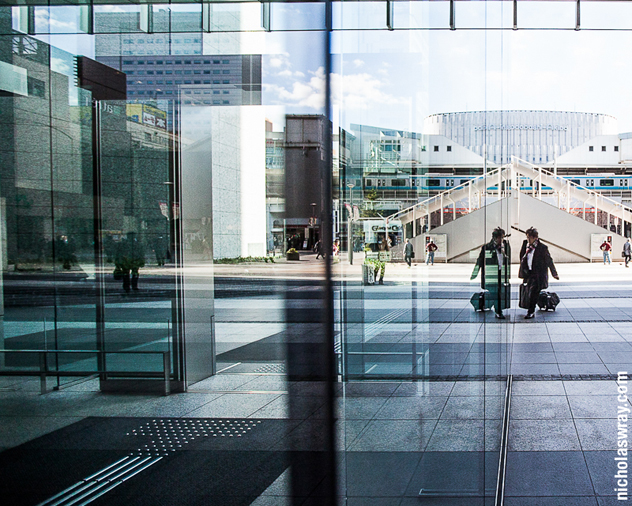
“People were really polite…just really nice people. I guess I shouldn’t be surprised by that—I guess I’m acknowledging that it was a really pleasant place to be,” he admits.
Upon Wray’s return, the images languished on his computer for months before he embarked on the arduous task of wading through the thousands of images captured on his journey and whittling them down into something manageable. Soon a series materialized and Wray decided that it was time for the images to emerge out of their cocoon and blossom out into the world. He presented the idea to his friend, Chris Ryan of Insight Coffee Roasters, to exhibit the work in each of its coffee dens, and after receiving an enthusiastic yes to his proposal the two began planning out the show.

The exhibit is a 145-image romp through the harried streets of Tokyo and Kyoto, the lush, verdant gardens that dot the countryside and everything else in between. Currently, you can find “Culture” at the Pavilions Café, “Street Life” and “Graffiti” at the Capitol Café, and “Bicycles” at the Southside Café. Wray says that the “Architecture” section of Japan will be included in the rotation but because of its sheer volume will make its debut at a later date.
“It’s kind of like a narcissistic pleasure of making a cool photo that someone else will enjoy,” Wray explains. “I think that the coolest thing for me is when someone sees one of my photos and they’re just like, ‘Oh my God, I have to have that!’ I know that they love that photo so much that they want to have it in their house. That’s my reward. It’s not about the money because I’m not making money on selling prints. Like this [show] costs me more than I’m ever going to get off it.”

Now that the exhibit is up, Wray reflects on his role as a member of the Sacramento art community. And while he’s carefully mapping out the location of his next photographic adventure, his time in Japan has reinvigorated the shutterbug.
“The way I look at my job is that I do mostly commercial photography for the market, and people pay me to take cool photos—they pay me to make art for their business,” Wray explains. “So sometimes I do something boring, like some product shot but…I make art all the time, it’s just consumed in a different way. It’s more like people commission me, kind of like a painter. Someone might commission a painter to make a painting, people commission me to make photos for their media.”

Nicholas Wray’s Japan is currently hanging around Sacramento at Insight’s Southside Café (1901 8th Street, Sacramento), Pavilions Café (566 Pavilions Lane, Sacramento) and Capitol Café (1014 10th Street, Sacramento). Wray’s Japan book can be purchased through the artist’s website, Nicholaswray.com.
Lord Pawn balances his graffiti writing roots with his current life as a professional artist
I must have been about 9 years old when I practically shat my pants from my first real world run-in with street graffiti, or at least what my young mind imagined street graffiti to be at the time.
My brother and I were walking home from school in our cozy Elk Grove-bordering neighborhood when we turned a corner and instantly saw five big distorted letters plastered on the adjacent fence next to us.
Dripping in what seemed like only hours-old red spray paint, the looming letters looked something like this:

To this day, I’m still not sure if that sloppily written message was saying Fuck U, or simply telling me to beware of FuckO, the newest graffiti boy on the block.
Frankly, it didn’t really matter; what I saw bothered me. Images of older, meaner kids roaming around my neighborhood with spray cans ran through my head as I pictured myself having to deal with one or all of them somewhere in the near future.
My childhood got a good gut check that day over what turned out to be nothing more than a one-time amateur tag job. What I witnessed was most likely done by a first-timer who might have just gotten a hold of his first can of spray paint and wanted to let loose on the nozzle for a thrill that, for some, only a canister of color and aerosol can offer.
Twenty-eight-year-old Sacramento graffiti artist Ryan Kroger, who officially paints under the name Lord Pawn, knows that feeling all too well.
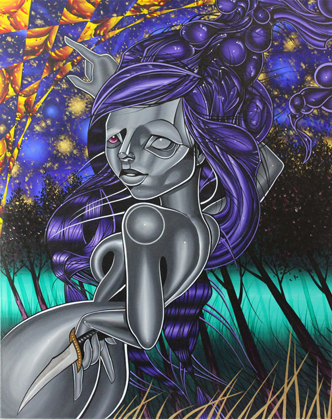
Growing up all over Northern California and eventually settling in Sacramento, Pawn says he’s been painting for as long as he can remember.
“It’s something that I loved to do and I just figured it out on my own,” he says. “And honestly, I don’t paint the way you’re really supposed to because I don’t really follow the rules that I was taught in school… I feel like with art, you can kind of break the rules sometimes.”
Pawn says he remembers the days when he too was just a punk kid running around with a skateboard in one hand and a marker pen in the other. It wasn’t long, though, before he discovered spray paint and began writing his graffiti name on any surface he could get his can on.
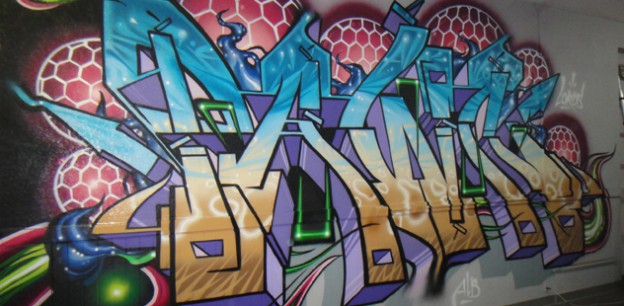
As he grew older, Pawn ran with a few different graffiti crews in town, going where he wanted and tagging what he wanted. But it wasn’t until he got with Ain’t Life Beautiful (ALB) and, eventually, accepted into the world renowned Legends of Rare Designs (LORDS) that he started to slow down a bit.
“I feel like it’s something I did in the past, and sort of something everyone has to go through at one point,” he says. “So I mean, like, I do miss it, ‘cause there’s nothing more fun than running out on the freeway and bombing stuff. But, I guess I just can’t really do that anymore.”
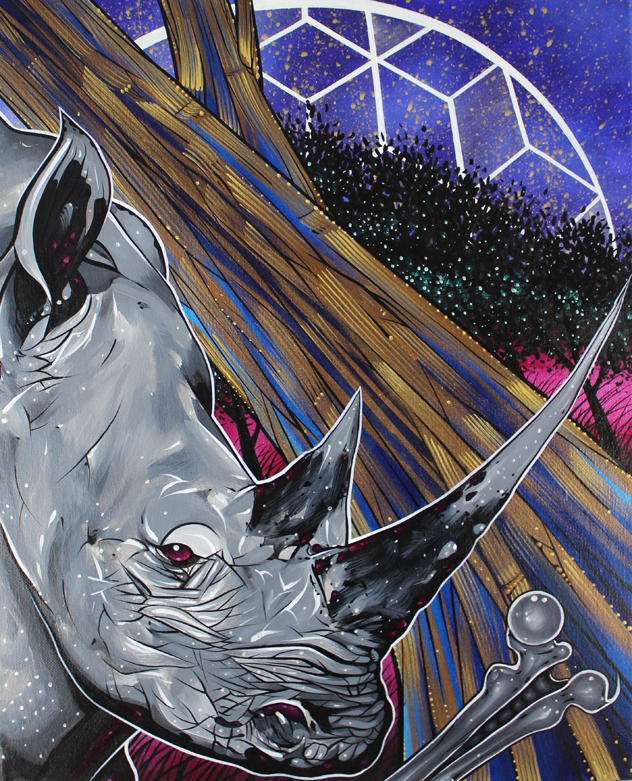
It’s true. Not only is Pawn well beyond his juvenile years, but he is also a professional artist now—in spray paint and acrylics—with a reputation to maintain and commissions to lock down.
“At least in this town, I’m getting murals and stuff like that,” he says of his recent work flow. “And I don’t want to be someone the cops are after or anything.”
Pawn says he’s been fortunate enough to secure work consistently over the past few years, painting mostly character murals for companies like Red Bull, Technine, Tropicana, Sacramento Mustang and even the Sacramento Kings.
He also does residential and commercial murals for smaller businesses, like a close-up piece he did of a girl’s face for Dabstix—a smoke shop in Roseville—about a year-and-a-half ago.
Ironically, sometimes even graffiti abatement programs will hire him to spray paint over an entire wall in hopes of deterring other taggers from constantly ruining it. Apparently, the backwards strategy works.
“So they’ll pay for me to put a mural on [a wall], and the kids will respect it—they won’t go and tag it anymore,” Pawn says. “Then the business doesn’t have to pay to paint over it every week. So it’s like a good thing for everybody.”
As focused as Pawn has been on his successful painting career lately, he says he still gets the itch to the hit the streets every now and then when his days get to be a little too mundane.
“Sometimes it’s good to be in a grimy place,” he says. “I’ve seen some crazy stuff just going and painting… You get stories out of it all; you’re going on adventures.”
Pawn says some of the best graffiti is done under the radar, usually in the cuts of any given city. Even now, he doesn’t take issue with painting in these remote areas, so long as it’s out of the way and not hurting anyone.
“You’re sort of out where nobody else goes. You explore a little bit, find a spot you can paint and you don’t have to be clean necessarily,” he explains. “You can just go and do it. And then you leave something beautiful behind that’s pretty. And people have to find it for themselves.”
At this point in his life, Pawn has struck a good balance between grime and convention.

While he says he’s mainly interested in traveling the world to pursue a legitimate art profession from here on out, he’ll still find himself at rail yards at times painting massive concept projects on train cars with at least one other fellow writer—what he and other graffiti artists call themselves.
Pawn says he knows the consequences of painting over trains, which can become a federal offense if they go over state lines.
“If you get caught, you can get in a lot of trouble,” he says. “But I don’t know. It’s like, to me, it’s sort of something that I’m willing to risk because it’s not like… you’re not a real criminal. You know? You’re not stealing, you’re not hurting anyone. It’s artwork.”
Pawn’s personal time isn’t always spent out painting the town red, however. He’ll actually stay home pretty often to work on more detailed pieces that he eventually puts up for sale.
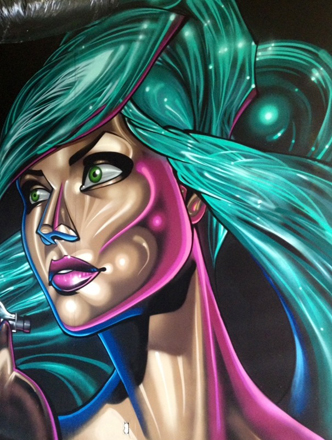
In fact, his very first art show was held this past Saturday, Nov. 8, at The Bench Art Supply and Gallery on 12th Street, where more than 20 original pieces—some acrylic, some spray paint—were on display and up for grabs to the public.
Prices went as low as $25 for prints to $5,000 for original works. His $5,000 piece—a 72-by-24-inch acrylic painting he spent a whole year working on—had already sold before the night’s end.
Pawn says he wants to do more art shows—not just for himself, but for the Sacramento art scene as a whole, which he thinks has potential to flourish.
“I think that there’s a lot to offer in Sacramento, but there’s just not that much of an art scene here, and there could be,” he says. “It’d be cool to start having some bigger artists coming through this city.”
Whether he stays in Sacramento to turn the art culture around or heads overseas to further his career, Pawn is sure to bring something new and exciting to the table in whatever scene he becomes a part of.
It’s funny how someone who produces such gigantic, surreal works of art can sport such a small name. But Pawn thinks it suits him.
“For me, it’s more of like a humble thing, you know? Because everybody wants to be a king, and really, we’re all just kind of like pawns—we’re the peasants,” he says. “There’s a saying that goes like, ‘The pawn is the most powerful chess player on the board,’ or something like that. Just because there’s many of you.”

Lord Pawn’s show at The Bench Art Supply and Gallery, located at 906 12th Street in Sacramento, runs now through Nov. 22, so if you haven’t gotten there to see it, we urge you to hurry it up! While you’re at it, follow Lord Porn on Instagram @PawnPaint. That’s what the cool kids are doing.
Though Artist Victor Malagon has Moved from the Streets to the Galleries, He Refuses to be Complacent
A love of graffiti ties together three artists sharing a show at the Sacramento State University Union Gallery this month. Their colorful, fluid stories once told on cement walls are now immortalized through three different aesthetics (though still sometimes on walls) and have been appreciated by a large audience for more than 10 years.
One of these artists is Victor A. Malagon, who went from can to oil paint and wall to cut wood, transforming his edgy sketches into sharp, quarter-inch-thick flat panels that trick the eye with their 3D illusions.
Malagon says the thin wood creates a sense of vulnerability that represents the artwork painted on the streets.
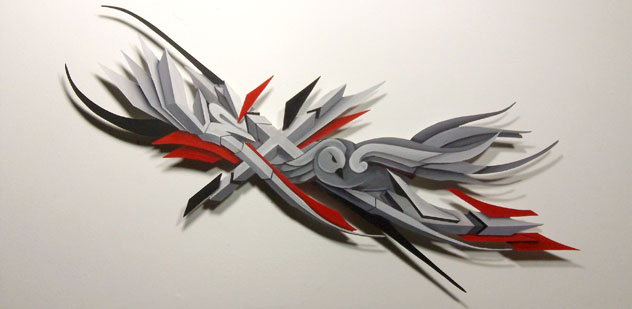
“Multiple hours, even days can be put in to create the artwork, but it can take seconds for it to be destroyed [dissed, covered up],” he says. “The same goes for my paintings; if not handled correctly, they can also easily be destroyed. At the same time, that kind of frailness and vulnerability is what makes them so unique and special.”
Malagon’s first exposure to graffiti occurred in high school.
“I had gone under the 7th Street bridge, a bridge that connects the south side of Modesto, Calif. to the downtown area and for the first time, I saw up close and personal the huge, colorful, wild style graffiti murals,” says Malagon, who moved to Modesto from Fremont, Calif. with his family when he was 13, and has since returned to settle there with his expecting wife. “That was it. At that time I had no idea who had painted those walls, how they had done it. I just knew that is what I wanted to do for the rest of my life.”
The successes of graffiti writers like Loomit and Delta, as well as the online global graffiti gallery Art Crimes, inspired Malagon to take his painting one step further, toward a career. However, he began work on his fine arts degree from a different perspective than his street art, with influence from the Bay Area Figurative movement of the ’50s and ’60s, and the Impasto style that uses thick brush strokes to provide texture on canvas.
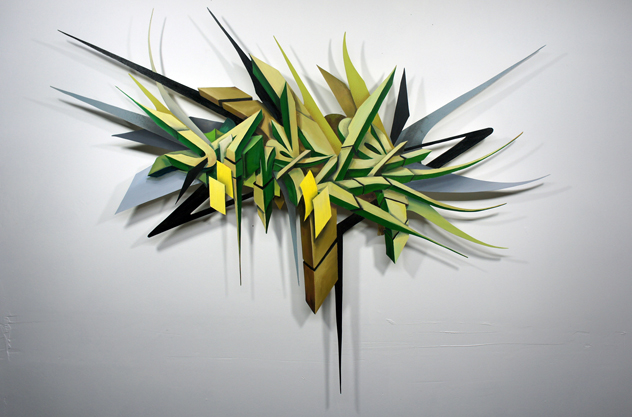
“I spent a whole semester creating a body of work influenced by that style [but] at the end of the semester during the critiques, my work was basically slaughtered by the instructors,” Malagon says. “They said, ‘Why create something that has already been done?’ They were aware of my graffiti background, and they actually gave me permission to build a wall in the art department so I can paint and practice when I had free time. They said, ‘You are doing something unique with spray paint and that style… We think you should head in that direction.’”
Malagon felt disheartened and lost at first.
“I felt like they didn’t get it,” he recalls. “Graffiti to me belonged in the streets, on walls. I had no interest in painting graffiti on canvas. At that point, I felt like maybe art school was not my thing. I decided to focus that whole summer on my letter styles and painting more. I decided that I wanted to make my letter styles more unique in form. As I began to sketch and began to make my letters stretch and flow outside the page, I thought to myself, ‘how cool would this look as a shaped panel!’”
Malagon had studied the work of Frank Stella but never thought he could use Stella’s idea of the shaped canvas to his own work.
Starting in 2004, Malagon created his first pieces similar to the style he works in now. Those first pieces are different than his commissioned pieces today, with fewer razor-sharp edges and a more clunky design.
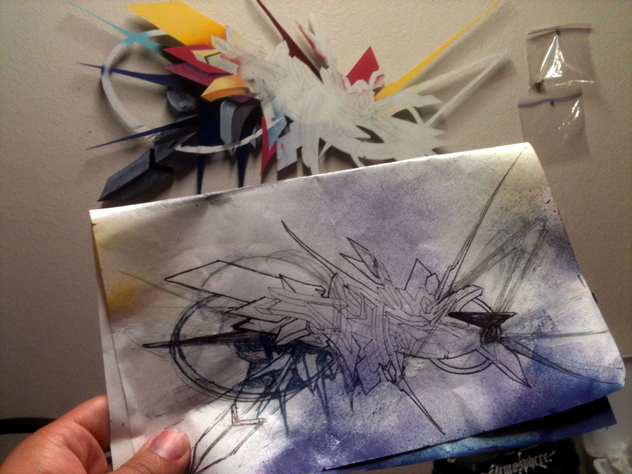
“I think that has to do with the use of tools, and learning how to use them and figuring out tricks on how to get that razor sharp and skinny without snapping or breaking the panel or cutting my fingers off,” Malagon says of the changes. “Also, as my style contentiously develops, the style changes. Unfortunately I have this attitude where nothing is ever good enough, so if I like something I did or just completed, a few hours later I start to dislike it and try to improve on it. I have been known to throw away and completely destroy paintings after spending over 80 hours on it if I feel it’s not good enough.”
Several artists from different fields and genres now recognize Malagon’s work and searched him out for commissioned pieces, including painter/designer/tattoo artist Chase Tafoya, DJ Reason, music producer Kenny Segal and Austin “Chumlee” Russell from the History Channel’s Pawn Stars.
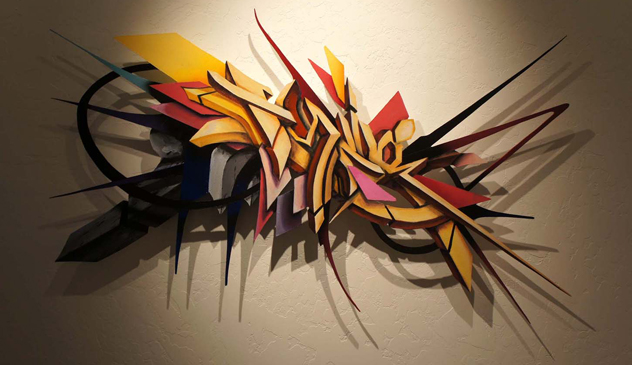
“I have been extremely lucky with the clients I get,” Malagon says. “I’m a fan of their work to begin with. I think Chase Tafoya was one of the first people who commissioned a piece. Music producer Kenny Segal!? Are you kidding? This guy makes beats for a lot of hip-hop artists I listen to. I remember when I dropped off the painting, he was telling me that Slug from Atmosphere was at his house last week! What? I’m a huge fan of Atmosphere.”
For Malagon, the best part about his commissioned pieces is the amount of freedom he receives. Clients might say they would prefer a certain color over another, but usually he gets “do your thing, dude.”
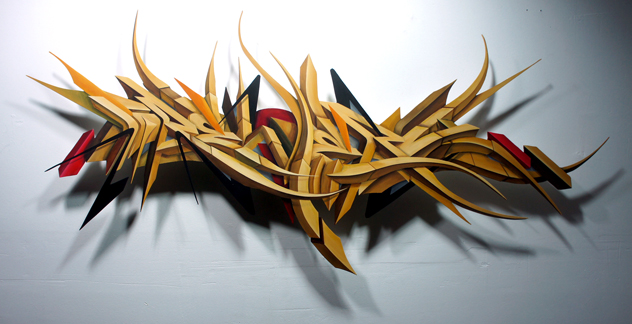
“I do try to research my clients and try to have a connection with them through my work via color and/or form. The paintings I did for DJ Reason, and for Kenny Segal for example, I only listened to the music they created while sketching their paintings, and in an abstract way, visually represent them,” he says.
Most of the work Malagon is showing at Union Gallery is commissioned and epitomizes the internal struggle to outdo his last painting in style, complexity, shape and form.
“I pay more attention to structure and architecture now too,” he adds. “I think my work changes with my moods. Music is [also] an important element when I sketch.”

Besides his art, Malagon has also manifested his love for street art, music and tattoos into a magazine he publishes with his wife, called Refused. The two launched the magazine in 2004 when they were still dating and attending CSU, Stanislaus. It is the second coming of a similar publication Malagon created on his own from 1998 to 2003 called Burning the System.
“I did about eight issues throughout the years until around 2003. I had decided that I really wanted to publish a full-color legit graffiti magazine and worked hard to save my money to make that happen,” he says. “I remember at that time, the popular art magazines would only feature about two to four pages of graffiti, street art or tattoos. The crew I ran with had incredible amounts of talent, but at the time were not featured in any magazines because they were not ‘known’ artists.”
Refused became a national springboard for him and now-famous artists like Robert Bowen, TopR and Alex Pardee, with distribution at all Barnes & Noble bookstores. The latest issue of Refused comes out April 2014.
Malagon’s artwork, as well art by Marcos LaFarga and Ricky Watts, will be on display at the Union Gallery through Nov. 21, 2013 as part of the Possibilities Are Endless show.

See Sacramento as an Open Air Art Museum
May is Bike Month is back, challenging all to abandon four wheels for the environmentally friendly alternative of pedal power, (which means riding bicycles versus gas guzzlers…keep up!). With miles logged and events listed, there’s still one more idea to add to this sunny month’s itinerary: the annual Submerge Bicycle Mural Tour. For three years now, we’ve scouted the entire Midtown and downtown areas looking for eye-catching artwork decorating businesses, like HR Sports Cards and Collectibles (2231 10th Street) and even discovered a growing number of collaborative art murals brightening up dingy alleyways. Grab a date, some friends or all of the above and visit each location to see the work of artists such as Shaun Burner, Mike Rodriguez, the women of the Few&Far movement and many who prefer to remain nameless. This year, I’ve included some bonus murals for all participants to find along the way. Plus, the routes are near many local businesses to turn a tour of alluring wall art into an all-day affair that ends near the Sutter’s Landing river entrance on B Street. Will you spot the lion’s head with a multi-colored headdress, or perhaps successfully stumble upon the woman underneath the moon? Pedal forth, keep an eye out and most of all ride safe.
Few&Far Animal Rights Mural
1800 24th Street alleyway
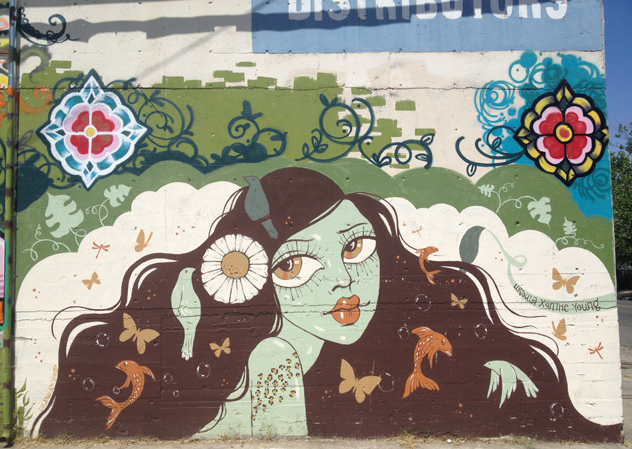
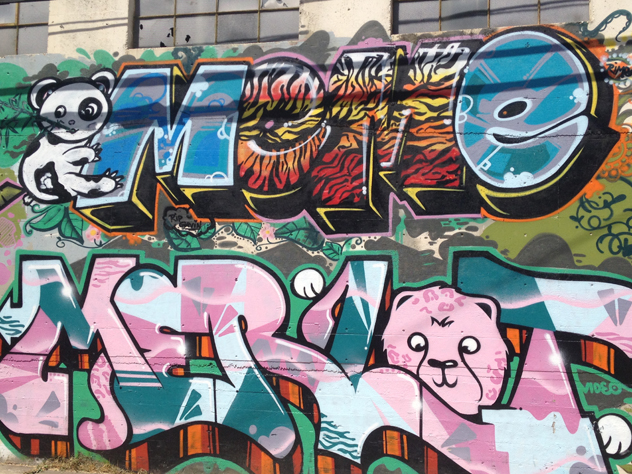
This marks the beginning of this two-wheeled journey. It appears that Sacramento’s alleyways, once dark and desolate locations, reeking of piss, have now transformed into a sort of new wave art exhibit. Who knew a splash of color and a concept could turn an industrial building with broken windows (1800 24th Street alleyway) and rusted fans into a tribute to all the cute, furry creatures of the world? Last September all day and throughout the night the Few&Far movement, a group of women all experienced in graffiti art joined together for animal rights. See doe-eyed giraffes, pink leopards and even a brown-eyed girl with butterflies, birds and daisies decorating her flowing locks. The mural is the collaboration effort of over a dozen artists from all around the world and yes, even Sacramento. Get involved at http://fewandfarwomen.com/.

Coexist
2321 10th Street on W Street
Members of the Kids Crew warn passersby that this wall, the second destination of the tour, is a “mural in progress.” The mural displays six gods of various religions—representing everything from Shiva, a Hindu deity, to Sikh and even Buddha. Each god is depicted in various colors and holds unique distinctions like the Koran or lotuses scattered below one figure, the lotus flower being a symbol of purity and enlightenment. What better way to bring peace to a neighborhood where according to manager of HR Sports Cards and Collectibles (2321 10th Street on W Street), Parker, is an unfortunate hot spot for tagging. “We have this mural because it protects the building from getting tagged,” he says. “Here, even the taggers respect mural art. It’s a really nice work of art and it gets so much attention.” Parker explains his interpretation of the mural as a call for all to coexist peacefully within all religions. After sifting through a box of comics—it was Free Comic Book Day after all—he then offered a little insight to what became two bonus stops on the tour.
Bonus find: Lion’s Head
W and 10th streets
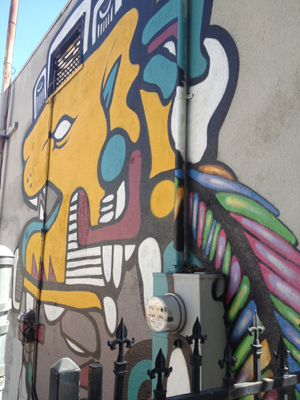
Head up 10th Street just past the comic book shop where a Mayan-inspired lion’s head with multicolored headdress growls from the top corner of a gray building, protected by fencing. Spot the lion and pedal forward.

Bonus find: Woman Beneath the Moon
W and 10th streets
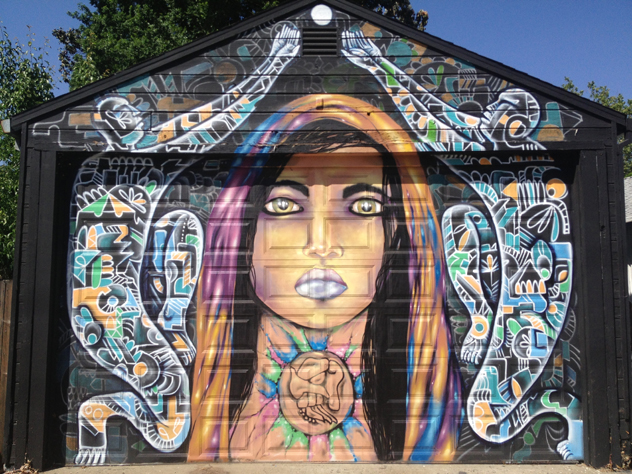
Just before reaching Osaka Ya (2215 10th Street) a downtown joint known for their enormous shaved ice treats and mochi. Turn right into the alley to spot the second bonus find on this year’s mural tour painted by artists Shaun Burner and friend Rubio. A solemn-faced woman with golden eyes stares into the alleyway, two male figures on either side of her raise their hands to a white moon at the peak of this decorated garage.
“I painted the outer sides with the two figures giving it up to the heavens praising the sacred feminine,” says Burner. “They are just giving up blessing to the universe. The sacred feminine has been so lost and disrespected at this point in time.”


Crest Theatre Alleyway
Alley between J and K streets near 10th Street
Behind the Crest Theatre (1013 K Street) is an alleyway. And, along the walls of this alleyway is an astronaut floating through a space of vibrant blues, magentas and various shades of greens. The mural, painted by Jason Bove and various artists, extends halfway through the entire stretch of building lining the alley and ends with all the colors of the rainbow dripping in succession from rooftop to pavement.

The Showplace of Sacramento
25th between J and K streets
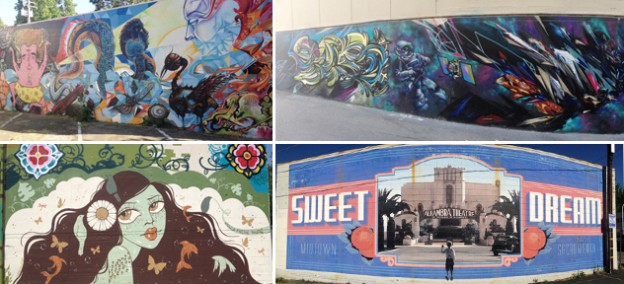
A boy dressed in ‘30s-style knickerbockers and suspenders gazes into the past of Sacramento’s historic Alhambra Theatre, demolished in 1973 to make way for a Safeway supermarket. Even though all that remains of this historic building is the original fountain still working at the south side of the parking lot, this mural on 25th between J and K streets, with its complementary blues and oranges will forever be a window to the past.
Contemporary Dance Conservatory
213 26th Street
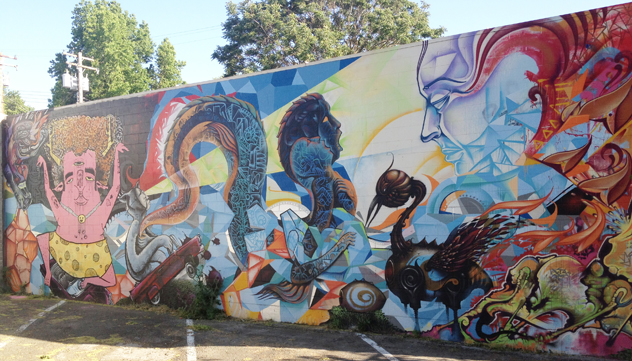
Starting the tour at W Street and ending at the Contemporary Dance Conservatory (213 26th Street) is perfect for two reasons, one being the mural at the entrance of the building painted by Mike Rodriguez, Shaun Burner, Letter D, Miguel Perez, Stephen V. Williams and Mark Prick. And secondly, it’s next to the Sutter’s Landing river entrance on B Street. Owners of this building grew tired of painting over tagged walls, so they invited a few good artists to hold a freestyle session using their dance studio as the canvas. Neighbor to the studio, Evan Duran, brought the collaboration together, “People respect art. If there’s already art on the wall, they won’t tag on it. But if it’s a blank canvas such as a buff building, it’s pretty much just asking kids to paint on it,” he says. The mural portrays a young figure riding in a car at the edge of a cliff; a shaman-like character to his right holds a key in one hand and blesses him with vision from a heart as the young figure faces the obstacles in front of him.
Word to Your Motherland aims to break down cultural barriers between South Asia, Africa and America
When Nisha K. Sembi and Mandeep Sethi last went to India, they met with a different kind of inspiration than what some might experience on the subcontinent.
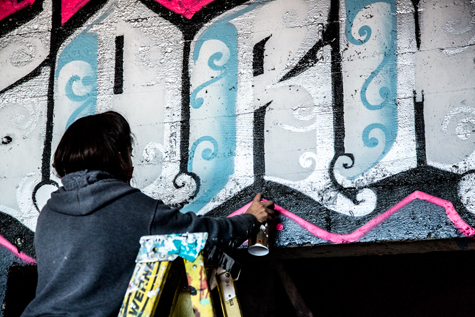
Sembi, then a Bay Area graffiti writer and mehndi artist, landed in India on a mission to paint one of her culture-inspired pieces on a city wall (and also, as South Asian immigrants in America often do, attend a wedding with her family in the motherland). What she found were walls already beautifully tagged—far beyond even her own skills—by Indian youths using liquid paint and brushes but in graffiti style because they couldn’t find or afford spray cans.
Alongside tagged walls Sembi saw diverse B-boy and B-girl jams, or breakdancing battles, in the slums, shoeless.
“I came to the realization that hip-hop is more than just art, it’s a revolutionary tool,” Sembi says. “The caste system is still alive and well in India and all these people came together to battle each other in breakdancing, all these people who normally wouldn’t come together because of the different castes. Hip-hop breaks down those barriers.”
While on his own trip, Sethi, an MC, videographer and youth mentor, also collaborated with Indians who were part of the hip-hop culture in their country, and he filmed, photographed and rapped with them.
Both he and Sembi reached an epiphany.
“I realized my work has more value than just looking cool,” Sembi says, looking back on the experience and wanting desperately to share this connection between two distinct countries to break down stereotypes and barriers.
Sembi and Sethi grew up in California—she in Berkeley and he in Los Angeles—heavily influenced by hip-hop culture. The two stayed tied to their Indian roots but also branched out in different artistic ways to embrace their love of hip-hop, Sembi says, admiring five hip-hop elements: breakdancing, MCing, graffiti, DJing and knowledge.
“I connected with hip-hop because growing up as an Indian girl in America, it allowed me to connect to other people with similar struggles,” says Sembi, who has left the illegal realm of graffiti for a career in fine art, graphic design and social activism.
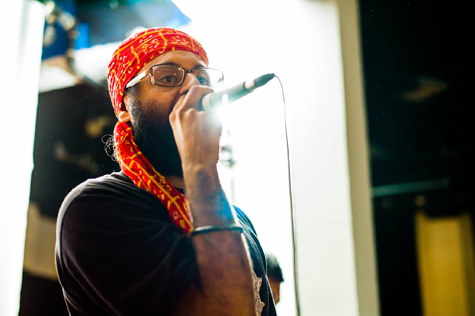
Sethi also used hip-hop to find a way to define himself.
“Hip-hop was a way to figure out where I am in my life, figure out my identity, figure out where I can position myself,” he says. “For a long time I tried to find more Indian youth in the hip-hop community around me and I didn’t find anyone.”
Sembi says she met with the same problem, and both friends started to produce work that became a manifestation of their hybrid identities. Along the way, they found others who also saw hip-hop as a common denominator, and learned more of the deep-rooted relationship between their culture and the hip-hop movement.
For example, Sembi says, one of her inspirations for her artwork is Tupac Shakur and his Thug Life motto.
“Thug comes from the Hindi word ‘thuggee,’ which means thief, and it’s what the British used to call a group of Indians who rebelled during the colonization,” she says. “Tupac knew that because he was intelligent and well-educated.”
A more unlikely inspiration in Sembi’s life—her uncle—indirectly helped solidify her decision to pursue her aesthetic. As a teenager, Sembi remembers helping her uncle move out after he had just graduated from college and stumbling upon his secret graffiti skills.
“I snuck up to his room and the whole room was bombed from top to bottom with graffiti,” Sembi says. “I had no idea.”
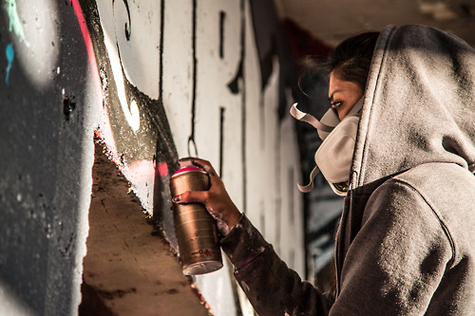
She later confronted him (he was reluctant) and found out he had been a graffiti writer in Oakland in the ‘80s, going by the name “Hero,” a comedic reference to Bollywood actors.
“There were generations before us who embodied this spirit, but never came to light, but with social media and technology, that’s all changed,” Sethi says.
Sembi continues fusing Indian and hip-hop cultures in her work, which has shown in the de Young Museum of Fine Art in San Francisco and multiple Bay Area exhibits. She still tags, but only legally with permission from building owners.
“There have definitely been circumstances where I’ve done painstaking pieces and had them painted over,” she says. “Seventy-five percent of the pieces I’ve done are gone. But within the last four to five years, I’ve transitioned to wood panels and canvases and I can actually sell those.”
Meanwhile, Sethi has become part of the national music scene, MCing across California, working with youth groups nationwide, showing at international film festivals and recording albums.
“I’m 24 years old, so sharing my travels, sharing my experiences with folks younger and older can allow for an exploration of ideas,” he says, joking that his South Asian parents still want him to go to law school despite the success. “I think that it’s important to not only bring back resources to my people in India, but bring back their conversation here.”
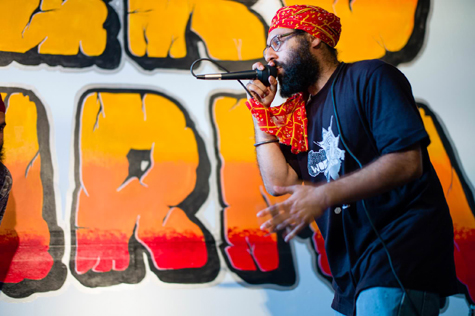
The duo set out to do just that, with the help of fellow hip-hop artists and family members, by curating their first multimedia show Word to Your Motherland.
The show, with Sembi as the featured artist, sets out to recreate an environment that visually, musically and aesthetically transposes the cultures of India and Africa and their people through the intersections with hip-hop culture.
The first exhibition ran in Oakland last year, Sembi says, when curator Anyka Barber asked Sembi if she would like to do her first solo show. The second run starts Feb. 23, 2013 at Sol Collective to celebrate the gallery’s eighth anniversary and recent Revista Siempre Mujer win.
“I thought, let’s use this opportunity to show people in America what’s going on in India,” Sembi says of the Oakland show, which was a success. “For this second one in Sacramento, we’re doing the same thing but instead of just India we’re showing the connection between India, Africa and America. It’s art as a tool for social change.”
Sethi says he wanted to build on the connection between India and Africa because the latter is seen as the original motherland, and the two used to coexist and communicate.
“We kind of lost that spirit so we are trying to inspire others to look inside themselves and rekindle that,” Sethi says.
Some of Sembi’s highlights will include a portrait of Tupac in the style of Indian truck art (part of a series) and political prints like one of Sikhs holding signs that read “Liberate Oakland.” She will also have a large mural installation of her graffiti work as a backdrop to musical performances by Sethi and others.
Guest artists at the show will include Sethi’s brother Puzzl3Peace, a photographer who works exclusively with 35mm film and has a series of shots from India; Eli-Jacobs Fantauzzi, a documentarian who covers hip-hop movements globally; and Sembi’s uncle, who agreed to create a few pieces for the exhibit because of his important influence on Sembi.
Sethi’s photos and films of his time in India with breakdancers, DJs and MCs will also be playing on two projections.
Word… will remain an ever-evolving show, Sembi and Sethi say, and the two hope to continue it in multiple cities.
Word to Your Motherland show runs through March 16, 2013 at Sol Collective, 2574 21st Street, Sacramento. For more information, visit solcollective.org.
Spotlight Doesn’t Seem to Spoil Travie McCoy’s Flow
When a front person for a popular band decides to put out a solo album, it always feels like his or her band days are over. Travie McCoy of Gym Class Heroes, however, seems determined to refrain from pulling a Stefani and stay put with the group that made him a star.
“I don’t necessarily look at Lazarus as me going solo, per se. It was more of a side project put out on a bigger scale,” McCoy asserts from his home, lounging on his couch with his dogs, feeling lucky that he has a couple of weeks off to enjoy himself before heading back out on the road.
Lazarus, McCoy’s first “solo” album, was released in June 2010, and had all the elements of a star-making effort. A high-profile team of writers, producers and guest performers were recruited for the album, including T-Pain, Bruno Mars, The Smeezingtons and Cee-Lo Green. Still, even with all these fancy new toys at his disposal, McCoy says he still yearned to have his band around him.
“The performance part was the hard thing,” McCoy admits. “The writing and making the music is something that’s in me, regardless of if it’s with Gym Class Heroes or not. That was the easy part. The performance part was something to adjust to. Being on stage and not seeing the dudes that I’ve been playing with for years–I’ve been in this band for close to 12 years.”
However, his instincts as a performer eventually kicked in.
“Once you realize that you’re there to perform and make sure the people who paid good money for those tickets leave feeling like they were a part of something, an experience,” McCoy says, “you snap out of it. You realize you’re there to have fun too.”
The majority of the music on Lazarus would certainly seem to facilitate a good time. As McCoy’s collaborators on the project would suggest, the album certainly has a feel-good vibe (exemplified by the opening track “Dr. Feel Good,” which features Cee-Lo on the hook) and a glossy pop sheen. McCoy says he has great respect for multi-faceted artists such as Mars and T-Pain who are able to write, produce and perform, but he’s not so much enamored with the idea of being an all-in-one recording artist as he is with Gym Class Heroes’ band dynamic.
“I look up to guys like [Mars and T-Pain],” McCoy says. “I wish I had the time to do all that stuff, but at the same time, there’s this organic kind of bond musically that I have with my band… We all pitch our two cents in, and I think that’s what makes Gym Class Heroes special. You have four guys from four different backgrounds listening to all kinds of music. The common ground is Gym Class Heroes, and I wouldn’t trade that for anything.”
McCoy took the time to answer a few of our questions and, among other topics, talked about his life-changing experience working with MTV’s Staying Alive Foundation, a global grant-making organization that aims to “encourage, energize, and empower young people who are involved in HIV/AIDS awareness, education and prevention campaigns.” McCoy is an official ambassador of the foundation, and his travels to raise HIV/AIDS awareness in Philippines, India and South Africa were chronicled in the short documentary “The Unbeaten Track.” More info on MTV’s Staying Alive Foundation can be found at Staying-alive.org.
The album had a few guest appearances. How do you arrange the songs for the live setting?
Obviously, I can’t have Bruno come out every night, so we have tracks set up and whatnot. For the most part, though, when we play “Billionaire,” I can’t hear myself over the crowd. Every night, the crowd takes Bruno’s place. I’m lucky in that aspect. With the other songs, we usually just cover the ground ourselves, just me and the band.
“Billionaire” was a big hit for you. When you recorded that track, did you have an inkling that it was going to catch on the way it did?
I think it’s tough to guess what people are going to gravitate toward and relate to, or what’s going to become a hit record. It’s always up to the public, I guess, but with that song in particular, after we recorded “Billionaire,” we all looked at each other like, woah. There’s definitely something special about that song. It ended up being a smash, so I can’t really complain.
The track has a positive message. The title might suggest that it’s all about material wealth, but it’s not. I saw the documentary you did with MTV’s Staying Alive Foundation, where they sent you to South Africa, India and the Philippines. Did that have an effect on that song?
Oh for sure, and on life in general. It makes you see things in a new light. That trip changed my life in general as far as not taking things for granted. It definitely had an effect musically as well. As far as my lyrics go, I tend to write about my life for the most part–things that I see and how I feel about things. That trip had a huge effect on me, the people I met, the things I saw… I think it would affect anyone. It definitely made its way onto my record in many different ways.
I saw that you were taking in the local flavor as well on that trip, seeing local bands and things like that. Did the sounds you heard stick with you when you went into the studio as well?
Totally. “Billionaire” sort of has an island vibe, like a reggae feel. Other songs have percussive elements that I heard in Africa, even. It was sensory overload. Being there for a good cause, but also being privileged enough to check out the local music scenes.
You’re working on a new Gym Class Heroes record now. How is that going?
Yeah, we started working on the record a while ago. We’re deep in the process now. We’re looking to put it out by the end of the summer. We have about 30 demos–when I say demos, it can mean songs that are pretty much complete, partial songs, jams that we might pull certain ideas from. There’s a lot of material that we can pull from, but after this tour I have coming up is over and the smoke settles and we get back together and start working on the album again, it’s going to be awesome. We just had a week-and-a-half session in New Jersey, and we put it up on Ustream with the sound off so people could watch what we were doing. At the end of the session, we’d play an old Gym Class song, just as a gift to the viewers for hanging in and checking us out. That’s one thing about Gym Class Heroes as well that keeps our fans stoked is that we try to stay as close to our fans as possible, be it via the Internet or at shows. We have a really cool relationship with our fans.
I saw that last year you were arrested in Berlin for tagging the Berlin Wall. I guess if you’re going to get arrested, that’s a pretty cool way to do so. Was that something where you said to yourself, “When I get to Berlin, this is what I want to do?”
It wasn’t anything that was premeditated. I’ve been writing graffiti since I was 7 or 8 years old, so I just saw an opportunity and took it, and unfortunately, I got caught and paid the price. But it is what it is. It was funny, because the next day there were pictures of kids in front of the piece I did. I guess in a sense, I made my little mark. At the same time, it was no disrespect to my German fans. The Berlin Wall is a huge piece of history. I was told by someone that it wasn’t illegal. There’s graffiti all over it, so I had the mindset it was fine–until I got arrested [laughs].

Travie McCoy will play Ace of Spades on April 1. Also appearing will be Donnis, Black Cards (Pete Wentz of Fall Out Boy’s new band), XV and Bad Rabbits. Tickets can be purchased through McCoy’s official website, the aptly titled Traviemccoy.com or Aceofspadessac.com.
Artist Robert Bowen returns to Sacramento for group show
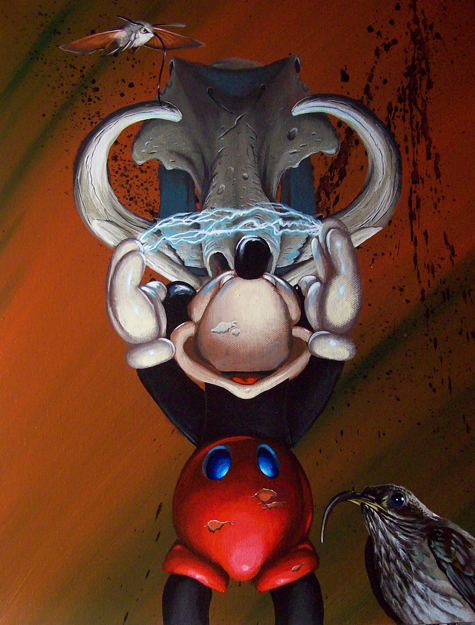
A collection of exotic colored butterflies and beetles mounted in simple black frames hangs on the studio walls of San Francisco based artist Robert Bowen. Scattered around the room are various other oddities: animal skulls and mounted antlers, curious antiques and Disney collectibles. The latter might not seem so odd in comparison to the others, but in Bowen’s paintings he reveals to us exactly how he feels about Mickey and friends. One in particular shows Mickey Mouse standing at the center of the composition, his cartoon white hands rise into the air and violent electricity passes between his eight fingers. His head is cocked up, revealing his iconic grin that now seems sinister. Behind him is an enormous elephant skull; the tusks curling and mimicking Mickey’s shocking arch.
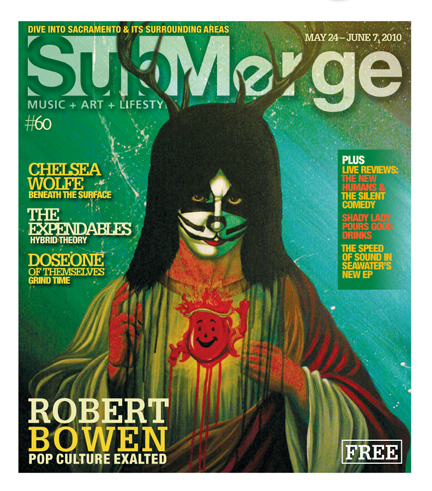
Although it all seems dark and sick at first glance, it’s hard not to ponder his sense of humor in all of this. Who paints Mario Lanza next to a giant banana that peels to reveal octopus tentacles? Or, Peter Criss of KISS appearing as Jesus with two giant kittens resting innocently in the foreground? It’s completely twisted but in a way that you can feel alright about being totally invested in it. A painting like St. Elmo’s Fire shows Bowen’s hilarious generational approach to subject matter. The lovable Sesame Street character Elmo is pictured as a biblical saint breathing fire as a white dove flies overhead.
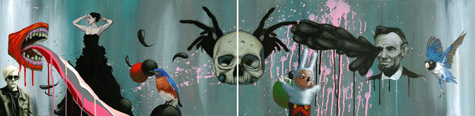
“It’s what I thought was a pretty silly joke and then it turns out to be a painting I’m kind of proud of,” says Bowen.
Bowen himself isn’t the only one impressed with his paintings. Recently, Juxtapoz magazine said that Bowen “is overdue to blow up in the art world.” Even genre superstars like Alex Pardee (whom Bowen has collaborated with) have chimed in on his skills with a paintbrush.
Juxtapoz is arguably one of the high ranking authorities on pop surrealism (lowbrow if you can get away with it, new contemporary if you’re selling to the big wigs) and a glance through the monthly publication will surely point you in the direction of who and what is making waves in the scene. And though Bowen has had his time to shine, many artists who have done so similarly are no longer new and interesting and have simply become a drop in that ocean past the breakers. The key is change and, furthermore, reinvention. Artists like Doze and Twist (the latter who was an important influence for Bowen) have continued to reinvent themselves along the way and have thus staked a future claim for themselves in an oversaturated genre. Bowen is on track to do just that. He has continued to evolve by incorporating stencil, mixed media and sculpture into his shows and isn’t stopping there.
“I want to have bronze works of some of the elements in my paintings,” says Bowen. “Some of the figures and whimsical characters would make really cool bronze sculptures. It’s always in the back of my mind.”
For Bowen, bronzing harks back to his art school days, when he learned quickly that the painting program wasn’t for him. With his introversion toward other students and an overbearing faculty, Bowen eventually “gave up on having art school teach” him how to paint. Since he was already enrolled, Bowen made the switch to a major in sculpture, hoping to have better luck with his formal art education.
A glance at Bowen’s own art history leaves me wondering why he chose to attend art school in the first place. Graffiti was Bowen’s first love and on the walls is where he learned to paint and where he studied color theory and composition. When Bowen was a kid, art programs were being cut (sound familiar?) and there weren’t many outlets for creative expression.
“When we were all growing up, public schools were falling by the wayside,” recalls Bowen. “It’s sad that kids have to resort to doing something that’s considered illegal to get an artistic background.”
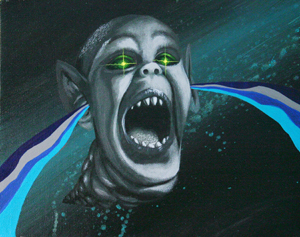
The graffiti influence is seen in Bowen’s paintings in a way that lends itself to his stylistic approach. The bright, bold colors of spray paint translate to acrylic selections on the canvas and what we see is beautifully rendered characters and natural world specimens mixed with lifelike portraits of pop icons like Schwarzenegger in Conan the Barbarian or Batboy from the pages of Weekly World News. What I like about Bowen is that he’s a sort of keeper of all things cool in pop culture. He paints them to mock them, yes, but he also paints to preserve them. The images from his childhood are sacred inside his own mind, and we’re offered an exclusive glance at what he chooses to unearth via these portraits. He’s not embarrassed about being a self-proclaimed pop culture geek, and he’s quick to defend his favorite relics. A recent Twitter post from Bowen reads, “Dear Hollywood, PLEASE stop ruining everything that was cool about my youth one shitty movie at a time. It’s getting really sad…”
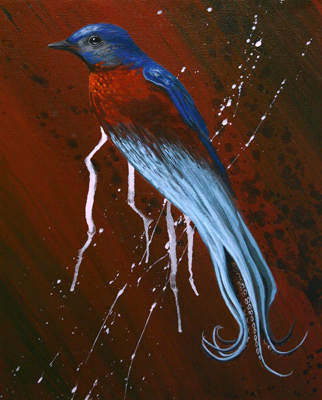
It wouldn’t be fair to pigeonhole Bowen by only shining a spotlight on his horror-like characters or his pop culture icons, though. The Audubon Society is a peak interest for Bowen, and we see that abundantly in his paintings. Out of the 51 images in his online gallery, nearly a quarter of them feature some sort of bird or bird-like element. And it doesn’t end there. Sloth, ferrets, tarantulas, bees, what appears to be Bowen’s dog and even Bowen himself make regular appearances in his work. Those curious collections that decorate his studio are fodder for his creativity, and he has no problem locking himself away and painting whatever sparks his interest.
“I’m kind of a hermit and I stay home,” says Bowen. “I’m totally fine just sitting in here and painting.”
You’d think living in San Francisco would prove to be a distraction. I know many creative minds that have lost their way in a city that has way too much to do all time. But Bowen maintains his focus, and maybe he learned a thing or two by living in a city with a slower pace. Bowen lived in Sacramento for about seven years before he made the move back to the Bay Area where he grew up. While living in Sacramento, he crafted his painting style alongside talented locals like John Stuart Berger, Kim Scott and Skinner. The late and sorely missed Toyroom Gallery was an important meeting spot for all these artists and Bowen showed there often.
“They always wanted to put us in shows,” remembers Bowen. “I showed a lot with Alex Pardee and Poor Al.”
After the Toyroom closed, many of the artists who showed there frequently continued to produce art but all went off in their own directions. There were scattered galleries here and there that offered shows that were similar, but none offered the kind of regular support and progression that Toyroom did.
“They had a good eye at the time, and they brought to the town what was needed and what wasn’t there. It’s a shame that it didn’t last very long because I think it’s still needed,” says Bowen.
Even though Bowen is “the one that got away,” he still has a special place in his heart for Sacramento. He’ll return June 12 like a prodigal son for the opening reception of Beyond the Frame at the Solomon Dubnick Gallery. Also on board for the exhibit are John Stuart Berger, Kim Scott, Gale Hart, Joshua Silveira and many others. Come see for yourself what makes a Robert Bowen show so hard to look away from.
Krylon Dreams
There seems to be an inherent marriage between the creation of art and the enforced destruction thereof by the powers that be. I mean, even John Lennon had an FBI file. So when local aerosol artist Paydirt7 first began his journey into the street-savvy world of writing on freight trains and buildings, he most likely had little inkling that he’d be targeted for the illegality of his work, despite its obvious radiance. But just as quickly, Paydirt7 hit”¦well, you know”¦and even has a commissioned piece hanging at City Hall. His work reflects both the vibrant urban decay of society and also the imaginary cartoon worlds of comics; but both breathe deeply with zeal, and there’s an irregular neo-tech tenderness to his work that separates the oil from the vinegar. Paydirt7 took some time out to chat with Submerge about his beginnings, his middles and why Beat Street changed his life.
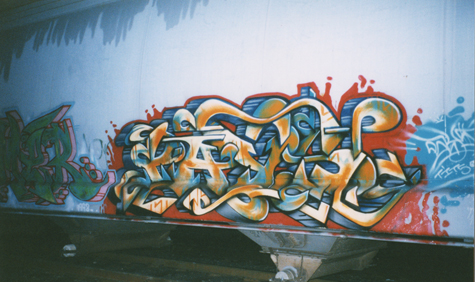
I understand that when you started out, you encountered a bit of trouble due to spray painting on the sides of freight trains. Can you explain a little bit about that era of your foray into art?
Painting freight trains is an evolution of graffiti from the subways of New York. Instead of a train running just in one city, they roll across the country. To me, a piece on a train takes on a life of its own.
What made you gravitate toward aerosol as your preferred method of creating your art?
Before I had even touched a can of Krylon, I was drawing comic book heroes and doing watercolors—you know, that first set of watercolors they give to kids. I’d sit around for hours painting dinosaurs, drinking red Kool-Aid and eating saltine crackers. My first exposure to hip-hop was watching Beat Street as a kid. I think it was around ’85 or ’86, and it was playing on the VCR at a childhood birthday party. Back then it was more about break dancing, and I remember hanging out in front of the supermarket trying to spin on my back on a flattened cardboard box. I think shortly after that we upgraded to a sheet of linoleum. That feeling of fun and creativity is what attracted me to hip-hop style graffiti. I started using an airbrush but got annoyed changing out all the cups of paint and being tethered to an air compressor. When painting murals 20 feet by 20 feet, it’s much quicker with spray paint. I can blast large areas of color with a fat cap and climb to the top of ladders with a papoose full of spray cans. I just like the mobility it provides. Also there is a sense of adventure and interaction with your environment painting outdoors with aerosol.
Your work reflects a lot of different influences, from comics to urban street art to pop culture; do you enjoy working outside of a presumed theme for your pieces?
There are so many styles and subject matters to explore. Some times I feel like Bob Ross, other times I feel like painting ridiculously exaggerated cartoon characters and graffiti letters. No matter what it is, I think my underlying technique and touch shows through.
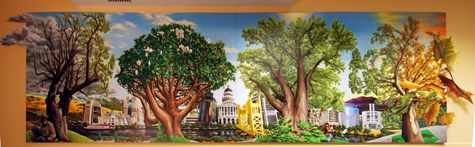
What did it mean to you to be commissioned for a piece at City Hall after having so many speed bumps with legal issues?
I grew up in Sacramento and it’s a pretty small community, so it’s kind of hard to hide from the po-po. I started writing in ’93 and shortly after that began receiving commissions by local businesses. I always wanted to go to art school but did not have the rich parents to pay for it. Also, I was already making a decent living painting murals so why go into debt paying back student loans? When I turned 18, I began teaching computer graphics and mural painting classes to kids in the day, and at night I would be painting freights in the yard. Shit was nice for a while, but when five cop cars show up at your house with a search warrant and you find the FBI has been watching you for the last year, things change. So I guess starting in the street and ending up with a painting in City Hall is a great irony.
What piece of yours are you most proud of?
Top of the list would be when I went to Europe and painted passenger trains in Switzerland. Watching the train I painted five hours ago roll in to the station bustling with people had me jumping out of my sneakers. I imagine it’s the closest I’ll ever come to experiencing what the original writers in New York must have felt when they saw their pieces running on the subway.
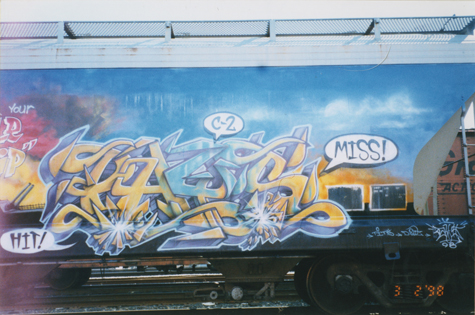
About how many pieces do you create in any given year? How prolific of an artist are you?
Now days I’ve been doing lots of commercial work and it’s hard to find time to paint just for me. I tried for a long time to do two to three paintings for every commissioned piece, but when your hobby becomes your career, you need to find some time to walk the dog. I have some real radical pieces that I’m working on right now—a 12-foot by 8-foot canvas that’s going to disturb some people. Also, I’m becoming more involved in animation and making video of graffiti inspired letter structures that bounce and pulse to music.
To whom or what do you owe your dedication to perfecting and progressing your craft?
My father was born in Hawaii and learned to carve traditional style tikis from a native Hawaiian. So having 5-foot-tall, meticulously detailed sculptures around the house while I was growing up showed me what could be achieved with patience and concentration.
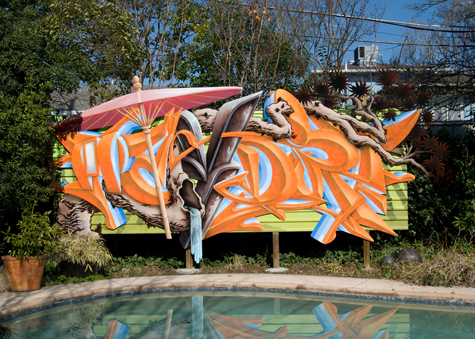
Artist 179 Taps into the Diversity of the Emerald City
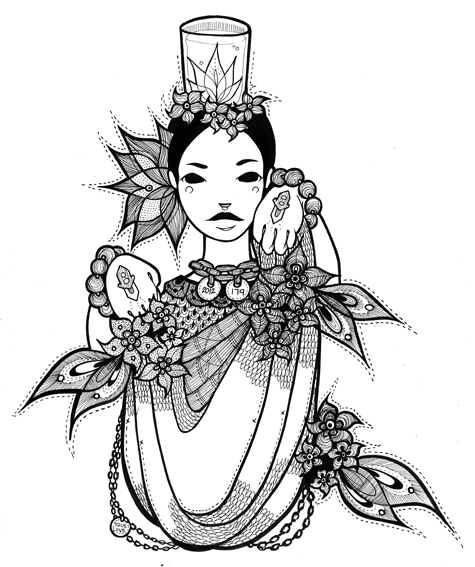
Seattle-based artist 179 got her start in the art world in 1997 as a graffiti artist. In 2000, she graduated from high school, entered graphic design school and started gravitating more toward fine art. Now the artist finds herself facing what most would consider a good problem—rising notoriety.
“It is exciting, and I’m really hyped about all the work I’m getting and all the exposure,” she says. “But at the same time it’s stressful because, like, ‘What if I’m not good enough? What if I slump?’ It’s the ‘what ifs.’ I get a case of the ‘what ifs.’
In spite of the added stress, 179 reports that she has gone through “a really good inspirational period these last few months.” Local art enthusiasts will have the opportunity to see her recent transformation. March 8, 2008 marked 179 first trip to Sacramento for a Second Saturday. The artist will presented a solo show at UnitedState (1014 24th Street) where she collaborated with local artist Illyanna Maisonet to create a live mural painting. In anticipation of the event, 179 spoke with Submerge about her art, upbringing and frightening sermons delivered in Spanish.

Is the graffiti scene in Seattle pretty active?
It comes in waves. A lot of people travel up here, because we have the trains. We’re close to Portland, we’re close to Vancouver, and so we have people who come and go on their way traveling. There’s a small core of people who paint”¦I think Seattle is such a young city that it’s still developing its identity. A lot of people move away from Seattle—they move to San Francisco, they move to New York. It’s always in a state of flux.
Did you grow up there?
Yeah, I’ve spent the majority of my life in Seattle, but I grew up in a farm, migrant town, a little way out from Seattle—about two hours out. I got the best of country life and the best of city life.
Are your parents immigrants?
My father’s from Mexico, and my mother was born in Seattle, but her family’s from Texas—San Antonio. So, I have the Chicano [side], and my father didn’t really speak that much English, he spoke Spanish.
I noticed a lot of animals in your work. Why do you gravitate toward painting creatures?
I don’t want to necessarily put a face on a painting. When you put a face on a painting, it becomes tangible. It becomes, “Oh, that person is a woman, an Asian woman.” A lot of my women look Asian because I look Asian [laughs]. When you put a face on it, you’re able to give it an identity, but with animals not so much. Animals can be a great many things. They could be your spirit animal, or birds could represent freedom because they can fly. They’re not really subjects, but they can be ideas. And that’s something I really started doing just this year—painting animals. I’m really liking that direction, because the possibilities are endless as far as painting them.
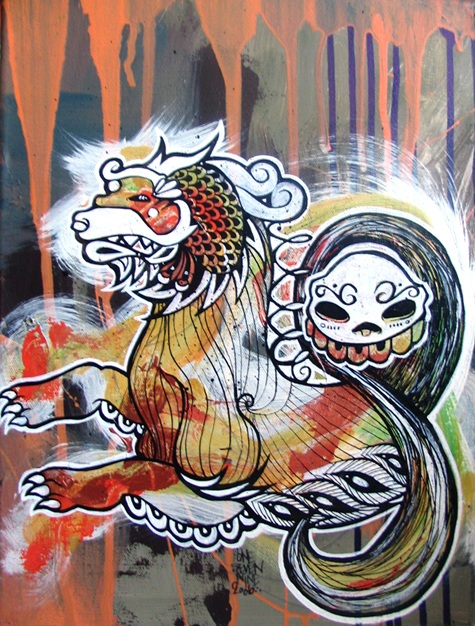
You mentioned that your human characters looked Asian, and I noticed there was an Asian influence in your work.
Yeah, well my family is very multicultural. I have cousins who are Filipino and Mexican, and cousins who are Japanese and Mexican. And so when I came to Seattle from that small city, I had all these different cultures clashing together. I was really confused, because I didn’t understand. When I grew up, I had my father and mother, and they were Mexican, and my sisters were Mexican. We knew white people, and we knew that we didn’t like white people because that dividing line between the farmers and the farmers’ workers. We had those kind of social guidelines. In Seattle, there were all these different kinds of people, and I didn’t know how to categorize them.
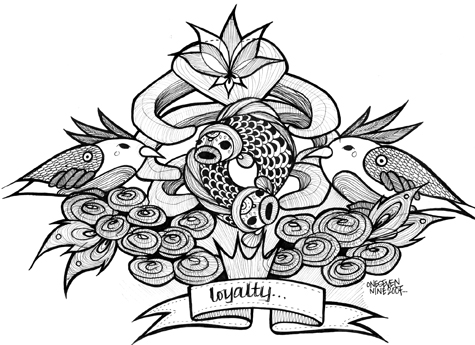
When I first saw your work, I thought there were a lot of religious themes, but the more I looked at it, I guess they’re more spiritual themes”¦
I grew up Mexican Catholic, and being Mexican Catholic revolves around fear and forgiveness. So, we’re constantly asking for forgiveness—like going to confession and stuff—and even in a roundabout way, asking the Virgin Mary for forgiveness. Going to church when I was little and having this priest yell at you in Spanish was very frightening [laughs]. It goes with the saying, “Putting the fear of God into you.” I came to Seattle, and it’s kind of the same, but it’s not quite as damning—the church I’m currently a member of. I’m not a practicing member, but I’m still a member of a church [laughs]. Don’t tell my grandma that, though.
A lot of the things that I find in Catholicism I don’t agree with, like the way they treat women. I also don’t think you should have to beg for forgiveness. You are who you are, and you try to the best that you are. I don’t think that being damned to hell because you were born with original sin is any incentive to be good. I think you should do good because you want to do good, not because you’re scared of hell. It is more spiritual because I think your connection to God is more spiritual than something in a book or a priest yelling at you in Spanish.
I take that Catholic iconography, and I make it spiritual, but I’m also kind of making a mockery of it, which my grandparents too terribly like. But they understand. I try to explain that I’m not trying to make fun, I’m just trying to figure it out. If I put a hot dog on a crucifix, I’m sorry. It just happens.
Are your parents supportive of your artwork?
At first they weren’t. At first it was graffiti, and it was vandalizing, and it was criminal, and they couldn’t understand that aspect. When I started doing more art, and I started going to school for design, they got more supportive. Now that I’m doing shows, they’re seeing the rewards of all my hard work. Because, you know, they’re family and their concerned: “Get a job, get married, have kids. You’re 25, why aren’t you working on a career and settling down.” Being Mexican Catholic, I should have five kids by now [laughs]. But they’re seeing it paying off and kind of breaking that mold of what it means to be a Latina these days. I don’t have to follow the same path that my aunties and my mom did.