Sacramento MC A.R.A.B. looks to infiltrate bigger markets with The Trojan Horse
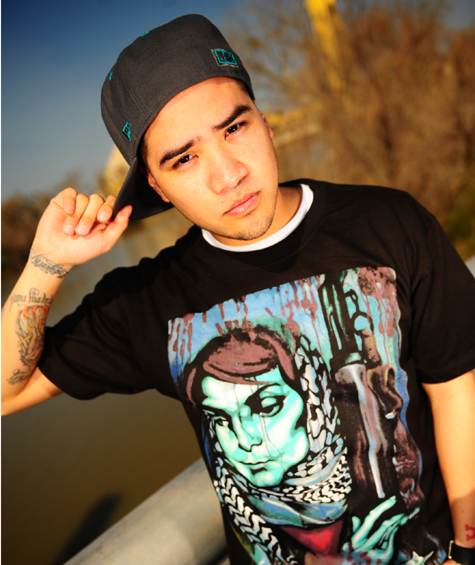
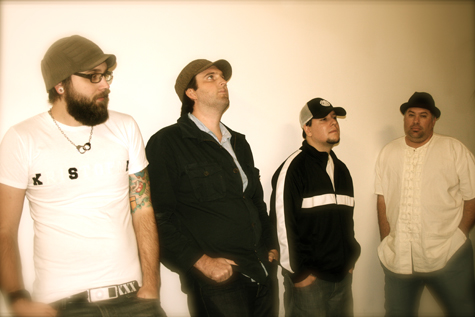
Talk with any rapper or MC who’s been hustling in the music business for five or more years and they won’t hesitate to speak on the “salt in the game”—shifty promoters and snake managers trying to swindle for petty pocket money. Sacramento MC A.R.A.B. weathered his fair share of rats, which is why he could not have picked a better acronym (Always Rise Above Bullshit) to summarize the path leading to his new record, The Trojan Horse—even the album title is a proper foreshadowing of things to come.
Along with his crew/company First Dirt Republic, A.R.A.B. is approaching the business with a perspective not often exercised in hip-hop. The sub-genres of hip-hop (backpacker, club, street) rarely mix company, but A.R.A.B. aims to walk among the culture’s various factions, whether it’s the most underground coffee shop show, a neon lit dance floor with caged girls dancing or a high school auditorium—no frills.
He’s seen plenty of the ugly side of the business, and through that gauntlet he’s emerged with a trustworthy manager and publicist, as well as a crew of producers, MCs and various arts performers that he’s able to call family. “We try to keep it close-knit so everybody benefits,” he said. “If you see us together, we’re tight. There’s a core 12 of us that’s only been together officially for three months, but we call each other family.”
Prior to this record, you released several mixtapes; is The Trojan Horse your first official album?
I had one solo project that I put out, then I had two mixtapes following that. I try to stay away from the whole mixtape thing now. I’m just not a big fan of them. I’d rather put my time and energy into something I can put a barcode on. Mixtapes are sloppy and thrown together. I want to spit on my own beats.
Going into The Trojan Horse project, what were some of your goals?
I think every album I’ve done is a reflection of what I’m going through at the time. When I put out For My Culture I had just beat a case, so I had a lot of negativity on my chest. With The Trojan Horse, this is our push as a group. It’s still my music, but it’s [First Dirt Republic‘s] push to get our foot in the door. The idea of a few conquering many is the idea behind it.
With the Greek legend in mind, should Sacramentans fear the idea of a Trojan horse invading their city?
No, our whole purpose is to get out of Sac through the Trojan horse. In promoting this record we’ve gotten shows in Los Angeles, the Bay Area, I’m working on a show in New York. My producer just got back from India and he wants us to do a show out there. My two goals before this project happened were to do a show in New York and overseas. I wrote it down and it’s on my fridge. It just started happening, man. So, I’m a firm believer in writing my goals down and keeping them in mind.
The funny thing is whenever we promote The Trojan Horse it’s either taken as condoms or viruses.
People aren’t privy to the Greek legend behind it?
Not at all, man. We’ll hand out flyers at events and kids will ask where the condoms are at. This has happened several times. It’s kind of sad. I’d much rather have a young kid assume I’m talking about a virus than naturally equate it to sex and condoms. I guess I over-thought the concept.
Your record is club ready, but injects brief nods to your underground hip-hop beginnings. How important was it for you to maintain that balance?
To me, it’s always going to be there. It’s important that regardless how catchy my beats or my hooks are, that I never sacrifice any of my content. Even if I do talk about more catchy, mainstream stuff, I try to implement my wordplay to a point that if a real MC was listening, they’d appreciate that aspect.
That’s where I come from. I’m an underground MC still. The project after this called Vintage is bananas. It’s all stuff like “I’m a Monster.” It will be nothing but sampled stuff—Raekwon type beats. I understand having dealt with certain people in the business; I have different alleys now that if I make certain songs, I can do more than just stay in one market.
So is the goal to ensure there are no limitations on the venue play, be it a club or a dive, you’ve got the material to fit that market?
With The Trojan Horse alone, I can play a show at a club, I can do a show at an underground venue or I could do a show at a high school. It will be friendly to everybody at those three venues. My goal is to reach a larger demographic. For My Culture was just for underground street cats. In my mind at the time it was a big demographic, but now I see it as a pebble in a pond.
You mention your crew speaks and performs at high schools. What messages are you sending to the youth when you visit?
It started off being more of a personal thing. I come from a troubled background and I worked at a nonprofit organization that dealt with at-risk youth for four years of my life. I’ve always been around troubled kids. I always wanted to talk to young people to try to improve their situation.
It turned into something that’s more musically based. I go talk to performing arts kids or marketing kids or somebody who wants a career in the entertainment business, and we burst their bubbles. We let them know it’s not easy. These kids think if they put out a video on YouTube or one song, they’re golden. I don’t try to tell them they can’t make it like that. I share my experiences. You have to deal with a lot of B.S.
What was your first eye-opening experience that introduced you to the ugly side of the music business?
I’ve been approached by three or four different people that wanted to be my manager. Having dealt with those people really exposed me to a different side of the business. I like the music. I like working with other artists, shopping around for beats and creating songs. That’s one side. When you start looking at the side of being managed and getting promotions, more and more it became less of what I thought it was.
I thought going into hip-hop I could leave all the stuff I’ve been through alone. I didn’t think I’d have to be a jerk, be an asshole. I don’t have to show my fangs and be like that. I thought I could just do music. Come to realize more I got into the business, the more I had to do that to avoid getting eaten alive.
So I saw that you’ve got a clothing sponsor that keeps you in fresh clothes. Who’s keeping you stocked with gear?
Revolutionary Me is hooking us up with gear right now. The head guy there likes what we’re doing and keeps inviting us to events. He’s trying to get his line off the ground, we’re trying to elevate our sales, so it works out.
The people we’ve been meeting keep putting us on big shows with big names, names the sponsor wants to be affiliated with, so it works out. The sponsor gets the exposure, we get on the bill.
Ever get sent anything that you refused to wear?
When Tank Theory was still in Sacramento, they hooked us up with a bunch of stuff. I wasn’t rocking too much purple at the time, but I’ve accepted it now. [Tank Theory] gave me a purple hat and this other dude I was working with gave me some purple shoes. At first, I was like I’m not wearing that. I’m not wearing the hat. The longer it was in my closet, I started looking at it like it’s kinda tight. I rock it now.
Now, I got these Los Angeles Dodger blue shoes with white laces. I look at them, and I can’t do it. Eventually I probably will, but for now”¦
Don’t do it, man.
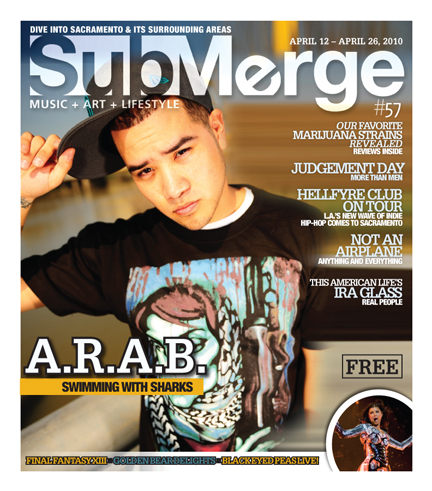
A.R.A.B. will celebrate the release of The Trojan Horse at Harlow’s on May 13. Tickets are $8 in advance and $10 at the door. This is a 21-and-over show.
Ex-Cuesta Drive’s Dane Drewis Takes His Music Solo”¦
Well, Sort of”¦
With the disbanding of Cuesta Drive last year, lead guitarist and vocalist Dane Drewis refused to go quietly into obscurity. Drewis’ work ethic speaks for itself as he’s already completed his solo record, Rock & Soul, and scheduled a release party April 30, 2010 at Harlow’s. The album may bear his name, but it’s largely a product of a strong family bond woven by generations of musicians.
Drewis’ familial and discovered influences seep into his style on Rock & Soul, be it a nod to jazz-rock or the heavy riffs of Led Zeppelin. His path to a solo career is not as inevitable as one might assume, but then again some people are fated to rock by stronger forces than blood relation. Although a fondness for DMX might not be apparent in Drewis’ sound, take a few minutes to ask him, and he’ll probably find the connection.
Honestly, the connection is there. While discussing the minor details of composing the drums on the record, Drewis said he listened to a lot of modern music, including sampling drum sounds from N.E.R.D. and The Neptunes. “We definitely studied modern production, even if they were not our style, to listen to the tones they were getting on guitars and drums,” he said. “The music itself still has the classic rock, bluesy, funk and soul edge to it.” He even listened to Lenny Kravitz, admitting he was not a fan of the musician, but an admirer of his production value. “We listened just to understand that if we could put my playing with that tone it would be awesome,” he said. “No one will ever know. It still sounds like our jazzy jam band sound.”
Let’s talk about your family’s involvement in the production of the album.
I guess I’ll start from the beginning. My parents were jazz musicians. They played in cover bands throughout ’70s and ’80s. That’s what they did full time, until they had their second kid, my sister Deena, then they had to get real jobs.
Both my sisters are very musically inclined. I tapped them on the shoulder for the album to come out and sing. Actually, my whole family came out to sing in the studio for the song “Friday Night,” which is the single we’re pushing. We did group vocals and individual vocals. My little sister Janel and I have written a couple songs and Deena is a really good writer. She works for a publishing company called Flatmancrooked. So she’ll shoot me lyrics all the time. We’ve done a couple gigs together, just fooling around. We definitely rehearse at home, but we’ve never got a full, official band going. But, it’s always been a possibility in the back of my mind.
ÂÂ
Since you’ve got your family involved in the recording, do you think you’ll invite them on stage to sing with you at your release show or one of your local gigs?
Well, my little sister is opening for me at Harlow’s for my record release party. She’s 18 and she has no idea how good she is. I always joke that someday I’ll be opening for her. My dad plays bass for me now. But, we’ve talked about doing a couple songs together live. At the Cuesta Drive CD release show two years ago I had both my sisters and my mom come sing backup on a couple songs, but it was so loud. They’re not used to loud rock stuff. They had a hard time hearing themselves through the monitors.
Definitely a possibility. It would be really great to capture on video since we’re filming the whole show. I’ll leave it undecided to surprise people if we do it.
ÂÂ
How has music being the family business strengthened the bond between your parents and your siblings?
It’s come to fruition more so lately than it has in the past. All through high school I was anti-jazz and rock ‘n’ roll. I was into hip-hop. My parents couldn’t stand it. I didn’t touch a guitar until I was 19. I got one in college.
My parents own a restaurant, Strings Pizzeria on Bradshaw, so we’re all working there, but music is our outlet. It’s a way to relax, let loose and de-stress. It’s the number one activity we all participate in, besides working at the restaurant. We do an open mic [at Strings] every Tuesday. When Janel is home, she comes and sings. My dad and I are always there, so it’s our new thing we do.
ÂÂ
So it was never a family tradition to sit and have a drum circle after dinner?
No. When I moved home from college about four years ago, it changed. We’d be sitting around and after a couple glasses of wine that’s when it would start happening. My parents’ friends would make us play or something.
ÂÂ
One of the write-ups on you said that because you were raised in a musical family it was inevitable that you’d be a musician. That notion struck me as strange, and I wanted to know if it felt that way.
It is kind of strange. It was a huge compliment, but so much of it is behind the scenes grinding and self-promotion that takes a strong personal drive. A lot of my friends are incredible musicians and I look up to them, but they don’t have the motivation beyond singing a couple songs around a campfire.
ÂÂ
With the idea of inevitability toward music in mind, did you have a rebellious stretch where you didn’t want to go into the family business? Maybe during your hip-hop days?
I did. My parents joke that all Asian kids play piano, and my parents made me play when I was a kid. I played for two years, and I was pretty good. The day they said I didn’t have to take lessons anymore, I was 14 and I stopped that day.
I couldn’t stand all the stuff they listened to when I was growing up; all the Motown, lots of bossa nova and Latin jazz. I heard it millions of times, but went out of my way to block it out of my mind. Now that I’m older it’s coming back in waves I would never have imagined. They never really pushed it on me. When I asked for a guitar for Christmas, while I was in college, it took them both by surprise.
I heard Led Zeppelin for the first time when I was a senior in high school. That’s how into hip-hop I was. I used to be able to go through whole DMX and Tupac albums word for word. In hindsight, I listen to those records now and there’s a lot of musical stuff going on there. It was my way of rebelling, but it led me here. Couldn’t have been that bad.
ÂÂ
Since your dad is a seasoned musician, has he given you any tips for the road of touring?
He tricked out my van, gave me his amps and some of his guitars. My mom is worried because he’s going out on the road with me.
ÂÂ
She knows what the road is like, too.
She’s having a heart attack. She knows how much we drink and smoke. She’s like, “Keep an eye on your dad.” But, I’m thinking, “Keep an eye on my dad? He’s supposed to keep an eye on me.”
ÂÂ
What’s the status of Cuesta Drive?
I think we’ll do a couple of reunion shows here and there. Thank God we’re still on great terms. It got to a state of the union last year about this time. We sat down in the back of Sweetwater and had a huge talk. We’d just finished that music video for “Rollin’.” We’d been a band for five or six years and we discussed what it exactly it was we were doing. I was pushing for buying a van, getting on the road, quitting your day jobs, be prepared. Originally that was the plan, but you know how guys are, they don’t talk about their feelings and shit.
We’re all gung ho as far as playing music, but our bass player Timmy got into grad school in Idaho on a long shot. We just kind of went our separate ways. I can always see us getting back together to play and jam, but right now I’m trying to make this my career. I have the drummer from Cuesta Drive still; he plays with me live. Timmy is coming home in May and is already talking about doing a couple shows. Why wouldn’t we? I’m sure we’ll always do a couple reunion shows—kind of like The Police [laughs], but on a small scale.
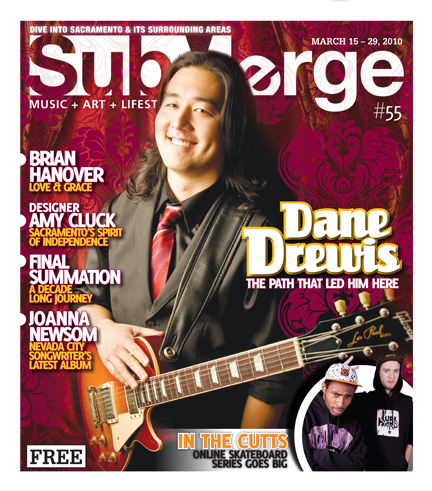
Dane Drewis will celebrate the release of Rock & Soul at Harlow’s April 30, 2010.
Peter Hayes and Black Rebel Motorcycle Club go their own way
An hour on the phone with the amiable Peter Hayes of Black Rebel Motorcycle Club and it is easy to understand why his service in Brian Jonestown Massacre was short-lived: Hayes was and still is far too sequestered in a polite, quiet state for that scene.
Given the chaos of Brian Jonestown Massacre, followed by the hardships endured in BRMC, Hayes could be a cranky egg, stressed to crack and spill—but don’t mistake quiet for easily bullied. He is part of a band that’s in control, despite the odds.
Bred from the same scene that produced Brian Jonestown Massacre and The Warlocks, Hayes is a notable creator in a genre that injected lightspeed pulsation into the heavy drone of shoegaze. He contributes bombastic guitar riffs to the BRMC sound that hint to a dark torment within all blues musicians. But gifts in the devil’s music always come with a contract.
BRMC gave its labels fits with its refusals to bend its values and opposing understandings of rock ‘n’ roll etiquette. There were constant tug and release battles, where the label would tug at the band with suggestions of wearing certain outfits for videos or licensing songs for commercials, and the band would refuse. BRMC’s refusal to allow the use of its music for commercials was the inevitable last straw for labels—goodbye, RCA; goodbye, Virgin.
After being dropped from Virgin Records, BRMC rethought its political stance and worked out a subversive middle ground. Now releasing records on its own Abstract Dragon label, partnered with Vagrant Records, BRMC understands that the move to independent circuit is not absolute or sans compromise.
Turn on the television and “Spread Your Love” from the band’s self-titled debut is blaring strong as a soundtrack to a Smirnoff vodka commercial. Hayes is unfazed by queries regarding the “sellout” backlash that may come with licensing a song to the corporate sales machine. “The way the business is going. It’s the only way you get anything out of this anymore,” he said. “Commercials are your lifeblood. When you’re offered them, you take them.”
It’s not widespread knowledge that BRMC is a band of philanthropists, but it should be. “We don’t want to paint record companies with a big brush as all bad. They love music too, but they have a business to run. We decided to let them have theirs because they need it and want it that bad. But, we’re taking that money coming to us and putting it back into what that company is destroying, as best we can.”
Hayes chuckled to himself as he described the technique as “subversively using their money against them.” The group donated its earnings from a car commercial to PlayPump International—a nonprofit that raises funds to donate PlayPump water systems to African communities and schools. “I don’t want to be misconstrued as that somehow being big of us,” he said. “That’s just how we do it. There’s a lot of other people doing a lot more. We don’t blame any band for taking any money. It’s just something we do.”
Hayes’ outlook toward the industry runs counter to the token diatribe often spewed by jilted musicians when discussing why were dumped by the majors and began releasing music independently. “Since you’ve been signed and dropped, is it liberating to be more in control of your music?” I asked, thinking he would regale me with horror stories of the evil labels and express a sense of liberation in going independent.
“The whole notion of control, I don’t really understand,” he answered. “You give up control to a record company if you want to. It’s pretty easy to say no. Although, it might not have been smart”¦I don’t feel in any less or more control. There are formulas to write good songs that are proven to work, but it can also come down to blind luck. Which is fine by me.”
Consequently, there’s never been a formula for crafting a BRMC record. The majority of Beat The Devil’s Tattoo, their latest release on Abstract Dragon, was conceived from jams, with 20 songs compiled. The remaining few were built from acoustic songs written outside of the group sessions. The record also features the first recordings with former Raveonettes drummer Leah Shapiro, who joined as a touring drummer a year ago.
For Beat the Devil’s Tattoo, old friends reunited in the same space the early stages of the group’s 2005 release, Howl, was created, a commune scenario of sorts in a small town on the fringes of the Philadelphia metropolis. “We all lived together,” he said. “Feeding each other, trying keep each other going. It was great.”
Often described as a band that meshes the influence of Johnny Cash into the sonic shoegazing of The Jesus & Mary Chain, it’s alarming that the tame, slow drawl of Hayes’ style of speech helps front a band awaiting the devil at the mouth of a murky delta.
“It’s no conscious choice,” he said of the band’s gothic overtones. “Even the happier sounding [songs] are disguised with the lyrics being quite dark. We always try to have a little bit of hope in them, whether it’s a sound that makes you go, ‘Oh fuck, that sounds cool,’ or there’s a little bit of light breathed in through the lyrics. It’s not about being all bad.”
Black Rebel Motorcycle Club will played Harlow’s Night Club on Feb. 26.
One Block Radius rises out of The Dump and embraces a new music model
For seven years, One Block Radius’ sound has come forth from one location in North Hollywood, The Dump. It’s difficult to imagine recording in such a claustrophobic trash heap littered with Monster Energy cans, discarded potato chip bags and Del Taco wrappers, but the beginnings of OBR trace back to original members Marty James and MDA living in their trashy workspace.
It is one of the least glamorous tales with an attachment to Hollywood that you will read. James and MDA no longer live in The Dump, but it has remained the group’s recording temple. “Right now it’s at a new level of stank its never reached before,” James said. “I think the dumpier it is, the harder I work.”
The philosophy is common for producers: stop showering and grow a questionable moustache, anything to keep people out of your workspace so you can create in isolation. James knows that a gaggle of groupies won’t try to hang out amid the junk food dregs and lingering stale stench. “There’s no room,” he said. “Me and two other people can sit in there if I move some boxes around. At the same time, I keep connections with other studios should a more established artist come through. You can’t really be asking E-40 or Sean Kingston to come through The Dump.”
Recently Marty produced music for Motown recording artist MoZella for her The Straits EP. James said she brought her guitar to The Dump and even though she clowned on it, she survived the stay. “There’s no frills,” he said. “It’s where men come to make records. There’s no foo-foo bougie shit in there. It’s just get down.” It’s a workspace he intends to always keep, even if it’s merely for nostalgia.
With third member Z-Man living in San Francisco, the group clocks ridiculous travel hours that include James producing a foundation for a song at The Dump, then taking it to Street Symphony studio in Fremont, Calif. James said he values those trips to the Bay as opportunities to sink into artist mode. Living in Los Angeles, he’s consumed with being in collaborator/writer/producer mode. “I’m from up that way so I click into my artist mode,” he said. “It snaps me out of the songwriter hustle I’m always in.”
Originally from Chico, Calif., Marty earned his stripes with trips to Vallejo, Calif. Only a teenager, he worked in Rated Z studio, while they were recording ’90s hip-hop group N2Deep—maybe you remember “Back to the Hotel?”
“I got in with those guys by sending packages to any address I could find,” James said.
N2Deep producer Johnny Z took James under his wing, loaning out his MPC in the studio and allowing James to take his SP1200 back to Chico. James spoke of this era in his life with great significance as the engineers and music clerks he met in Chico lacked the knowledge of hip-hop production he gained in Vallejo. “I’d be playing them Ice Cube songs, and they’d give me all kinds of wrong information,” he said. So wrong they invented (only in their minds) an instrument called a “synchronizer” to explain the tricks of the trade. “I was going to music stores asking people for synchronizers,” he said.
James moved to Vallejo, forming his own group, Scapegoat Wax. The group released a few underground records until he moved to L.A. in 2001 and began his conquest of the industry. One Block Radius dropped its debut Long Story Short in 2005. The exposure from the debut, a mixtape and the “You Got Me” single led to a major label signing to Mercury/Island/Def Jam—a short lived experience.
With the terrain of the industry drastically shifting, major labels are essentially lost without a paddle as to how to properly promote a record. Still relying on radio play and other archaic promotional tools, OBR never had a chance at national success. James has no ill will toward the dissolution of the contract. “We were doing pretty good on the charts,” he said. “When momentum started to slow down we put our album out. It came and went fast. We probably should have held off, but there was a lot of good that came out of it.”
James said it was a learning experience, that given his prior history, he should have known better. For him, it was easy to get caught up in the whirlwind and excitement of being signed after years of independent grinding. Major labels aren’t suffering from an abundance of clients, but understaffing. It’s inconceivable that a rep can manage more than three acts in a day, let alone 15, which does happen! It only took a few months of major label life to recognize that the contacts James had established on his own would be all he needs to build a career. “The greatest part about the industry now is music can travel,” he said. “The first album still has a word of mouth attached to it.”
James recently inked a deal with DAS Communications, which handles The Black Eyed Peas, to manage OBR. He said he’s acted as his own manager throughout most of his career, but saw this as an opportunity to focus more on working in the lab, while his management handles his Twitter, Myspace and Facebook accounts. Because that’s the direction of the industry; being accessible digitally and not just having music, but being a personality in those vehicles. “It’s a challenging time to be an artist,” he said. “I think what’s happening is, no one is getting rich anymore and so the people that really want to be in music are the ones that stay in it.”
James is optimistic for OBR in this new world of music. He sees it as a singles driven market that rarely involves a well-conceived album. He’s not entirely turned off to a record deal as he is still in talks with people, but he said securing a record deal is low on the group’s priority list. “A group like us who is still just buzzing, we need to drop multiple singles,” he said. “We’re too self-sufficient to bother with a deal unless we are looking for radio play. I’ve yet to see a deal that does something for the group that we’ve not already created ourselves.”
This has been the core plan. James continues to build his name as a writer and producer, rubbing elbows with industry elite, while OBR works in the wings crafting catchy singles like “You Got Me” and its latest, “Broke Ass Holiday.” The single is a positive song about being grateful for what you have. For a group that began in a place called The Dump to still speak positively after seven years of being relegated to that spot, speaks to a humble presence in its members.
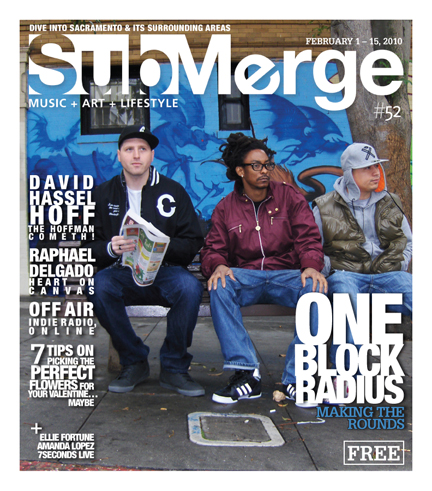
One Block Radius played The Blue Lamp on Feb. 10, 2010. First Place and The Freshmen also preformed.
Steven Borth’s CHLLNGR takes dub to the next level
Jet setting around the world to collaborate and tour, studio sessions with music’s most renowned creators, and splitting living time in Sacramento and Copenhagen with a beautiful girlfriend would seem to make for a full life for most musicians, yet Steven Borth II seeks more from his endeavors. The well-traveled musician is exploding back onto the scene with his new project, CHLLNGR, a dub revolution that takes some history-digging to get to its source.
Borth was born and raised in Sacramento, but found his niche as a musician in the Bay Area. Remember ska? More specifically, remember third-wave ska punk? It had a good run in the ’80s and ’90s and Steven Borth II was a part of that as a member of the East Bay’s Link 80. He joined the group in the latter years of its existence, but his involvement is integral in shaping CHLLNGR.
Link 80 frequently toured Europe, enjoying the fruits of the punk rock circuit in the United Kingdom. It was on these tours that Borth acquired a taste for dub music. “I would help load in the gear, do a sound check with just enough to time to go outside and ask someone where the nearest record shop was,” he said. “I would make it just in time before they closed, and I would pick up what I thought may be good. How I really got started was collecting the Trojan box sets.”
The dissolution of ska was far from pretty. Link 80 suffered traumatic losses and its surviving members found new outlets. For Borth it was joining Rx Bandits, another Bay Area ska revival band. He’d been in Link 80 for four years, but when Steve Choi offered him a spot, he joined up because, he said, Rx Bandits’ sound shared the direction of his interests musically and politically. Those Trojan box sets he scored while on tour with Link 80 introduced him to dub originator King Tubby, which inspired him to continue his exploration of dub while on European tours with Rx Bandits.
Borth started a side band called Satori while playing in Rx Bandits. He described that band as homage to Jamaican music, which served as a foundation for CHLLNGR—his foray into the next era of dub.
Borth first graced our radar as the bearded, almost Teen Wolf look-a-like saxophonist in Purple Girl. The all-too-short-lived funk band could have been Sacramento’s answer to Hall & Oates, but it was not meant to be. Months later, Borth’s three-piece project Dub Defender emerged at The Press Club. Dub Defender’s first run of shows featured Borth on keys, vocals and sax, with Purple Girl/Who Cares keyboardist Young Aundee contributing falsetto vox and DJ Whores cutting up club-friendly hip-hop samples into the dubbed-out fold.
That night featured hip-hop and indie rock bands, yet wedging a dub set into the mix was far from an uncomfortable juxtaposition. Borth’s willingness to let his projects breathe and grow makes Dub Defender an intriguing plot. There is no blueprint for Dub Defender. Borth opts to let his instincts and interests amalgamate until he’s satisfied with the results. “One of the most important things for me in music and in life is to always be open to new ideas,” he said. “I try to make open roads for myself and anyone that is involved in my projects.”
Borth and company leaked a single, “Change Is Great,” as Dub Defender before changing the name. The project is now called CHLLNGR, which is pronounced “Challenger”—he just dropped those useless vowels. Borth explained that the new name is meant to express the boundless nature of the project. “I felt the name Dub Defender could be restricting stylistically,” he said. “I really want to explore this project and take it as far as it can go.”
CHLLNGR began on a TASCAM 388 reel-to-reel machine made in 1985, which Borth purchase in San Jose, Calif. He enjoyed the dusty aged sound of the quarter-inch tape. “[The seller] tried to say it worked, but I knew that it didn’t,” he said. “It cost me $800 to fix, but in ’85 it was retailed at $5,000. Using it made me think a lot about studios, and if you’re looking for a vintage sound, it’s better to be limited, because that’s technically how it was.”
The recording sessions were structured as a game for the collaborators to play. Borth invited his friends to add their touch to the simple chord changes he’d laid down, until each musician was satisfied with their bit. Once the structure was settled, he recorded on the TASCAM until the proper vibe filled the room.
“I wasn’t looking for perfection as much as I was listening for the take where everyone’s own style came out the most,” Borth said. “What I really captured in doing it like this was that once we got it, there was a certain freshness to the sound since we were really learning and creating the songs while in the process of recording them.”
Those sessions will be CHLLNGR’s debut EP, which is scheduled for a spring release on Green Owl. The EP’s release has been pushed back several times, but the delay has not phased Borth. He said, “When the project gets debuted we want it to be perfect. The people I’m working with on this record have been making music for a long time, so we know how to do it wrong. We’re taking the necessary measures to be certain that the timing is right.”
The live set, since we last heard it, focused primarily on dub vibes; but when Borth mentions collaborating with Zach Hill, Brooklyn’s Ninjasonik, former The Defendants member Dr. Echo and London’s Afrikan Boy, the direction of CHLLNGR becomes puzzling. It’s not surprising his session with Hill in the Bay Area involved noise nuisance disputes. Borth invited Hill over to lay down drums and even took the necessary steps to warn his landlord and neighbors of the impending noise. “I knew it was going to be loud, but I had no idea how loud.”
“[The landlord] said it would be fine but to try to get done by a certain time since they had their grandparents coming over,” Borth said. “Once we were done we walked outside and my landlord looked like he wanted to kill me. He said it shook the whole house. Needless to say, we were done in time and no heart attacks occurred.”
Living the life of a nomad, but keeping an apartment in Copenhagen, Borth said it’s been a taxing process to continue recording CHLLNGR on his beloved TASCAM. “I have been creating a lot more of my music utilizing modern technology, i.e my laptop, micro-Korg and an Mbox, which I think will be reflected in the sound,” he said. “I will most likely use the TASCAM again for this project, but at this point since I am traveling quite a bit, and it is easier for me to put everything in a duffle bag, travel around and capture sounds.”

CHLLNGR played the Submerge 50th Issue Party/second anniversary on Saturday, Jan. 9 at Marilyn’s on K with TAIS and DJ Mike Diamond.
To see when and where CHLLNGR will play next you can check out www.myspace.com/chllngr
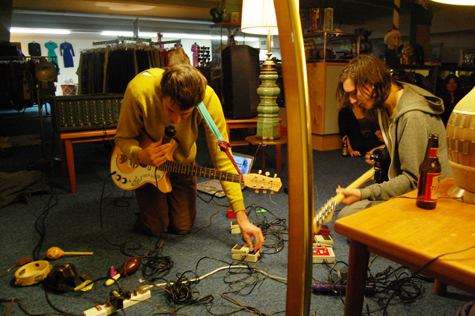
Bows & Arrows secondhand hipster apparel boutique is not known for its live entertainment, but the dozen or so hip enough to be in the know got a brief, but aurally excitable performance from Placerville’s Pregnant Dec. 3.
Formerly grid kids, Pregnant moved out to the sticks, possibly to their greatest benefit. Their album, Liquidation on Swans, is a complicated experience. Bountiful in picturesque collages, the record will rack your brain in wonderment as to where Daniel Trudeau found these sultry sounds—which is why seeing Pregnant perform is such an enlightening delight.
The Bows & Arrows atmosphere complemented Trudeau and his guitar-strumming assistant, Michael Saalman. The lights were turned off except in the small floor space, cleared for their instruments. The band played in the lighting of kitschy lamps for sale, while onlookers sat on the floor, giving these living room scientists a fitting workspace to kneel among their array of pedals and build each song from scratch.
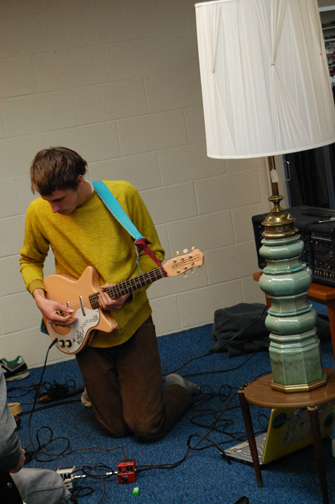
The joy of watching Pregnant comes precisely from that. Saalman noodled at his guitar endlessly, while Trudeau methodically looped each piece of his instrumentation into the fold. Trudeau beatboxed, pitch shifted his voice into kooky layers and strummed a wooden lizard to complete the steps of “Do That.” He created bass from rhythmically breathing heavily into the microphone, tweaked a kazoo into a swarm-of-bees buzz, and skronked on a saxophone, proving his talents beyond the junkyard noise. The scatter of percussion tools on the floor and the effects pedals were all utilized to steadily bring each song to fruition. The sound was reminiscent of Brooklyn-based noise bands like Say No! To Architecture, GDFX and Zs. However, Pregnant is inherently California freak folk. Those Brooklyn kids are all harsh noise from buzz saw reverb and nose bleeds, while Pregnant is countrified and tender. Birds chirp, wind chimes made of bones jingle and the warmth is candid.
There’s nothing to fear in a Pregnant record and that kindness is present in their performance. The duo never acknowledged the audience, far too engulfed in their process, but once they finished, they thanked us, awkwardly bowed, locked hands and dry humped a lamp.
Pregnant plays traditional venues, but if you have the chance, see them in a living room, a boutique or a basement. Make sure there’s carpet and a place to kneel. It’s best to be as comfortable as the musicians, which means removing your shoes and letting those toes wiggle a little.
Life in 24 Frames takes a progressive approach to their music, in more ways than one
It’s time the music industry faces the truth that soon the CD will be an obsolete technology. While it is heartbreaking that record stores might disappear as well, it’s impossible to deny the power and ease of the MP3. With this in mind Sacramento’s Life in 24 Frames has developed a clever marketing strategy as an act of accepting these changing times.
The download card is so new it feels awkward. Life in 24 Frames use these business cards with download codes to spread the word. No physical copy exists of the band’s music; rather demand is created through limited time offers on its Web site. The response has been mostly enthusiastic, but the band worries that perhaps there is something lost in translation when they give out cards to fans.
After a show in San Diego, the band was loading up when a girl looking to purchase the band’s music approached. When the lead singer Kris tried to give her a card, she respectfully declined, saying she would prefer to buy a CD. “I don’t think she understood what it was,” he said. “I think she thought I was trying to pick up on her. Not a week later I gave someone a download card and he said, ‘This is sweet, but do you have anything I could buy?'” Tony added that given this economy they never thought people would be so insistent on buying a record instead of getting free music.
Eventually Life in 24 Frames will compile its songs onto a CD. The band hopes to have it completed by the spring or summer of 2010. Until that day though, they are continuing the awkward exchanges in hopes that the cards will catch on. Kris said having a pocketful of cards excites him, as he’s often been tempted to make it rain cards on the audience, but can not justify wasting free downloads.
Life in 24 Frames expressed a focused approach to its writing process. The cards make it a task to have three new songs available every two months. The drummer, who simply goes by Mango, said the band has set a standard that requires discipline.
“There’s nothing worse than when your favorite band takes two years to put out a new album,” Kris said. Life in 24 Frames is constantly writing to maintain fan interest in this digital age where music is available with just a click.
“Some bands can do that,” lead guitarist Tony C. said in reference to taking years between records. “But, obviously with a new band like ourselves, we can’t afford to do that.”
As for their sound, Kris admitted the band has yet to write a song under five minutes. Life in 24 Frames has an experimental sound that builds toward ethereal crescendos.
“None of it is intentional at all,” Kris said. “We never go into the studio with the plan of making a seven-minute epic, but we also don’t stop building the song until everyone is comfortable with their part.”
The band often gets comparisons to Radiohead and Pink Floyd, but the members came together in their appreciation for ’90s indie rock like Built to Spill and Sunny Day Real Estate. Mango was the last member to join. He heard Life in 24 Frames’ first EP and immediately envisioned playing drums for the band.
The bassist Wes said the band hopes to eventually achieve that perfect pop song greatness, referencing The Beatles’ “Happiness Is a Warm Gun” as an example of fitting dozens of great ideas into the three and a half minute pop mold. “They are long songs, but they don’t feel like long songs,” Mango said. “We don’t focus on how long it is. They all have to reach a specific energy.”
Life in 24 Frames said it came to terms with its current sound four months ago. Wes said despite each member having different backgrounds and playing in bands that sound nothing like Life in 24 Frames, they all seemed to be arching toward this moment. “I’m sure we won’t be the same band a year from now,” he said.
Press so far for Life in 24 Frames has the band adopting a bad publicity is still publicity mentality. One show review that amused them in particular was after a last minute scheduling in San Francisco. The reviewer that night trashed the band for having an atmospheric sound that did not translate to the live setting, suggesting that the band be best enjoyed while doing homework, making out or falling asleep. Despite the writer’s intentions, Life in 24 Frames considered the remark a compliment.
From its inception the band has been based around technological savvy. The members all met on Craigslist. Kris joked that whether you’re trying to sell your lawnmower, need a girlfriend for the night or a new drummer, the list will fulfill your needs. Kris has a background in video production. Life in 24 Frames hopes to eventually incorporate video into its recording sessions, but he quickly admitted that filming and playing music at the same time is a difficult task. It did few favors for The Beatles when they attempted to document its Let It Be sessions and Life in 24 Frames are aware of those concerns. “When you’re part of the music writing process there’s absolutely no way you can also from an outside perspective to film it,” he said. “I would like to shoot one of our long drives back from Los Angeles as a music video.”
The Scary Art Collective Brings Their Art to the People
A fault of artists is their inability to comprehend a recession. Despite being conditioned for poverty, artists on the Second Saturday circuit continue to tag their work with lofty prices, turning a cold and dented shoulder to the slimmed pockets that stroll through the galleries.
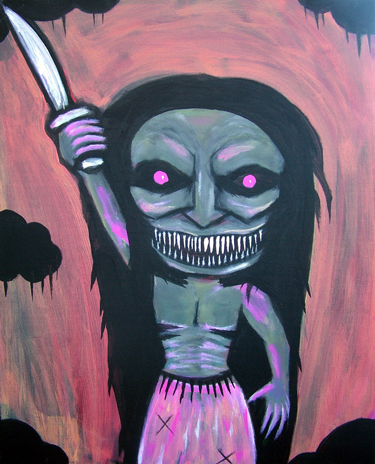
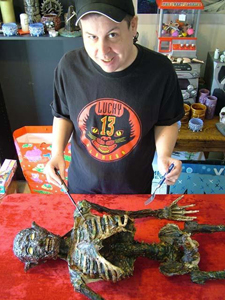
Nicolas Caesar does not have the privilege of letting his art remain in his possession. He’s got bills to pay. Call it low brow, call it tawdry, call it plebeian, but you can’t call it depreciated, as Caesar and his Scary Art Collective are selling their art before they can get it out of the boxes.
Chip Conrad, owner of Bodytribe Fitness, was the first to coin the collective. Four years ago, Conrad opened his fitness center to Caesar and his friends to use as an art gallery one Halloween, the only holiday that complements Caesar’s macabre style. “I remember getting this Myspace message asking if I wanted to show my art in a gym,” he said. “I totally thought I was walking into [a situation] of getting raped, but I’m like the girl who can’t say no.” Caesar did not get harmed, physically or emotionally; instead he formed a friendship that led to a love for the Sacramento art scene. It was a love that he described as a refreshing escape from the Bay Area scene.
From there, it became a repetition of faces. At galleries in Midtown or San Francisco, Caesar was showing his work and cheering beers next to the same few people. In this overlapping, Mark Fox, Temple Terkildsen, Cinder, Krissi Sandvik and Caesar began seeking each other out and sharing galleries. The loose organization has an unrecorded number of members, with an East Coast and West Coast branch. “Since we share the same territory, it’s a cross between Thanksgiving and AA,” he said. “We all share our tragic stories and our successes. Every Second Saturday is like meeting up with our second family.”
The art is mostly Gothic and dark, pulling inspiration from horror movies and the morbid subconscious. The artists share a magnetic desire to express their darkest thoughts, creating an organization comprised of your garden-variety goths to the criminally insane. Caesar is a pen pal with convicted serial killer Wayne “Skid” Lo, who is not a member. “Wayne is not officially a member of the Scary Art Collective,” Terkildsen said. “But, he does trade art with Nick.”
“My whole feeling about it is, the guy’s in prison,” Caesar said regarding his lack of concern. Caesar bought a piece of Lo’s art called Flushy the Toilet Monster. All of the proceeds from Lo’s art go to the victims’ families. “I’m gaining the Gilligan’s Island of strange and weird people [in my life],” Caesar said. “Weirdness is attracted to us.”
Living among the proletariat, Caesar is a self-proclaimed artistic anarchist who disregards the traditional rules of gallery art. He markets his work to the collectors and appreciators that keep a 30 pack of Pabst Blue Ribbon in their refrigerators and eat Top Ramen to get by. “I sell to my own demographic,” he said. “[Artists] don’t really understand who collects their art”¦ Artists have to go back to catering to the people.”
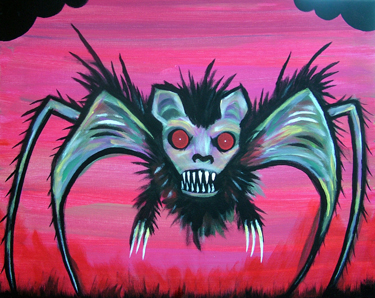
Terkildsen said the members of the collective are firm believers in the bartering system. On a slow night, she’ll trade two cases of beer for her art. “I’ve traded a painting for a haircut,” Terkildsen said. Essentially, they sacrifice the pompous satisfaction of selling one great piece at top value for the opportunity to put hundreds of pieces in as many living rooms as possible. Caesar and Terkildsen do not hesitate to call themselves art gypsies.
For Caesar and Terkildsen, the collective is an extension of their daily routines. Terkildsen said she works her shitty part-time job, works on art for four hours at home and then spends the remainder of the night at Caesar’s home drinking the Blue Ribbon and watching campy horror films. With work habits like that, the duo produce more art than they can store in their homes, making the bartering system all the more necessary.
“I’ve actually timed this,” Caesar said. “I can make three pieces to the movie Escape from New York.”
They are unapologetic in their merits. Both artists recognize the critiques that can be made of their leftist perspective, but they seem to revel in the judgment. Caesar said the collective’s strongest attribute is a lack of competitiveness in a cutthroat profession. Before founding Scary Art, he was frustrated with the unwillingness of his contemporaries to share galleries and the snootiness that comes with a saturation of artists. The Scary Art Collective aims to redefine the relationship between artists and galleries by operating outside traditional spaces. The collective has had shows in adult boutiques, tattoo studios, S&M clubs, gyms, coffee shops, bars, horror and comic conventions, warehouses and churches. Caesar likes Sacramento because of its bounty of unique spaces run by down-to-earth people.
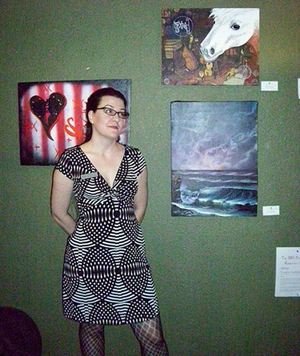
Terkildsen described the horror of galleries outside of Midtown, expressing a loathing for curators who proclaimed they could not show her art due to its pricing. “You’re in a fine art gallery with a bunch of fuckheads you’d never talk to and you think, ‘Wow I really can’t stand this,'” she said. “Immediately, I want out and to be doing a show with Nick. I prefer the open flea market of Midtown.”
Ritually our conversation came back to PBR and living a life without the knowledge of which fork is for salads. To the affluent, this might seem like a life devoid of taste, but Caesar and Terklidsen’s art reflects a deep-seated passion for beer and cheap horror films. Read any of his comics and you’ll find black humor applied to boozed-up zombies. They share a distaste for the art critic, or in Caesar’s mind, the pastime of gremlins suffering from insomnia. “It’s a useless occupation,” he said. “For as many pages as an art critic can write, there’s going to be that person that goes into an art gallery and says, ‘You know what? I like skulls’ and buys our art.”
Terkildsen sees no glamour in an artist living off corn tortillas from the dollar store, nor does she have kind words for art critics. She keeps doing art for the feeling that comes from hearing the excitement in a few little girls’ voices at a recycling show. “I was fixing this skeleton inside this sculpture only to hear two little girls [exclaim], ‘Wow, that’s awesome,'” she said imitating their childish wonder. “How do you put a price tag on that reaction?”
Making Caesar and his friends into scapegoats for lowbrow art would only validate their convictions as monsters of the art form. Growing up, Caesar sympathized with the plight of the monsters in movies—Dracula’s eternal life, the Wolf Man’s inability to control his animalistic hunger. He sees the humanity in these pariahs. It brings to mind Caesar’s drawing of a zombie ghost feasting on a person’s head with the caption “What?! It’s what I do.”
“I was the oddball,” he said. “I was the weirdo and the freak. As an artist you’re perpetually shit on. It’s right back to the peasants and the pitchforks.” He takes comfort in being the artist who stands out from the landscape paintings, by being the guy next to the canvas bearing a bloody headless image.
On Saturday Oct. 24, 2009, Terkildsen and Caesar had a gallery showing and costume party at Side Show Studios at 5635 Freeport Blvd. Ste. 6.
Ross Hammond and the Tao of Improvisation
At this year’s SXSW, Ross Hammond, performing with Teakayo Mission, put his rockist touch on the traditional hymn, “Let Us Go Into the House of the Lord,” leading a 14-minute tour of the heavenly kingdom. The live recording sounds as though he and his band mates reached nirvana; but for Hammond, this was just another night of performing in one of his many side projects.
It is tough to say why I feel this way, but the guitar has always been a spiritual instrument in my mind. Perhaps it is images of Jimi Hendrix kneeling in a prayer position, conjuring flames from a burning broken instrument, or the intoxicating feelings that come from Eddie Hazel’s 10-minute guitar soliloquy on Funkadelic’s “Maggot Brain.” A guitar is especially powerful when improvisation is introduced, allowing a guitarist to operate on instinct and inspiration—it is in these delicate moments that musicians seem touched by a divine muse.
Pulling the pomp from these circumstances, such musings can be reduced to just another good night for improvisational jazz—a scene that is garnering some attention in Sacramento. Ross Hammond has been operating within the limitless art form for over a decade, dividing time between improvisational groups, working as a sideman for singers and songwriters, teaching private lessons and curating local jazz shows. Some of his current projects, whether as a leader or session player, include RACE!!!, Teakayo Mission, V-Neck, Lovely Builders and Joaquin’s Night Train. Even with such a prolific resume, he’s reluctant to be dubbed torchbearer for the scene. “A lot of these projects that I’m playing in aren’t mine,” Hammond said. “There’s a lot of passing the leader title around in different projects. Usually a new project is from meeting someone new that’s into a similar idea or finding a new concept about how to present your music.”
Even in the most possessed thralls of improvisation, an artist cannot reach this higher ground without an intense dedication to the craft and community—one monk can’t run a monastery. Hammond views his eagerness to continually invite new musicians into his circle part of this ideal. “Playing with all kinds of different musicians and styles keeps you sharp,” he said. “That’s really the whole idea, in being able to play as much as I can in as many styles as I can.”
Hammond’s predilection for an unabashed marriage of style and technique are the principles for his latest solo record, An Effective Use of Space, a title penned by his wife. “It’s a phrase [she] likes to use when we talk about how things should be arranged in our house,” he said. “I’m sure someone could make a good musical meaning for it too. But it was more of a title that was given after the fact.”
Essentially, his wife has unwittingly helped this writer do just that, as his album suggests jazz feng shui. In a traditional sense, feng shui is an ancient Chinese system of aesthetics for improving ones life through placements of positive energy, but Hammond’s feng shui comes from his guitar-plucking intuition. The record also features several stylistic choices that require delicate placement.
[audio:Heaven Was Getting Crowded.mp3]
Hammond occasionally deviates from his signature sound to pose dedications to friends and family. One of his favorite songs is “Heaven Was Getting Crowded,” which features his recently departed grandmother—Hammond recorded her delivering this joke during her final stay in the hospital. “I wanted to get a recording of her telling her favorite joke, so that’s pretty much how it came out,” he said. “She was a very loving and supportive lady, and she loved to make people laugh. She would tell us and the doctors and medical staff jokes up to her final days.” Without overshadowing the recording, he supports his grandmother’s joke with a bittersweet mood created from solo electric and lap steel guitar loops. “The song is meant as a way to remember her jovial side,” he said.
Once again, I recall Hammond’s SXSW recording. It is as though his guitar is in deep meditation, yet there’s an unspoken connection with his band mates. The spiritual is the constant, while the exploration of a deeper understanding is ritually being sought throughout the performance. “I try to communicate whatever I’m feeling in the moment,” Hammond said. “That obviously has some day to day changes, but there are some parts of my personality that are pretty much constant.” Originally from Lexington, Ky. and raised in the church, Hammond’s spirituality is connected to his guitar playing. “I think most improvisers are that way,” he said. “You should be able to get an idea of what a person is feeling by listening to them play. I think that’s what keeps improvised music honest. But there’s also the factor of what your other band mates are doing. So, it is definitely a balance of trying to get across what you feel while still listening to what’s going on around you.”
The practice of meditation in Eastern religions holds relevance to the improvised jazz performer. Obtaining Zen through meditation involves intense mental stamina as a person directs awareness toward breathing or counting until he or she establishes a trance state. Improvised music shares principles with meditation, as the beat is the groundwork for the journey that comes from reacting to your group and the impulses you feel in the moment. “It’s like you are an antenna that is channeling the music from somewhere else,” he said. “When I play, I’m definitely not thinking about scales or keys. There’s an old adage that says if you are thinking when you play, then you’re gonna muck it up.” Once again, Hammond likened it to his personal experience of participating communally in church, “I think that is a very spiritual thing, because in that sense the music is something that is bigger than just me and whoever I’m playing with. It’s definitely greater than the sum of its parts. I think it’s a similar feeling as being in church, or meditating or whatever else people do to escape. When you are improvising it’s a timeless feeling in that it’s hard to tell if the song you just played was five minutes or 45 minutes.”
Hammond stresses that, though time loses its relevance while performing and the transcendental progression is intoxicating, it is important to hold dear to your purpose. For Hammond, creating is far beyond notes on staff paper, matching scales to chords and counting beats. He spoke with restraint, worried he’d sound too “new age-y,” relating that he created “to convey a sense of unity and harmony in the world we live in.”
Finally, I asked Hammond if he thought his style of improv-jazz was less intimidating than most jazz because of its focus on the guitar and crafting soliloquies. He resisted my hypothesis stating, “I don’t see jazz artists like John Coltrane or Pharoah Sanders being that much different than Pete Seeger or Bob Dylan,” he said. “They are all trying to convey a message through their music. That’s the important part. I think at this point jazz just means ‘not pop.’ Just play what you are feeling. That’s where the real music lies.”
Aroarah Returns from the Road with a Big Package
The party girls of Aroarah are home and back to their day jobs after a July tour, but in their minds their real jobs are on hiatus. These four ladies from Orangevale could teach a class on touring, proving they can rough it just as much as the boys—and still have room in the van for makeup.
“If we had our way, we would permanently be on tour,” lead guitarist Morgan said. Aroarah travels in “a big ol’ Chevy van,” an extended back version with a reclining bed backseat—the family vacation special, before RVs owned the road. Road habits include nights spent on campgrounds, friends’ couches and even rest stops. “There’s enough room for us to sleep in the van,” Lydia said. “If we can’t afford a hotel or no one is giving us a place to crash for the night, we’ll just crash in there and get really sweaty.” It’s a romantic lifestyle, but sometimes it yields unwanted results, like a giant moose carcass at one of the rest stops.
Bassist Chelsea compared their touring lifestyle to traveling gypsies, working the angles to live off the grid. To clean up after that night’s sweat smell out, they hit up chain mega-gym 24 Hour Fitness, the national chain they have memberships to. “We look like hobos going in there,” lead vocalist Lydia said.
After years of touring, the band has noticed significant touring differences between guys and girls—the most obvious was the lack of “smelliest balls” contests in their van. “We like to look nice and wear makeup on stage,” Morgan said. “Even though we have raccoon eyes at the end of the set.”
It might be odd to imagine, but even girl rock bands have groupies. It was the first query Morgan’s co-workers had when she returned from the tour—and of course, the follow-up question of whether she slept with them.
“It’s different,” she said. “We’re not out there partying, doing drugs and having sex with them. They usually offer us a place to stay. It’s a far cry from the cliché male role.” Even the girl groupies who love Aroarah are not getting a chance backstage. “We’re not sluts, yo,” Lydia said.
The pranks that come from countless hours cooped up in a van together are manifested through getting their groupies drunk, convincing them into embarrassing antics, and inside jokes too contained to be understood outside the four-girl circle. Several times during our conversation, odd catch phrases were echoed amongst the girls, making them laugh and me feel left out.
“It helps that we were friends before we were a band,” Lydia said. “Two weeks into being a band we kicked Chelsea out, only to regret it minutes later. At this point we’ve got a deep family bond that if any of us tried to quit, the others wouldn’t let it happen.”
Drummer Mackenzie is described by her bandmates as the designated road warrior; fueled by weed and pomegranate Rockstar energy drinks. “We have to make her stop driving to eat when she gets too wound up,” Morgan said. “Someone also has to stay alert in case she crashes [from the Rockstar].”
Chelsea broke down the post-show routine. “Morgan and I are usually wasted,” she said. “Lydia has to sleep to rest her voice or she’s wasted as well. So Mackenzie and Carl, our tour manager, are driving.”
The furthest Mackenzie has driven is South Dakota, which led to a gig overshadowed by the Sturgis motorcycle rally. To boot, the bar was so small the band could not fit its equipment on stage, forcing them to use the house gear.
“I had a 15-inch bass amp, which was blown,” Chelsea said.
“Kenzie actually had a toy monkey with cymbals as her kit,” Lydia joked.
Since Sturgis stole Aroarah’s core biker crowd, the van rolled through to see what all the fuss was about, only to find American Idol‘s Chris Daughtry. Oddly enough, Daughtry haunted the girls’ tour schedule, playing the night after them each stop. “We might as well have opened for him,” Lydia said. “Sorry Chris, we were headlining this tour, maybe next time.”
Even so, the girls managed to sell a few CDs to a few Hells Angels they encountered at a rest stop outside of Sturgis, and have gotten some rave reviews from them on their MySpace page.
Aroarah seems to operate best in the seedy underbelly bars. The band played at the Hellbent Clubhouse biker bar in south Sacramento this June, winning adoration from the counterculture’s most intimidating sweethearts. Minutes before the set, Morgan got a tattoo on her wrist that reads “patience” as she frantically insisted the tattooist finish so she could plug in. “It was pretty intense,” Morgan said. “We had security, but they were all so unbelievably kind.”
“Whiskey” is all Chelsea had to say regarding their stop in Fresno last month. My first interview was a phone call after this night. “We just got out of IHOP this morning,” Lydia said, even though it was 2 p.m. The Fresno venue hooked it up with a $75 tab that, to Aroarah’s knowledge, was well surpassed. “We’ll definitely be going back,” Chelsea said. Sadly, Lydia’s vocal troubles kept her from partaking as she stuck her nose in a book and indulged in her vocal remedy of honey water and Chloraseptic strips.
States such as Utah that wield a cap of 3.2 percent alcohol by weight on beer sales get outsmarted by the raging ladies of Aroarah, who discovered an exception—Icehouse. “It’s 5.7 percent alcohol,” Morgan said. “But you have to get it from a specific liquor store at a specific time that’s run by the state”—making Icehouse not only difficult to swallow, but a chore to obtain.
The ladies of Aroarah spoke appreciatively about the promoters that gave them food, booze and sometimes a place to sleep and shower. But the band is anxious for bigger tours that come with full tour riders, and would love to stretch further east. What’s their first ridiculous rock star request? “Pink M&Ms,” Lydia joked. “I’ve decided that when we do get to have a decent tour rider, I’m requesting rainbow farts.”
Until the road calls again, Aroarah is back on its dull daily grind. In this down time, the band members are focused on recording and shopping new songs to labels in hopes of getting picked up by a major indie.
If the plan sticks, Aroarah will have another album ready by next summer, even if it’s self-released again.
This week the Boardwalk, the same venue that gave Aroarah its first gig, will commemorate nearly eight years of dedicated rocking with Aroarah’s The Big Package CD release party.