Grimey: Death Grips
Tuesday June 7, 2011
Townhouse Lounge, Sacramento, California
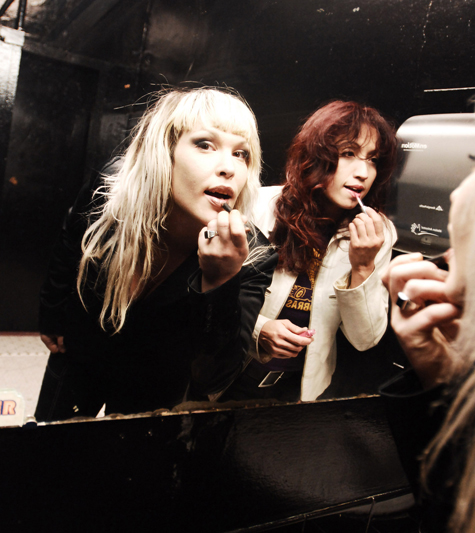
On Tuesday, June 7, DJ Whores booked dubstep DJs from distant lands like New York City and France. But when the downstairs cleared for an upstairs Death Grips set, for once Sacramento showed some goddamned pride.
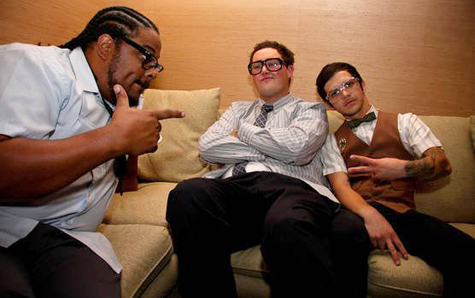
Death Grips bears the rumblings of a strange new era for hip-hop–if the genre is even appropriate. Between Death Grips and the teenage riot of Los Angeles’ Odd Future Wolf Gang Kill Them All (OFWGKTA) crew, hip-hop seems to be embracing a DIY and punk mentality that hasn’t been prevalent in the genre since Fab Five Freddie was kicking it with Debbie Harry in the Lower East Side. Devoid of heavy-handed derivatives, Death Grips respectfully appeals to Sacramento and the indie world-at-large’s iTunes playlist without losing an ounce of visceral gnarl. The Ex-Military mixtape is the group’s call to arms through heavy bass warbles, juke break beats and vintage psych-samples from Link Wray and The Castaways. Critics jumped the gun when they hailed New York-based MC Waka Flocka Flame as the first metal god of rap. No one could have predicted Death Grips’ Stefan Burnett, a Kimbo Slice-looking dude from Oak Park, was lurking in the trenches with a deeper-seated metal intent with lyrics, “Dismiss this life/Worship death/Cold blood night of serpent’s breath/Exhaled like spells from the endlessness/In the bottomless wells of emptiness,” over the thunder of Zach Hill’s drums.
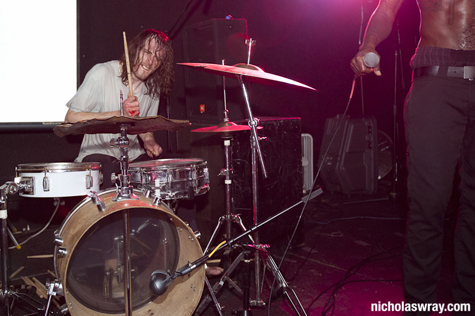
The Sunday prior to the Grimey set, Death Grips played a secret show at Press Club, a set that made its way to YouTube in record time. The Grimey announcement was as last-minute as it gets, with most of the curious anticipating a Davis house show as the unveiling of the mysterious Zach Hill project. The cloak was off entirely, as was frontman Stefan Burnett’s shirt as he stalked the stage, like any moment he might snap and start cracking skulls. No one was injured during the set, nor did a full-on mosh pit ever break out. The surprise was the rush to be on top of Death Grips without taking the stage–an instant embrace virtually unheard of for a local act. Burnett’s coined grunt of “Yuh” was mimicked on cue and other times in brief quiet moments, affirming his bark as the group’s battle cry. Sacramento is excited for its locally raised rap beast–enough to shed the cool, shed the cynicism, shed the apathy and get buck for 40 minutes in ToHo. It caught me off guard so much that I’m reluctant to mention it for fear it might backfire and curse the unabashed enthusiasm.

Whether we sustain our buzz in the home front or not, Death Grips is in takeover mode with or without us. This week (June 15), the group performs L.A.’s Low End Theory, a weekly melding of art and music held every Wednesday at The Airliner, a stage that made the careers of DJ Gaslamp Killer and producer/musician Flying Lotus. In the end, if Death Grips maintains an indifference to hype present within the music, it will always have a home in Sacramento. The nihilistic candor on tracks like “I Want It I Need It (Death Heated)” and “Spread Eagle Across the Block” boasts a lifestyle prevalent in Midtown yet to be captured sonically. I, for one, hope this is the beginning of many voice-shot nights shouting “Yuh” to come.
The Detroit Cobras Scour the Archives and Revitalize Long-Lost Hits
The Detroit Cobras are good at what they do. So good, they kept the critical media scratching their collective temple as to why the band struck a familiar chord, but the origins were not quite traceable. Four albums and a gang of singles deep, the Cobras’ garage and R&B nostalgia earned them the company of their most-beloved songwriters and a friendship with a particularly notable Grammy Award-winning, Detroit-raised producer.
It is old hat to fuss with clever ways of calling the Cobras a cover band. The Detroit Cobras are a cover band. Don’t let them tell it with a fine slant. The good news is, they’re a band with exceptional taste rooted in the vaults of lesser known Ronettes, Irma Thomas and Otis Redding hits. Guitarist Maribel Ramirez sums it up with, “To me it’s not important whether you write or you don’t write, it’s that you come up with great songs.” The Cobras are far too rad to play your cul-de-sac soirée, Fire Department barbecue fundraiser or wedding reception. It leaves the covers of Fleetwood Mac’s “Don’t Stop” to the animatronic band in Chucky Cheese restaurants.
“We’ve never reported ourselves to be a cover band. It’s not like we’re doing Motown review and I’m coming out with my hair in a beehive doing Supremes songs,” lead singer Rachel Nagy said. “Once one critic found out, other critics started raving, but we never said we wrote them. It’s not a hidden issue.”
It’s been four years since Tried & True, making my first inquiry quite obvious–what’s the haps on a new record? Turns out, the Cobras are waiting on fellow Detroit native Don Was, a man whose production is well worth the delay. If the name is not ringing a bell, perhaps these will: Lyle Lovett, Iggy Pop, Elton John, Bob Dylan, Bonnie Raitt, Garth Brooks and The Rolling Stones.
“The whole Don Was thing is kind of nebulous right now. He’s a very busy man.” Nagy said. “We’re talking about maybe mid- to end of summer to start recording. We may even do it backwards now that all the hip kids are putting out singles. Just start putting stuff out as we record it.”
While the Cobras wait for Mr. Was to grace them with his time and expertise, we took to discussing the meat and potatoes of the Cobras’ next step in being the best darned (cover) band around. With the cat out of the bag and old songwriters coming forward at their shows, it’s an exciting new time for the band, in which perhaps an original or two might sneak into the tracklisting.
It’s been a while since the last Detroit Cobras record. What’s the motivation going into the new record?
Maribel Ramirez: Being able to record a little better. We make decent records, but we’d like to take it a little further than we already have–make it more powerful. We’ve done a decent job by ourselves. In talking to Don [Was], it’s something we both want to do.
Will there be a shift in the bands that influence the music?
MR: It’s digging deeper. It’s almost attitude-wise, you know what I mean. We’re a little more grown up and we still want to make a dance record, but dance by our definition.
Rachel Nagy: Was said to us, “Look, I won’t do this if I don’t know what to do. If I don’t understand this and don’t know what I can bring to you guys, I won’t try to fake through it or turn you into something you’re not.” And that’s what we needed to hear.
Does the band feel pressure of possible misrepresentation, considering the songwriting process is built upon previous works? Do you ever get approached by disgruntled fans or the original songwriters?
MR: You’d think we would have, but to tell you the truth, most people don’t know the records. People aren’t really going to come up to you and tell you negative things anyway. When we cover a song people go looking for it. Most don’t say, “Hey, I know that.” When we were in Europe, it was cool to see the effects of having done this. People come out and say, “Let me show you what I’ve got.”
In Los Angeles a person came to the side of the stage and said, “There’s a person here who says you covered one of their songs.” I remember thinking, “I thought most of them were dead?’ Who the fuck is standing at the door.” It was Jackie DeShannon [one of the first female singer/songwriters in rock ‘n’ roll]. We went to a little studio and wrote a couple of songs with her. One of the songs we wrote during that session I want to use on the next record. I at least want to give it a shot.
Have you ever had someone try to pull the wool over you and pretend to be related to one of the deceased musicians to get paid in some form?
RN: The closest thing that ever happened to that was Mickey Lee Lane’s brother. I don’t think we met him, but I think he sent us a letter. It was cool, but then died. The next thing you know we’re getting these long e-mails from his brother. He started on the whole, “Yeah, I actually wrote that and here’s some other stuff I wrote that I’d love if you guys would do.” It was very obvious that he hadn’t written anything.
The other music he was sending us was terrible. It was really bizarre shit like I don’t think we’ll be doing a dance remix of the blues anytime soon. Other than that, we’ve never really had anyone try and play us.
Considering many of these songs are obscure hits that are either out of print or impossible to find, has there ever been an interest to do more for the originals beyond the band’s interpretations of them? For example, a label that focuses on reissues or a compilation?
RN: We absolutely have the utmost respect, it’s one of the reasons we do what we do. But this is our personal jukebox. We get together, share each other’s weird records, drink some beer and play the songs we love and find fun. Other than that it was not supposed to be anything deeper.
I wouldn’t really call us collectors. I’ve lost so many records. It comes down to the difference between boys and girls. The girls run around, dance and have a good time, while the boys are the librarians discussing who begat who.
We’ll leave all the reissuing to those boys that are great at cataloging and remembering and not losing their records and not moving from a house and forgetting two boxes in the attic.
Detroit Cobras will perform The Blue Lamp on Thursday, June 9, 2011 at 9 p.m. Also appearing will be Girl in a Coma. Tickets are $12 in advance and can be purchased at Eventbrite.com.
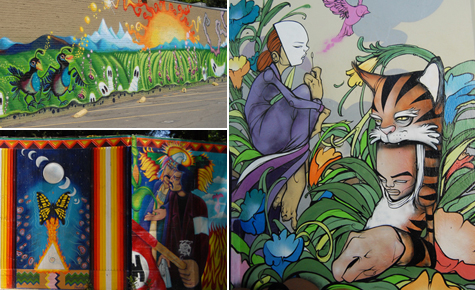
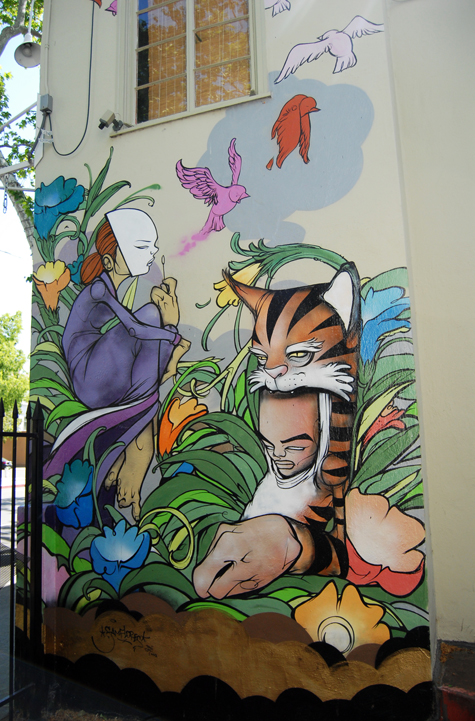
Whether you ride low, got a Dyno with black mags, test your guts on a fixie or cruise casual, if you’ve got a bike and love art, we’ve got an afternoon activity with you in mind. In celebration of May Is Bike Month, Submerge rode through Midtown mapping out a mural tour with eight points of interest. It should be noted this is not a comprehensive listing of Midtown murals, as we could send you down J Street or through seedy alleys on a dangerous mission to enjoy art. Our mural tour is a list of staff favorites that can be viewed safely as you happen to cruise past local businesses we frequent. Please ride carefully, stay hydrated and respect Omri Casspi’s handsome face.
A) Old Sac Walkway & Parking Garage Murals
A fairly solid launch point to cruise past the history of Sacramento and some psychedelic butterflies of Laserium, then hang a sharp right before Macy’s to pass the parking garage as it transitions into Metamorphosis by Centro de Artistas Chicanos.

B) Southside Park Amphitheatre
T Street / between 6th & 7th streets
Built in 1934, the Amphitheatre rests on the north side of the park and won’t look like much upon pulling up, but pedal around to the stage and bask in the Chicano-centric art by members of the Royal Chicano Air Force. It’s a great place to rest in the grass or on the stage and hydrate if needed.
C) Beer’s Books
915 S Street / between 9th & 10th streets
Painted in 2005 by Stephanie Taylor, the mural on the eastern wall of Beer’s depicts the grandfather of California literature Jack London along with several quotes from the author. Explore Sacramento’s history even further by perusing the stacks of local publications, or just stop in to pet Raffle the bookstore’s furball mascot.
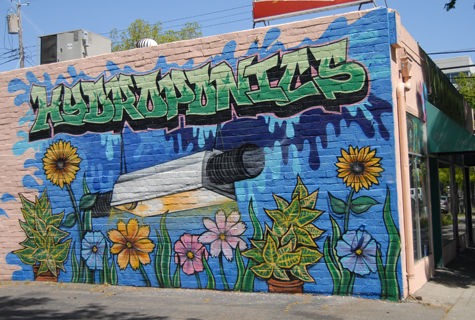
D) Constantly Growing: Hydroponic & Garden Store
1918 16th Street / between T & S streets
Bikes on 16th require self-assured riding, so if you have the chops for it, make a stop at Constantly Growing on 16th between S and T streets. The graffiti burner is well crafted and wraps around the establishment.
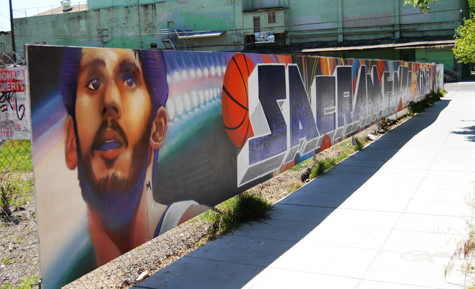
E) Sacramento Kings Mural
16th Street / between Q & R streets
Painted by Anthony Padilla, the Kings mural might be a bit dated given a few trades, but it’s always nice to cruise by either with hope for another year, to catch a glimpse for the last time ever or just to check on Omri Casspi’s face. Be sure to check out the biker friendly schwag and appetizers at Hot Italian across from Fremont Park.
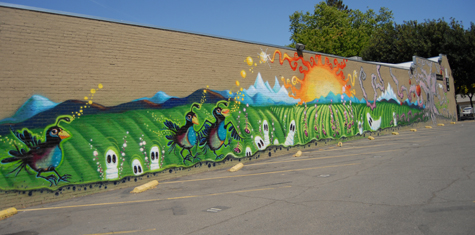
F) 1716 L Street
between 167h & 18th streets
The tremendous 200-foot mural painted in 2009 by John Stuart Berger and Dolan Forcier means you are halfway finished, but given its length, taking it all in will slow you down. The good news: Old Soul Coffee Shop rests in the alley to caffeinate for the remaining trek.
G) American Market Mural
Corner of N & 24th streets
Be mindful of pulling up to the American Market mural by Shaun Turner and Dan Osterhoff. The gorgeous woman stoically watching over the corner of 24th and N is liable to cause accidents. Oh, there’s a peacock too.
H)
Bon Air Deli & Market and First Edition Murals
Corner of J & 26th streets
The corner of 26th and J is an active one for artists. Within a stone’s throw of one another is the graffiti mural by Sam Flores on the side of First Edition, formerly Upper Playground, the mural on the northeast corner of Bon Air Deli by Joshua Silveira and Gabriel Romo and University Art supply store should you be inspired to create your own.
Comedian Ellis Rodriguez takes a yeoman’s approach to standup
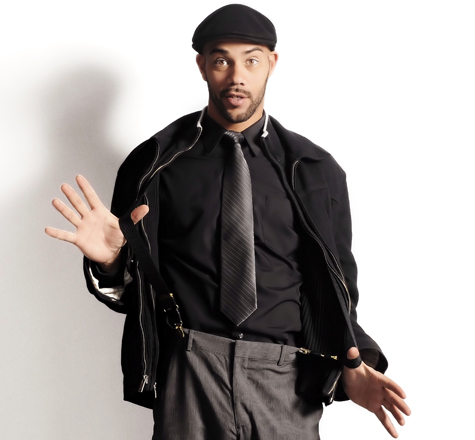
It’s 10 p.m. on a Sunday and I’m in a bowling alley bar with the hottest girl in Elk Grove (her claim) and local comedian Ellis Rodriguez. The topic of discussion: who has the best life ever? The 22-year old Elk Grove girl swears up and down it’s her, since she coined the phrase “best life ever,” but her mom has to drive her home for political reasons. I feel as though I’m disqualified from the competition because I’m drinking in a bowling alley bar in South Sacramento. But Rodriguez is the closest to actually living it because, as he puts it, “I draw comic books and I tell dick jokes. That is the best life ever.”
I meet up with Rodriguez the next day at the Stoney Inn a couple hours prior to its open mic night, which is complemented by country karaoke night in the adjacent room. What type of crowd attends this open mic, I ask? “Random assortment of mostly urban comedy goers,” is his reply. This is the trenches for a comedian. In a night’s time I receive a crash course in one comedian’s regimen for sharpening his jokes just to squeeze one funny minute out of the week.
His first night up was an open mic at Old Ironsides. He says with conviction that he became a full-time comic the day he got on stage, but at the time he did not have a job standing in the way. Rodriguez was living out of his car, working comedy at night for three months before a friend got him a job as a branch manager selling wholesale toilets.
“I was branch manager/trainer/operations recruiter for the number one wholesaling plumbing company in the world,” he says. “Great company. Great people. Couldn’t fucking stand it.”
He gave his days to toilets, but the nights were long drives to San Francisco to wait around at open mics for opportunities to do five minutes on stage. Keep in mind it is comedy courtesy to stay until the end.
“Once I drove to Pleasanton for an open mic,” Rodriguez says. “Another comedian told me about it, and I looked forward to it all 12 hours of my shift that day. I got into work at 4:30 [a.m.] that day. At 5 [p.m.] I headed straight there after work only to arrive to an empty bar that wasn’t even open. I heard there was some stage time in San Francisco so I went to get some time only to arrive and be told that I ‘might be able’ to get some stage time. I stayed until the end that night, desperate for time. I was the last one called up at 11:14 p.m. I got home at 1 a.m. and it was inventory week. I had to pull a 12-hour shift again the next day. Par for the course.”
Now a full-time comic, Rodriguez employs a strict regimen that includes open mics Mondays through Wednesdays and paid gigs at clubs on the weekends. The drive I ride along for begins on Del Paso Boulevard, treks up to Folsom and then over to Roseville. He’s never alone, though. His 2-year old Italian Greyhound named Muñeca rides along. “Tonight I’ll do three [open mics], tomorrow I’ll do two, Wednesday I’ll do four or five and then work the weekend,” he says. “It’s one of the few things I’m actually regimented about. There’s no excuse. None of the mics start before 8 [p.m.]… you can get up by 8.”
Rodriguez goes up around 8:30 p.m. at Stoney Inn to the crowd he predicted. Minutes before he goes up, he’s in my ear scrolling through his cell phone notes, running jokes by me that he might try out. It’s a fleeting moment of meekness. The related fragments have potential, but it’s when he takes the stage, assuming a confident persona, that Rodriguez discovers exactly what it is about “testing out white slavery for a month” that makes people laugh. Rodriguez just secured another minute toward his full hour set.
“I write around five to 10 minutes every week,” he says. “If you write 10 minutes, then one minute is going to be good. You keep that minute. At the end of the year I’ve got another 52 minutes.”
Rodriguez is in his fifth year of standup, tirelessly logging hours and pages of notes. He records all his sets, reviewing the tape like a scouting coach hoping to find flaws and room for improvement. “I do black rooms, white rooms, alternative rooms,” he says. “I do every room I possibly can to get as good as I can be in that room. You have to be able to read an audience and know how to react to it, but not necessarily think that once you crush it for 10 minutes that you’ve conquered that room. Can you do it again with different material?”
An hour later we’re at Po Boyz Sports Bar & Grill in Folsom and, save for three 20-somethings having a night out and the owner’s friends, the room is littered with comedians waiting to get up. Cheryl the Soccer Mom from the Real Funny Housewives of Rio Linda is hosting, and a young comedian is on stage venting about being excluded from the News & Review’s comedian feature. It’s a hostage situation.
Unfortunately it creates discomfort in the room that seems impenetrable as several comedians to follow struggle with the sound of silence. Rodriguez embraces the awkwardness and begins riffing hard on his friend Samm Hickey, who’s in the room. He tries out an AIDS joke we’ve discussed a few times that has yet to reach its full potential. We step outside to smoke a cigarette after his set and casually discuss the dos and don’ts of STD jokes. To him there’s something undeniably funny about saying his friend, who was recently diagnosed with AIDS, having “double AIDS,” even if it didn’t go over well the previous night in Elk Grove.
“I think I did all the herpes things,” he says. “I did most of the crabs thing, but they were really uncomfortable. I think there were a couple people that had that shit. I wanted to write another STD joke, but I’ve found that nobody knows enough about gonorrhea or syphilis for it to be funny. It’s just gross.”
Throughout the night I gather insider knowledge about the ideal crowd from Rodriguez and overhearing other comedians relate stories. Rodriguez tells me it was not the crowd itself, and never should be blamed, that made his Elk Grove show difficult, nor is it the presence of a bowling alley in the next room. An ideal room is dark, slightly chilly and compact. One comedian stressed the importance of seating the audience in order to prevent a scattered crowd.
“The crowd was too spread out so they are able to form a consensus of what’s funny within their little groups,” Rodriguez says of the Elk Grove gig. “They didn’t have to worry about what the people around them were feeling. That contagiousness of laughter is what makes it easy. But, if you can kill that crowd, then you’re going to destroy whatever show is set up properly.”

It is nearing midnight and we’ve arrived at the Boxing Donkey, a narrow Irish Pub in Roseville, for our final open mic. The bouncer asks that Rodriguez, a former Marine, tuck in his tags and Jesus piece–apparently they’ve had chain issues previously.
I ask Rodriguez about his time in the military, considering he was always a jokester growing up. “I was not a good Marine, at first,” he says. He was 19 and distracted with partying instead of attending his college courses when he decided to join the military.
“I’ll join the Marine Corps because they’ll make a man out of me,” he says. “I realized very quickly that Marine Corps does not make a man out of you. It gives you the opportunity to be a man. It puts you in situations where you’re pushed and strained. You’re constantly being tested and the choices you make, make you a man or a Marine.”
The Marine Corps wasn’t all precision posture, firm salutes and combat training, though. Rodriguez says there was still room for humor. “One of the things we did was send a person to retrieve an ID10Tango form on the other side of the base. They’d show up and the people there would say, ‘what are you doing here, you get that from ADMIN first, then ADMIN would say, ‘you need an ID10Tango release from your unit.’ They would come back and someone would finally tell them to write down ID10Tango. I. D. 10. T.”
It is nearing 1 a.m. when Rodriguez seizes the mic at Boxing Donkey. The room is brightly lit, less than ideal, but it gives him a visual on the room’s reaction. By now he’s told the bit about being so drunk at a Halloween party that he actually thought he was Superman for the third time in the night, but he is orating with the proper emphasis and pauses to make absurd glances to pull the most laughter. He takes notice of a group of black men not laughing much by the bar. “I’ve got one for you guys,” he says and launches into the white slavery bit, winning over the doubters with a blindside punch line.
I don’t get back to my Malibu parked on Del Paso Boulevard until 1:40 a.m. The Stoney Inn is long closed, I’ve got a burger in my hand from Jack in the Box and a guy on a bicycle is circling Rodriguez’s car giving us weird looks before pedaling off. He tells me he’ll wait until I get in my car before he drives off. It’s par for the course for Rodriguez, but for me it’s damn exhausting.
“I’ve got hours to log,” he says. “You keep coming back until you get a nice easy room at The Improv opening for Bruce Bruce and you’ve only got to do 25 minutes, but you’re going to kill because you did all these gigs at crappy open mics working out new material in bars and bowling alleys.”
Ellis Rodriguez will perform at Tommy T’s in Rancho Cordova on April 28, 2011. This will be a live DVD taping. Also performing are Dennis Martinez and Hunter Hill. This 17-and-over show starts at 8 p.m.
Michaele LeCompte’s Migration of Form is the sum of a lifetime of collecting
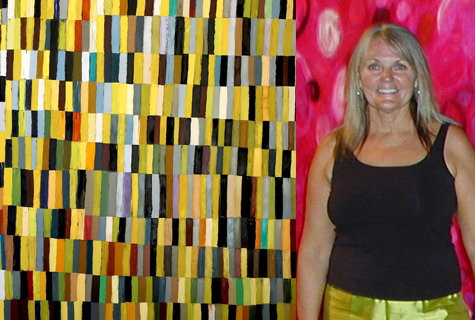
The things and people we acquire in life are inherited into our being whether we choose to address it or not. Michaele LeCompte chose to embrace her inheritances and her past through her Migration of Form exhibit, now showing at JayJay Gallery.
LeCompte, a Sacramento City College art instructor and modernist painter, honed her geometric style through years of pursuing various interests and acquiring creative friends along the way. Eventually she obtained the suitable influence required to produce her latest exhibit. Whether it was a friend’s poem, hand-me-down paints or her own past works, she had the intuition to make sense of their significance.
“The most important quality for me as a painter is my subconscious,” she said. “As soon as I make that mark, I think I’m going in one direction, but the painting starts to speak to me and assert itself. It wants to go in a direction I want to fight like crazy. Eventually I have to investigate where I am supposed to go with the painting.”
As an instructor of 26 years she preaches patience in art and her exhibit is living proof. “A favorite image of mine that I share with my students is this artist named Wolfly,” she said. “He was incarcerated in a mental institution and at some point his therapist saw he had talent. From floor to ceiling in his room he had stacks and stacks of work. I always held that in my mind. When you’ve done that many paintings, then maybe something happens. The idea of being patient with yourself is something I always stress.
“There are lots of young artists doing great work already; some of us just have that luck and the gift. They get carried away on a high energy, but for most of us it’s a slower journey.”
Her exhibit is a vibrant depiction of her collected works, spanning decades, collaged into new discoveries and the transformation of poetry into geometric figures. The glaringly obvious first question was how she found the courage to take the scissors to her past work.

Aerial, 2011
So how did you bring yourself to do it?
Everything you do doesn’t come out the way you think it will or does not hold up to your standards over time. I had a collection of things I felt someday would be a good collage piece. Just this year I had been working on these large paintings and I wanted to have something I could start, put down and walk away from, then come back to.
Was there a specific era you decided was worth using for the collage or is this collected throughout your life?
Some of these pieces have art that goes back all the way to 1975, so there’s little stories in them for me.
Was it difficult to get over the nostalgia for a completed piece from earlier in your life?
Nothing stays the same. What I liked back then does not have anything to do with what I like now, or there will be bits and pieces. So actually it felt like a great weight off my shoulders. To make something from something else that was not working for me and to turn it into something I like better was a neat process. Who knows in 10 more years maybe these will get chopped again.
Looking at these collages, clearly you’ve never had one style. So how did you arrive at the modern geometric forms style that is present in your larger pieces accompanying the collages?
In 2007 I moved into a new studio that didn’t have water. For a very practical reason it made me switch back to oils after many years of acrylics. Plus, I had a friend who had given me a large number of her oil paints…
I didn’t want to use any brush marks. I started using the pallet knife only and that’s how I started the series. My friend Susan is a painter and I asked her how she starts her paintings. She said she starts in the upper left corner and goes to the bottom left corner. It made me laugh so much that I figured if she could do it this way, so could I.
I’ve never been interested in making taped lines. The edge of the pallet knife clogs up and you have to decide if it’s something you can live with or not. Someone was watching me once who was not an artist and he said, “Oh, it’s like you’re frosting a cake,” which is exactly right.

Degrees of Gray, 2010
The piece Degrees of Gray was inspired by the late Quinton Duval’s poem “Oltremarino.” What was it about the poem that spoke to you?
Well, in his poem Quinton uses a quote from another poet, I think it was Robert Hughes, so it’s like we’re all in this line–artists and writers. We have connections and crossovers. But this painting was done so recently after Quinton had died and with the gray pallete, the neutral pallete it was just a perfect thing when I read that poem.
So this is like an artistic time line, in a way?
You can look at it that way. What I aspire to is having my paintings feel like the visual equivalent of what a poem might be. All the parts work, there’s nothing extra. It’s kind of lean and yet it moves you. You get a satisfying, hand-made quality out of these paintings.
Has the overlap of poetry and art always been present in your work?
I’m not making literal connections; I’m not trying for that. I’m not illustrating a poem. There’s a relationship and thread that goes through the work over a long period of time, much the way a poet would rewrite a poem or rework a poem over time.
I got that feeling from your collages. Immediately the words “editing” and “meta” came to mind, which I normally would not associate with art as much as I do with literature.
I’m so bent on working with surfaces that I’ll paint over an old canvas and then you have to deal with the scars that come through from its previous life. I love throwing things together that conflict or press on each other.
Michaele LeCompte’s Migration of Form is showing at the JayJay Gallery now through April 23, 2011. The gallery is located at 5520 Elvas Avenue, Sacramento. For more info, call (916) 453-2999.
Mistah FAB breaks past ties and forges a new route
On the heels of the hyphy movement of the mid-Aughts, Oakland rapper Mistah FAB struck gold with the single “Ghost Ride It” in 2006. With its lifted Ghostbusters theme synth line and instructions on how to “ghost ride the whip” (which is such a dangerous hobby that I’ll refrain from describing it for the kids’ sakes), “Ghost Ride It” earned Mistah FAB a contract on Atlantic Records.
He inked the major label deal in 2007, but his anticipated album Da Yellow Bus Rydah never saw a release date. When I asked FAB whether he still ghost rides the whip for nostalgia’s sake, he said, “Naw, man. It’s too dangerous now.
“I’m not trying to make it seem like I’m some old-ass critic,” he said. “I’m 28. My mind is just not there anymore. I don’t even like going out much. I’m an old-ass young man. Going out is boring to me now. I have a daughter, and my main thing is getting home to her.”
Last month, FAB dropped his I Found My Back Pack mixtape, which was rooted in the traditional boom-bap hip-hop vibes, instead of the Bay-centric sonics synonymous with his style. With a new album title for his next official release, FAB talked about the changes in his style, his attitude toward music and the changes in Bay Area music.
The I Found My Back Pack mixtape is neither a sound nor style typically associated with your music, but you’ve always had ties with the backpacker community. Why did you commit a mixtape-worth of material to that style?
Even when hyphy was in its glory days, the albums I put out during those times still had songs that showed ability and a plethora of styles. Unfortunately, what was popular at the time took away from my ability to be creative and speak to the artier hip-hop fans.
It’s been a while since I wanted to focus on that craft. Not only to display my ability, but to just prove to myself that I could still make music that doesn’t have to glorify diamonds, clothes, cars and materialistic items, nor do I have to be on the club scene.
Have you paid much attention to reactions to the mixtape and this new direction?
I’ve enjoyed it. I love the mixed emotions. I love that people are still shocked and say things like I didn’t expect you to do that, which is unfortunate. After all, what’s an artist if he’s not able to reinvent himself, be creative and give people something new to talk about? I love the fact that people are still able to have things to say about me.
From researching the projects you’re working on with Alchemist and DJ Drama and listening to your recent interviews, it feels as though you’re in the middle of a significant change in your career. Especially since your next album will no longer be titled Yellow Bus Rydah, but Liberty Forever.
Life is about growth. Life is about change. It’s about accepting some of the areas you indulged in and admitting faults… With the changes I’ve made musically, if I was to put the album out with the title Yellow Bus, before listening to it people would assume it would be on one of the previous styles I was on and wouldn’t give it its fair shot.
The name of the album is actually the name of my daughter, Liberty Forever. But as for the direction I’m going in, I don’t feel like I’m at fault for it, but I definitely influenced some people to do some negative things. As well as some things I’m pretty sure they wish they didn’t do. It was a wonderful moment. We had fun. We enjoyed it. Some weren’t able to bounce out of it and grow out of it, but it’s like when you’re in college and you’re a wild party animal. Then you see some friends years later and they’re like, “What’s up, bro. Let’s go party.” But you’re like, “Naw, I’m a businessman now.” I’m not trying to say that I’m better, but this ain’t college no more. You know?
That explains my growth; like a frat bother growing up. We had fun, the college days [the hyphy days] were great. Now we’re on the business route.
You’ve reached a point where it’s no longer enough for people to associate you with a Bay sound or hyphy, but as an artist known nationally and not pigeonholed as a regional act, is what you’re saying?
I’ve always had an ability to work with everyone. On my Son of a Pimp album I had a beat by Kanye West, but it stayed under the radar. I am known by the name. I might not be an in-house name to the fans and everyday people, but the landlords know me. It allows me to work with different artists.
On my new album, whenever it does come out, cats like Lupe Fiasco, Rick Ross, Bun B, Snoop Dogg and Jadakiss are on there. I’m working with people’s favorites. It’s very humbling to grow up listening to these guys, wanting to be like some of these guys and now they view me as a peer.
Are you still on Atlantic Records?
I’m not. I’m going through the final stages of this release. But I’m able to make more moves this way. It’s no hard feelings. They gave me an opportunity I didn’t capitalize off of due to surrounding things going on in my life. There’s no excuse for it. Atlantic is a great label. It’s a growing step. I’ve graduated in my maturity to realize that some things I missed because I was immature, not ready for certain challenges–challenges that I am ready for now.
You’ve always struck me as an artist that, despite your deal not working out with Atlantic, you could sustain purely on your live performances and self-released material. I’ve always thought that spoke volumes of your identity as a self-made man.
I appreciate that, man. That’s always been the most significant part of my career, my ability to do a live show as well as continue to create. Unfortunately a lot of artists get idle in their creative processes when they’re awaiting major albums or signed to labels. They just get lost in the sauce. Their relevance erodes. Fortunately for me, I’ve been able to stay relevant on pretty much all levels–the Internet, thank God for the Internet. Sites like Twitter and World Star Hip Hop allow artists free promotion. Shouts to all the blogs that post my new songs and continuously show me love.
It’s my work habit too. I’m addicted to the music. I’m in the studio constantly. I have libraries of music. So it’s nothing for me to put a project together just to sell at shows. For this tour I’m about to be on, I put together a freestyle mixtape. I’ve been able to financially survive. I love my art, but love doesn’t pay bills. What pays bills is hard work and dedication to creating a product and selling yourself–not literally–to keep yourself relevant.
How do you feel about the emergence of Lil’ B in the Bay Area and his elevation to the national spotlight?
I love Lil’ B. When he was 13 or 14 years old, I first recorded a song with [The Pack] and I will always support Lil’ B. I feel that he’s a marketing genius. People are so judgmental on artists that they critique him without even meeting him. He’s established a lane for himself that no one else was covering, no one else was worried about, no one else had even thought about. I don’t see anyone giving him credit for reinventing himself. He turned himself into an entity and made a brand out of himself. The people are ignoring that. We’re in a game where marketing and strategizing of commerce is something that should be saluted, and no one is giving him credit. It just shows you how selfish people are. It’s just disgusting to look at the way people view him.
My concern is it seems that every time an artist from the Bay gets the push into the national spotlight, there’s encouragement at first and then it gets cannibalized by backlash.
I want to shout all the Bay area fans who are haters. They’re like a selfish kid. You know how a kid will have a lot of toys, but then there’s the one toy they never play with that strikes big? They want to say, “That’s my toy! That’s my toy! I had that toy first.” Then it becomes, “That toy’s old. Fuck that toy now. I hate that toy.” It’s like goddamn, bro, are you serious right now? The world finally gets a chance to see what we have and all of a sudden you want to start hating?

Sister Crayon Steps It Up Further on Debut LP
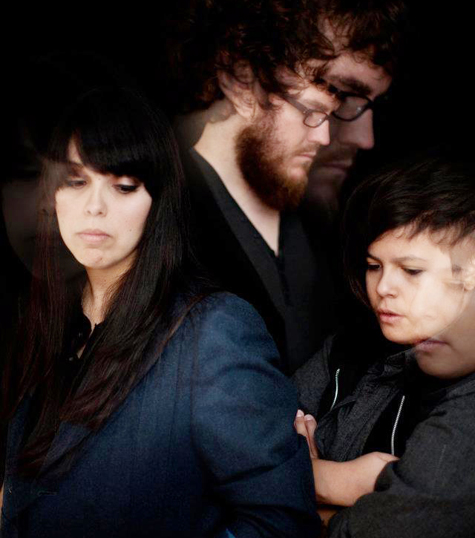
 It was a gray and windy afternoon on the beaches of Malibu. A tidal wave warning was in effect, but there local band Sister Crayon stood, fully-clothed, sharp shoreline rock at their ankles, as photographer Eliot Lee Hazel barked orders to capture the frozen chaos of crashing white caps for the band’s debut album art.
Lead singer Terra Lopez slipped during one shot, cutting her leg, but Hazel ran his shoot like a drill sergeant. “He just said, ‘Get up. Don’t smile. Don’t look at me,’” Lopez said. “Well, he’s a sweetheart, nice guy, you can sit down and talk to him, but when he’s taking photos he is so intense.”
As absurd as it feels to the members of Sister Crayon, Lopez and drummer Nicholas Suhr spoke of the shoot as one of their most memorable music experiences–even though it had little to do with music. Along with Hazel’s artwork, the band has a high-def music video done by celebrity photographer Robert Ascroft. Browsing both photographers’ websites, perusing the tastefully gratuitous images of Devendra Banhart, Usher, Mariah Carey, Edward Sharpe and Brad Pitt, Sister Crayon will be the first to tell you how privileged, yet out of place they feel. Are these the last remaining minor moments of Sister Crayon before they receive Coachella bookings and Japan tour offers?
In the next few weeks, the band is playing humbler venues like Townhouse for the Sacramento Electronic Music Festival and Luigi’s Fungarden for the Bellow album release party. So our indie darlings have yet to grow too big for our sleepy city. Lopez looks like a siren Viking vixen in the video for “(In) Reverse,” but when I met with her and Suhr at Mondo Bizarro (formerly Butch & Nellie’s) for an interview, she was back in her Midtown garb, a second-hand green army jacket and jeans–the Lindsay Weir of Freaks and Geeks look. She’s still the same shy songwriter, fronting a gloomy pop act that seeks inspiration in the lonesome despair of poets like Jean Genet and Fernando Pessoa.
The Bellow sessions scattered across the span of a year and a half. The newly realized lineup of Sister Crayon crammed in 18-hour shifts at The Hangar with engineer Scott McShane, who described the process as “tense” and a “guerilla recording style.” McShane produced the first Sister Crayon EP, Enter Into Holy (Or)ders, and the band never entertained the thought of working with anyone else. “Recording already is a really intimate thing. We bond so well with him. He gets what we’re trying to do, even before we understand it,” Lopez said.
“He’s able to throw out ideas that’s not in an insulting way. It’s just full-on experimenting and you know that it’s for the best. He pushes us to succeed,” Suhr added.
The tension came from the hourglass pressure of paying for studio time and the unfamiliarity of having a new drummer join two weeks prior, writing his parts on the fly. Suhr was not a complete stranger, knowing Lopez from her stint in The Evening Episode, but he and Lopez talked of the anxieties surrounding a debut full length. “We were zombies. We’d spend 18 hours in the studio and you can hear it in the record,” she said.
Originally, Bellows was intended to be a five-song EP, written by Lopez and synth-keyboardist Dani Fernandez, with “I’m Still the Same Person” being the only pre-released song to make the album. But once the band wrapped recording those five songs, creativity was running high and five more songs were written collectively. “Scott kept telling us there was a lot of tension on the record,” Suhr said. “If you know what was going on at the time it makes sense. There was a lot of time spent coming to an agreement on things, but whenever we’re writing together there’s no awkwardness. It was easy to go into the next five songs with an open mindset.”
Indeed, the settling in is brazen and culminates with a spacious piano ballad called “Ixchel, The Lady Rainbow,” in which Lopez’s visceral croon soars over a piece written by former member Genaro Ulloa. “Ixchel” was the last song the band recorded, a one-take recording done well past the midnight hour. “We did it live tracking,” Lopez said. “He was in the other room and I was in the main room singing. We could see each other through a little window, but that was it. It was the first take and it was incredible. I know it sounds corny, but there were tears in everyone’s eyes. We were all exhausted. Even Scott had tears in his eyes.”
Suhr added, “It’s one of those songs. Every other song on the record we did multiple takes because we felt we could do better. At the end of that song, everyone was just like what the fuck. It’s one of those songs where if it didn’t sound like that, with the imperfections left in, it wouldn’t have worked.”
The gloomy pop instrumentation informed by the troubled words of dead poets is an appropriate setting for an album titled Bellow, but Suhr said a lot of the mood is owed to McShane’s guidance. “I heard the five songs written before I joined, but the mood had changed through Scott’s ears.” Lopez said his touch is most prevalent on “Here We Never Die and “(In) Reverse” as he took the band’s ideas and focused them into a cohesive sound.
In addition to McShane, the Sister Crayon sound, most notably the lyrics, is in homage to the writings of Fernando Pessoa, a 20th Century poet and literary critic. Lopez only admitted her obsession with Pessoa’s work. She has a Pessoa tattoo and her Pug’s name is Ophelia, after Pessoa’s secret crush to whom he never confessed his love. “It’s the despair,” she said. “It sounds dramatic, but he was such a lonely individual. He was very mysterious and obviously people are drawn to that.
“I think that is a huge part of Bellow. ‘Here We Never Die’ is my talking to a lover in that way. The despair and sadness that he wrote is so sad that I can’t even finish one of his books. I have to read a sentence a day sometimes because it’s so much. It just floors me. I have no option when it comes to his presence in my music.”
As intense as Sister Crayon is sonically and visually portrayed, Hazel’s insistency that the band stop smiling as the chilly Pacific waves capsized on their heads speaks of the band’s unbridled joy in its work. As arresting as “Ixchel, The Lady Rainbow” is, Bellow closes with “Souls of Gold,” a cheery campfire sing-a-long with a blasting brass section and woozy synths. “We’re always such a serious band and a lot of our songs are really dark,” Lopez said. “I do like that the album ends on a lighter note than what it could have been.”

See Sister Crayon live at their release party for their new album Bellows at Luigi’s Fungarden on Feb. 19.
Daedelus rides the always tumultuous wave of electronic music
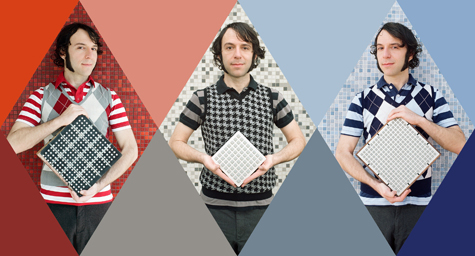
The dandy garb of Alfred Darlington suggests he’s a man lost in the past. His digital instrument, the Monome is a brilliant future trapped in the neon glow of a push-button box. Far from an eye-grabbing gimmick, Darlington is expressing himself beyond the DJ booth of electronic music, which in his opinion will combat banality and the demise of electronic genres of the past.
Darlington is resistant to the label of elder statesmen, but with over a decade of experience in electronic music, he’s seen enough sub-genres come and go to speak eloquently on what it takes to sustain. To him, it’s a presence of personality, which is a glaring separation between the Los Angeles beat music he helped cultivate at Low End Theory and with dub-step. “When [dub-step is] good the bass is really pushing air on your organs, and yet it isn’t about the person expressing it,” he said. “There’s very little energy on stage. It’s usually a very controlled amount of chaos that I think will limit that scene, much like what happened to drum ‘n’ bass. There’s amazing parts of the sound, but personality is hard to come by. Whereas this beat thing, people are really willing to, for lack of a better term, let their freak flag fly–that’s a terrible phrase. But there’s something to it.”
On stage Darlington is Daedelus. He began DJing for Dublab.com in 1999 and by the early Aughts was releasing albums on Plug Research, Mush and Ninja Tune. Much like the mythological Greek character Daedalus, Arlington is a tinkerer and lover of invention. His experimental music caught the attention of Brian Crabtree and Peter Siegerstrong, two developers of the Monome box, which is a sampler imbued with the freedom of improvisation. Through the use of the Monome, Darlington is fossilizing the notion that live electronic music must be static and built on pre-existing recordings. His weapon of choice was our first topic, as I attempted to understand its power.
How did you get connected with Crabtree and Siegerstrong to obtain a prototype of the Monome?
It was really quite accidental; a lot of my career has been a series of happy happenstance accidents. They invited me to play a gig a long time ago when they were undergrads in San Diego. They showed me the prototype, and it fulfilled all my wildest dreams for sample manipulation. Then there was a lot of begging, pleading, bribing and coercing until I got the device in my possession.
It’s funny to think we live in such a wonderful age of invention for young music makers. All the buttons we want to press are out there on some device you can obtain. When I was coming up in the early Aughts this wasn’t possible. Either you got an MPC and did all the weird things like use zip discs to load samples, enduring painful breaks while you waited for the sample to load–five minutes of waiting around. Or you would use the computer and get computer face with the blue screen projected on your eyes and you’d be dead to the world in your bedroom.
Is it a device that made sense immediately? Or did it take hours of fiddling to even get a basic feel for the Monome? Because it looks like a complex piece of machinery, given all the buttons.
There was some stuff to the guts that were complicated initially. What’s cool about it is it’s a very open platform. We’ve added a lot of functionality and play validity, I guess. But the device itself never needed to change because it’s button matrix. The initial idea of sample manipulation was there and it gets more refined as people engage it as an instrument.
It’s funny because at first my imagination tricked me into thinking I could manipulate samples on this, but I’d still need a keyboard to play them. That’s not the case. The potential energy of the instrument was great enough that it’s continued to move forward.
Do you still get a lot of people who are moths to your button machine? Or have they gotten used to its presence and are dancing again?
In 2010 there’s been a sea change. A general shift has occurred and people are used to instruments on stage again. It’s OK. There’s still some of the staring types, but not as many. I think people are kind of getting the idea that electronic music can be live, and it isn’t a matter of life and death that they just stand there.
Have you been following the Anti-Rave Act that is currently passing through legislature?
Yeah, I played at EDC [Electric Daisy Carnival], which is one of the fermentors for the recent spat of anti-rave talk. For a show that was markedly safe with over 200,000 people over two days, which for a non-festival is the single biggest event in America in the past couple years, there was a death of an underage kid there. That began this moral wrestling because it was partially the city of Los Angeles’ fault. There was a lot of controversy, since they were supposed to be carding.
It’s funny because at any given moment people are living their lives outside of a controlled situation, such as a rave or event. I’m sure there are, unfortunately, multiple deaths of teenagers from drinking or drugs on any given night, but they are not all concentrated in one space. With EDC especially, there were paramedics on hand a lot of people being helped and saved, but it’s easy to point a finger.
It’s always been this way. As much as I love the attention given to the scene and the opportunity for young artists to play in front of large audiences, every time the electronic music scene goes underground it tends to bear more fruit. I guess that’s a small piece of solace I’m trying to derive from this negative attention.
How did you feel when you read the phrase “pre-recorded music” as the musical format that this act intends to criminalize? I’m still baffled as to how this definition could be monitored and policed.
At sporting events I’m sure they’re playing pre-recorded music for sleazy cheerleaders. I’m sure people are dying on the field and off, and yet I don’t see them banning those games.
I’ve read that you’ve become an elder in the L.A. music scene, someone who’s even sought out for advice. That has to be a strange transition considering in your younger days. You were treated somewhat like an outsider.
It’s one of those things where when I was growing up I was really enamored for a lot of the new sounds, and for the drum ‘n’ bass scene in general, but it wasn’t for me in the end. It’s a gift that I wasn’t allowed in, because there’s not a lot of those people around right now. Sounds change and being forced to be on my own was beneficial at that time.
By propagating a sound forward there are a lot of likeminded people that have cropped up. I don’t take any responsibility for their music, but I do feel wonderfully inclined toward people like Flying Lotus and Baths. These are people whose weirdo energies can all be combined to make a sort of Power Ranger of Doom.
I don’t know about the elder statesmen thing. I don’t think a lot of what I’ve gone through is represented by what we’re currently in. I had the wonderful benefit of being around when Myspace was influential for instance. I got featured on Myspace and it seemed to make all the difference in the world. In a single day I had 150,000 listens on my tracks. These huge waves are just not there anymore. Facebook doesn’t feature musicians in the same way. In a lot of ways those experiences can’t be propagated. I think the idea of not being bitter is the biggest lesson I’ve learned.
Can we expect dandy garb during your Sacramento performance?
I might have a bit of a tan from a large Southeast Asia tour, so I won’t look appropriately Victorian dandy as far as paleness goes. There are two aspects of it. I like the Victorian dandies and presenting it out of sorts in California. Also by being dressed up on stage, it frees people from their banality, hopefully. They don’t have to worry about someone wearing stupid Kanye West slatted shades and bouncing up and down ridiculously. It hopefully allows people to get into a different headspace.
Your next record on Ninja Tune will be called Bespoke. How far along are you?
It’s done. It’s just artwork that is getting completed. I’m getting ready to begin a big 2011 push for the record.
I’m picking up on a correlation between your retro-fitted clothes and customizing one’s style playing a role in the concept of the record.
It’s definitely bringing it all home. All of these concepts I’ve been propagating for a while now, it’s time to bring them all back. I wanted to do a record that was about combinations. I have a lot of guest vocalists. In a very altruistic way I want the record to be about creating your own reality, customizing your environment to your needs, rather than letting it be banal. I think banality is our worst enemy. Boredom is our worst enemy–the kind of thing that causes people to become punks and other unfortunate subcultures. There’s nothing wrong with being a punk; trust me, I spent my time, but I’m not a big fan of nihilism. We create our own structures and for me it begins with bespoke clothing. People used to hand-make everything for instance, now nothing is made by one person, except for music and the arts. Why not embrace that, push it forward, as opposed to having it be a secret?
See Daedelus and his fascinating Monome as part of the Sacramento Electronic Music Festival on Thursday Jan. 27, 2011 at Townhouse.
Who Cares Teenage Ego Trip
(Independent release)

When I was introduced to Who Cares, I heard a group with the purest of intentions struggling to craft music beyond the traditional hip-hop realm, while not betraying its beloved culture. I’ve always admired the courage in a group that was willing to make a song as heavy as “Heaven Ain’t That Hard” and follow it up with a Bambaataa-esque throwback like “They Killed the Radio” with Egyptian Lover.
Despite my admiration, there was a glaring struggle in identity that I always perceived as heavy-handed and off-putting. It was as though Who Cares might function better as two entities, one that loves trans-European electro-party jams and one that is meant to be heard during a rainy-day self-reflection session. Who Cares’ third record, Teenage Ego Trip, released last month, is its finest to date. With the help of an engineer and studio guidance, the album also serves as the resolution of the aforementioned identity crisis.
Easily the wisest move Who Cares made in crafting Teenage Ego Trip was pulling Dusty Brown into the project as its engineer, contributing producer and co-writer. His fingerprints leave evidence throughout the long player as he employs the same trademarks that made his This City Is Killing Me EP an instant classic. With Dusty behind the boards, Who Cares resolved its clash in styles found on the previous CD-R the group peddled at shows. Teenage Ego Trip is rich in texture, featuring a studio band intent on boastfully marauding for abstract sound pieces typically reserved for the likes of Damon Albarn and his Gorillaz project. This makes previous Who Cares efforts sound like skeletal demos; it’s as though the past years of songs were written in order to achieve this sort of breakthrough.
Subtle and lush, no song is without nuance in style that is not only rewarding, but adequate in placement–no tricks for the sake of flare–nor are the instrumental affairs exaggerated or embellished. In the past you could have made a case that Who Cares was wanking off a bit, or that a different perspective was relying too heavily on its virtuosity–take your pick. The choicest amount of care is given to production. Take, for example, the snare drum intro on “Cherry Boy” that’s run through filters, muting the percussion to a pitter-patter that, once refashioned, creates a pop to the instrumentation as Ernie Upton, aka Fernie Fresh, comes in with the vocals. The Who Cares style of old haunts the record in small doses: grandiose sax solos are fed as distant radio transmissions. Young Aundee’s falsetto crooning is employed sparingly, not to suggest it should be, but “These Three Words” is given room to breathe and earn its electro-outro that features an Aundee refrain, instead of forcing a vocalist into a boom-bap production or customizing the boom-bap and running the risk of the cursed “crossover” scarlet letter.
Who Cares is well past its juvenile days of rewriting Pete Rock and C.L. Smooth’s “T.R.O.Y.” a dozen times over. The transformation is strictly from a sonic perspective as Fernie Fresh maintains a deep connection with the disenfranchised and half-broken in his lyrics. Teenage Ego Trip is a well-constructed teddy bear for the latchkey kids and survivors of broken homes that took to the seedier side of life and are seeking to do better with their days and weeks. Perhaps it’s time to heal the gloomy demeanor of the Who Cares bear cartoon, give it a congratulatory pat on the back and put a crooked smile on its worried mug.
Who Cares’ Teenage Ego Trip is available for free download online at www.forhiphop.com.
Screen printer Laura Edmisten and the unassuming growth of her Asbestos Press
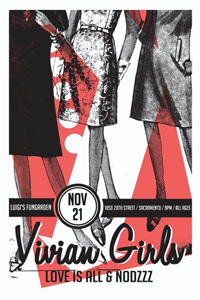 Five years and roughly 100 poster designs ago, Asbestos Press was a nameless curiosity sparked by the purchase of a screen-printing starter kit from an art store. But it only took Laura Edmisten five months of toying with the kit to toss the starter and turn her bedrooms and kitchens into workspaces–any place better than the deadly basement where it began.
Edmisten initially bought the speedball kit to screen print greeting cards, but when a musician friend inquired about a show flyer, she forgot about giving Hallmark competition. Her first poster was The Noise Geniuses. By her third poster she was hooked, trying out five colors on a poster, which takes a firsthand acquaintance with the process to truly understand the grueling nature of going beyond three colors.
“In my old apartment I’d do screen printing in the kitchen and my roommate would be in the living room watching TV,” Laura said. “I would put posters to dry all over the floor around him, leaving little paths for him to walk around. That’s how these things start: small, doing things for friends and it just grew.”
Her first workspace was supposed to be the basement in a friend’s house. But the house was 100 years old and even after a proper cleaning, she still would have to deal with the asbestos issue. The operation moved to her kitchen, but growth combined with a cooking space that looked like Jackson Pollock’s workshop forced Laura to move the operation once more. She now lives in Oak Park with an upstairs office all to herself. No matter where she moved, though, that first workspace stuck with her. “So I was trying to think of a name for all this,” she said. “As a joke someone threw out Asbestos Press. We all laughed and it stuck. There was a running joke that I mixed asbestos in the ink, like how Kiss put their blood in the ink.”
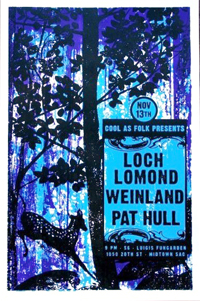 Despite limited-run posters being labor intensive, Edmisten appreciated the hands-on craft that produced a unique poster with each swash of paint pressed into the paper. I visited her at home to see the process first hand, which was the day before her big move into a space at Tangent Gallery at 2900 Franklin Boulevard. As she put on her trusty yellow apron, speckled in every possible color of paint conceived, Laura noticed me take an uneasy step back from her work board. “I’ve had this for five years,” she said looking down at the messy apron. “Every poster is on here–which is weird to think about.”
Laura spoke of her poster hobby turned side business as a saving grace to an otherwise creatively unfulfilled life. Around the time she bought the kit, she was a struggling graphic design student at Sacramento State. Screen printing was her shot in the arm, although it still didn’t guide her through a degree. “I wanted to start doing my school projects screen printed and my professors wouldn’t let me,” she said. “They were like no you have to abide by this rule, otherwise you can’t do proofs. But, I was like no I want this typography, with this distress on it. They’d be, like, no. It just made me want to do it more.”
 he spends her weekdays keeping the bills paid as a graphic design artist, but once she’s home, a homemade office awaits. She and her uncle built her current setup by nailing plywood to a couple of wooden horses. They built an exposure light box made from a sink cabinet and Home Depot supplies. Surrounding her tools is a seemingly endless supply of source inspiration she acquired from scrounging through garage sales, estate sales and secondhand shops.
She dug around a display of items, picking up a striped battery from the ‘50s because she admired the typography, an old inkbottle from the ‘40s with a pirate ship, vintage boxes for vacuum tubes and flash bulbs. Junk records and even discarded records from the Davis library, for which she has a project in mind; she picked through a box of old cards and admired the bird images. “I love old stuff,” she said. “I collect vintage packaging and old magazines. Things just have a way of coming to me. Before I designed posters, I’d just collect this stuff.”
 Her garage was no different. Her pack-rat tendencies were hidden out there with a collection of old bikes and her roommate’s Burning Man rickshaw. She owns a press for fabric, because she is trying to learn how to do T-shirts and tote bags, but for now it’s buried in the garage. “I really do like paper. Fabric is totally different. It moves and it’s flexible. I tried a couple things but it hasn’t panned out like I thought it would.”
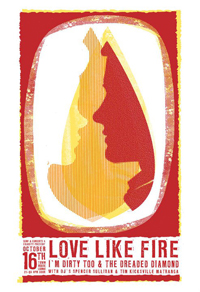
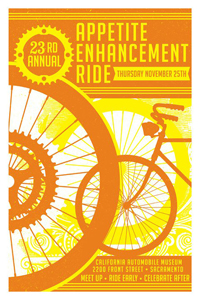
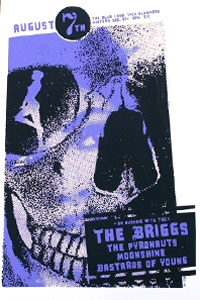
Back in the office we moved to a stack of posters that included a Doom Bird release show, John Vanderslice show at The Townhouse, a Japandroids show at the Blue Lamp and a recent Jandek show sponsored by KDVS. She pointed to the Doom Bird poster: “This tree came out of a magazine of the ‘70s,” then the Japandroids poster: “This was an air conditioner unit illustration from the 70s.” She held up the Jandek poster. “The hand came out of a magazine from 1932, which was my grandmother’s, it’s an Art Deco hand. The eye came off of an album from the ‘50s, this head image came off a health book from the ‘30s and the chair and the window came off a ‘40s home improvement magazine. All of these have a different story.”
Among the scattered creations, her workspace walls were lined with framed show posters that she didn’t create, but came from shows she attended. We shared a brief commonality when we discovered we were at the same Les Savy Fav show in San Francisco, from which she had a poster. “I listen to the music,” she said regarding her creative process. “I try to see what their style is, what kind of mood that evokes in me and how I can translate that into a design that will get people to the show.”
 Laura creates by one simple rule: “If you take it, you have to make it your own.” She didn’t hesitate to admit to novice drawing skills. She relies on bits and pieces of things, collected and perused until she feels inspired; an acquired knowledge of the best paper stock, what color inks work and what don’t, what you can get away with. She even keeps mess-ups and test prints; everything is recycled. “It’s funny because I can track my style,” she said. “I’ve made some clunkers. It happens. It took me a long time to get to this point.”
Without a happenstance request, Laura may have never found her artistic calling, but since discovering it her perspective is forever altered. “I had no knowledge of any of this, of poster, of the community, none of it,” she said. “I knew Frank Kozik, but that was about it.” Edmisten is displayed in the Rock and Radio Museum and predominately at Luigi’s Slice in Midtown, in addition to an upcoming display at Phono Select in December [2010].
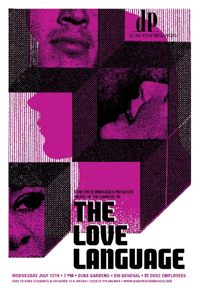
 Her biggest run was 200 posters for a Love Language show at Duke University. She did the cover art for an issue of Tape-Op and contributed a piece to the Of Great and Mortal Men: 43 Songs For 43 U.S. Presidents compilation. She’s part of a community, working on shows with Concert 4 Charity at the Townhouse, with bands and with other poster artists on the scene. “I’m friends with everybody and it’s kind of a little scene,” she said. “We’re all supportive of each other.”
She’s filled requests to make wedding invitations, design album art and toyed with making tote bags. The “About” section of her website boldly states she strictly prints her designs and is not a commercial print shop. “I get weird requests online. Like, ‘Can you make a fake band poster for my boyfriend’s birthday?’” she said. “‘I only want one and I live in Canada.’ I’m really not interested in that stuff.”
I asked if she denied the request because the person was Canadian.
“No.
 “People think I have a workshop with machines,” Laura said. “I’ve had people want to be my intern. It’s funny because a lot of people don’t realize this is a small operation. It’s growing, but I’m kind of quiet about it. I do art shows. I sell posters online, but I’m a pretty unassuming person.”
Asbestos Press’ poster show is on Second Saturday in December (2010) at Phono Select records on K Street, Sacramento. There will be posters, DJs and possibly live music.